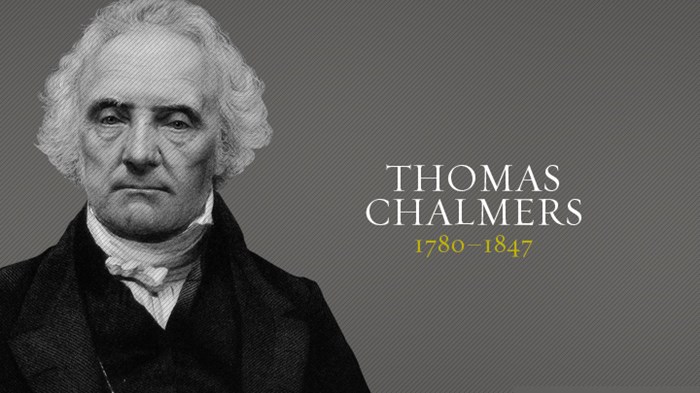
Thomas Chalmers


"What is the most effectual method of making Christianity so to bear upon a population as that it shall reach every door and be brought into contact with all families?"
William Wilberforce, the famous abolitionist, said, "All the world is wild" about him. And one bishop applied Dante's words to him: "The holy wrestler, gentle to his own and to his enemies terrible."
They were speaking of Thomas Chalmers, a man of extraordinary energy and passion whose life—at least after his conversion—took on a laser-like focus to answer the question he himself once posed rhetorically: "What is the most effectual method of making Christianity so to bear upon a population as that it shall reach every door and be brought into contact with all families?"
Timeline |
|
|
1729 |
Jonathan Edwards becomes pastor at Northampton |
|
1732 |
First Moravian missionaries |
|
1742 |
First production of Handel's Messiah |
|
1780 |
Thomas Chalmers born |
|
1847 |
Thomas Chalmers dies |
|
1848 |
Marx publishes Communist Manifesto |
Parish system
Chalmers was born in Anstruther, Scotland, on the Fife coast and educated in local schools and then, beginning at age 12, at the University of St. Andrews (he was the second youngest student). In 1802, he became minister at Kilmany, where he took more interest in national intellectual life than his parish: in an 1805 pamphlet he wrote that a minister should be able to complete all his duties in two days and spend the rest of his "uninterrupted leisure" in whatever manner he wished.
But failure to establish literary fame or academic appointment, combined with a bout with tuberculosis, pushed Chalmers into spiritual crisis and then a conversion. He then began associating with evangelicals and became zealous for missions, home visitation, and relief of the poor.
His reputation as a preacher also grew. At age 35, he was invited to become the minister at a wealthy Glasgow parish, where his eloquence thrust him into the national spotlight. What ignited his passion in Glasgow—ravaged by the grime, squalor, and exploitation of the industrial revolution—was meeting the needs of his poor parishioners.
At his next parish, St. John's, the poorest parish in Glasgow, he was given free rein to try his schemes to make the parish the hub of spiritual care, education, and help for the poor. He wanted everyone to have a church (1) near enough, (2) at seat rents low enough, and (3) with a district small enough to be thoroughly cared for.
He divided the parish of 10,000 into manageable areas and appointed deacons and elders to visit families; he rejected government aid and encouraged self-help and communal sharing as the ways to help the poor. Chalmers was sharply criticized as unrealistic and many argued that he ultimately harmed the poor, but Chalmers claimed his experiment was a success.
Lack of support
In 1823, he left parish ministry for the chair of moral philosophy at St. Andrews University. He became increasingly troubled by the individualistic self-interest promoted by economists and politicians. He believed the only remedy for the evils of industrialization—and its attendant poverty, rootlessness, illiteracy, and threat of revolution—was a parish system, where the lives of the struggling poor could be ministered to effectively.
Furthermore, Chalmers believed a parish system could only work if administrated by a well-endowed national church. In 1834, he began campaigning vigorously for a parish system in which no parish was larger than 2,000 inhabitants, in which Christian discipline and cooperation would be revived through evangelical preaching, and in which Scotland would become a "godly commonwealth."
"Disruption"
Though Chalmers founded over 200 churches, the British government refused to endow them. Chalmers's relationship with both the British and Scottish governments soured even more when the courts, against a large church lobby, agreed to continue to let patrons of churches (whether they were members of the Church of Scotland or not) to appoint ministers to local parishes (even against the wishes of the parish).
This was too much for Chalmers, who led a third of the clergy and people into the Free Church of Scotland (FCS) in 1843 (this event is commonly called "the Disruption"). In a few years, the FCS erected over 800 churches and 500 schools to become the second largest church in the land.
Chalmers, however, became discouraged with the inability of the FCS to reverse the misery and growing irreligion in cities, and he spent his final years trying to organize urban missions. He argued that these were far more important than even the interests of the Free Church.

Support Our Work
Subscribe to CT for less than $4.25/month