












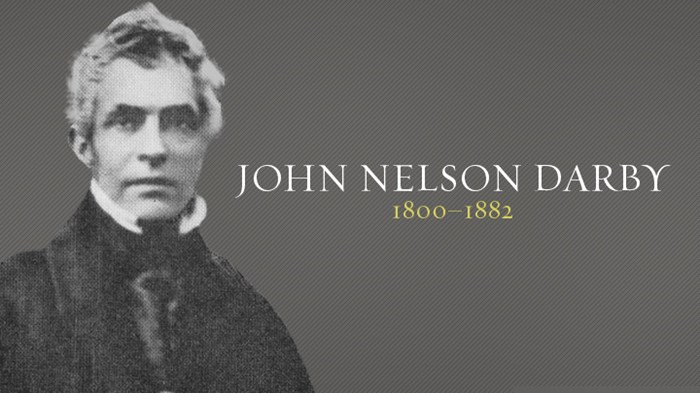
John Nelson Darby


"The Christian is directed to turn away from evil and turn to the Scriptures."
"The church is in ruins," wrote John Darby, then a successful Anglican priest in Ireland. Echoing the lamentations of Protestant reformers three centuries earlier, he believed that the Church of England had lost any notion of salvation by grace and that it had forsaken biblical ideas of what church should be. For Darby it was time to start afresh with a new church and prepare for Jesus' imminent Second Coming. What resulted from Darby's departure was a new way of viewing the church and history that still pervades much of evangelical Christian thought.
Ever-changing vocation
Born in London into a prominent Anglo-Irish family, Darby received the best education possible. He attended London's Westminster School until his parents moved to an ancestral castle in Ireland. He graduated from Dublin's Trinity College as a Classical Gold Medalist and continued his studies in law, being admitted to the Irish Chancery Bar in 1822.
Timeline |
|
|
1789 |
French Revolution begins |
|
1793 |
William Carey sails for India |
|
1799 |
Schleiermacher publishes Lectures on Religion |
|
1800 |
John Nelson Darby born |
|
1882 |
John Nelson Darby dies |
|
1895 |
Freud publishes first work on psychoanalysis |
But Darby's law career was to be short-lived. Within four years, largely due to his desire to help poor Irish Catholics, he was made a priest as a curate of the Church of Ireland. "I owed myself entirely to [God]," he explained of his career switch. "I longed for complete devotedness to the work of God."
He was assigned to a parish in the mountainous regions south of Dublin, and he quickly became an excellent pastor; rarely would he return to his cottage from pastoral visits before midnight. Still, as he read his Bible, he became frustrated with how "established" the church had become. The formalized Anglican church, so associated with the State, was lifeless beyond repair.
"It is positively stated (2 Tim. 3) that the church would fail and become as bad as heathenism," he wrote. "The Christian is directed to turn away from evil and turn to the Scriptures, and Christ (Rev. 2 and 3) is revealed as judging the state of the churches."
And so Darby resigned his position a mere two years and three months after receiving it. He joined a group of similarly disillusioned Christians who called themselves simply "Brethren." Committed to operate by strict biblical methods, the group had no professional ministers. Rejecting denominationalism, they believed the Holy Spirit would lead worship, so they focused their meetings on simple Communion services, served by a different individual each week.
Though officially no more a leader than anyone else in the group (now called the Plymouth Brethren because of their gathering in that city), Darby quickly became its most prominent voice. His pamphlet The Nature and Unity of the Church of Christ (1828), which described their beliefs and practices, quickly spread throughout the West. The former priest traveled to churches in Western Europe, North America, Australia, and New Zealand condemning denominationalism and calling believers to his new ecclesiology.
The end of the world
Believers came, drawn not only to Darby's view of the church but also to his view of history, especially the end of it. Premillennialism, the belief that the world will get worse until Christ returns to set up a visible, thousand-year reign of peace, had fallen out of favor for 1,500 years. Some occasional premillennalist movements had appeared over the centuries, but usually ended in disappointment after predicting Jesus' imminent return.
Darby, on the other hand, developed a new premillennialism, which he called "dispensationalism" after the division of history into eras or dispensations. Though later dispensationalists quibbled over the number and names of these periods, most agreed with Darby that there were seven, like the seven days of creation. Darby listed the ages as: Paradise, Noah, Abraham, Israel, Gentiles, the Spirit, and the Millennium.
Darby saw history as a "progressive revelation," and his system sought to explain the stages in God's redemptive plan for the universe. There was nothing especially radical about dividing history into periods. What separated Darby's dispensationalism was his novel method of biblical interpretation, which consisted of a strict literalism, the absolute separation of Israel and the church into two distinct peoples of God, and the separation of the rapture (the "catching away" of the church) from Christ's Second Coming. At the rapture, he said, Christ will come for his saints; and at the Second Coming, he will come with his saints.
Harsh critic
Though Darby's teachings became increasingly popular (and became more popular still after his death when C.I. Scofield published Darby's ideas in the annotated Scofield Reference Bible in 1909), Darby's return to England brought a split to the Plymouth Brethren. Riled at a member's differences on issues of prophecy and church order, Darby excommunicated him even after the man admitted and repudiated his error. Darby demanded that public refutation of those beliefs be the basis of admitting people to the Lord's Table. When the Bethesda church refused to comply with the demand, Darby refused to receive any of its members.
Eventually, Darby's followers created a tight group of churches known as Exclusive Brethren (also called Darbyites), while the others, maintaining a more congregational church government with less stringent membership standards, were called Open Brethren.
Historians have criticized Darby's tendency to treat opponents harshly: "His criticisms of what he considered error were forceful and enlightening yet at times extreme, perhaps closing otherwise open doors," says one, noting that Darby condemned Dwight Moody (they disagreed on freedom of will), who made efforts to befriend his British colleague.
Though Darby may have burned his bridges, his message gained a larger and larger following. Today his dispensational premillennialism is the view of many modern fundamentalists and conservative evangelicals.

Support Our Work
Subscribe to CT for less than $4.25/month










