

















George Herbert
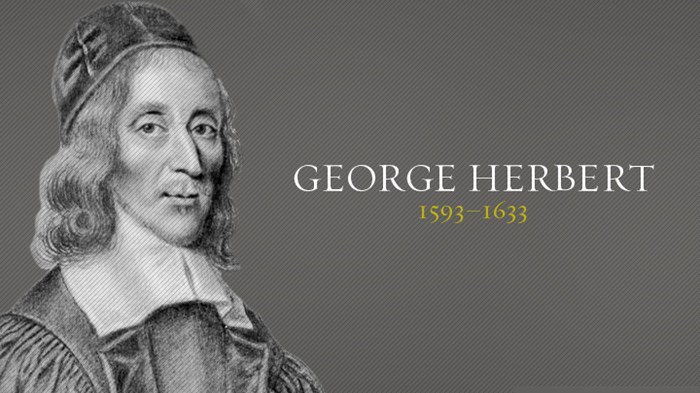


"A verse may find him who a sermon flies."
It was the New Year's celebration, and Magdalen Newport Herbert had received two sonnets from her son, George. These were quite unlike those of William Shakespeare, who had published his Sonnets the year earlier. They were far more akin to the work of John Donne, who had dedicated his Holy Sonnets to Magdalen, his patron. They referred not to his mother's kindness, her beauty, or any other characteristic, nor did they mention the occasion for the sonnet, New Year's Day. Instead, George wrote that the love of God is a fitter subject for verse than the love of woman. It foreshadowed the aesthetic and vocational bent of a man who was to become one of England's finest metaphysical poets.
Timeline |
|
|
1565 |
Teresa of Avila writes The Way of Perfection |
|
1572 |
St. Bartholomew's Day Massacre |
|
1577 |
Formula of Concord |
|
1593 |
George Herbert born |
|
1633 |
George Herbert dies |
|
1646 |
Westminster Confession drafted |
"Holy Mr. Herbert"
Herbert's was a distinguished, noble Welsh family (his brother, Edward, became the father of English deism), but his father died when George was only 3 years old. His mother was left to raise ten children. She homeschooled George's siblings and then enrolled George in Westminister School, where he studied Latin, Greek, and Hebrew. From there he attended Trinity College in Cambridge, and in 1620, he became the university's "public orator," a position he described as "the finest place in the university." Since one of the main duties of the office was to express the sentiments of the university, it was considered a launching point to high office.
Herbert's career continued to climb, as did his prestige—Sir Francis Bacon dedicated his Translation of Certain Psalmes to him, and he was elected to Parliament—but then came a series of tragedies: King James died, as did many of Herbert's sponsors; Bacon died; his mother died (Donne delivered the funeral sermon); the plague broke out.
After getting married in 1629 (to his stepfather's cousin, Jane Danvers), he gave up his secular ambitions and prepared to enter holy orders. When his friends expressed shock at his taking a job so "beneath" him, Herbert brushed them off:
"It hath been formerly judged that the domestic servants of the King of Heaven should be the noblest families on earth. And though the iniquity of the late times have made clergymen meanly valued … I will labor to make it honorable, by consecrating all my learning, and all my poor abilities, to advance the glory of that God that gave them."
Herbert moved to the rural countryside and became rector at Bremerton near Salisbury. He rebuilt the church with his own money, visited the poor, consoled the sick and dying, reconciled neighbors. He became known as "Holy Mr. Herbert." He served for only three years, however, dying of tuberculosis in 1633.
On his deathbed, Herbert sent a "little book of poems" to his friend Nicholas Ferrar, founder of a religious community nearby. "If he can think it may turn to the advantage of any dejected poor soul," he wrote in his instructions, "let it be made public; if not, let him burn it, for I and it are the least of God's mercies."
Pictures of spiritual conflict
The book, published later that year with the title The Temple: Sacred Poems and Private Ejaculations, contains some of the most memorable poetry in the English language. Several poems contained in the book are now used as hymns, such as "The God of Love my Shepherd Is," "Teach Me, My God and King," and "Let All the World in Every Corner Sing."
Herbert described his poetry as "a picture of the many spiritual conflicts that have passed between God and my soul, before I could subject mine to the will of Jesus, my Master, in whose service I have now found perfect freedom." Among his poems is "The Windows":
Lord, how can man preach thy eternal word?
He is a brittle crazy glass;
Yet in thy temple thou dost him afford
This glorious and transcendent place,
To be a window, through thy grace.
But when thou dost anneal in glass thy story,
Making thy life to shine within
The holy preachers, then the light and glory
More reverend grows, and more doth win;
Which else shows waterish, bleak, and thin.
Doctrine and life, colors and light, in one
When they combine and mingle, bring
A strong regard and awe, but speech alone
Doth vanish like a flaring thing
And in the ear, not conscience, ring.
Herbert is also famous for his prose work, A Priest to the Temple, or the Country Parson, published posthumously in 1652. In it he outlines "the form and character of a true pastor, that I may have a mark to aim at: which also I will set as high as I can, since he shoots higher that threatens the moon, than he that aims at a tree." The key to being a good pastor, Herbert argues, is to be a good person. He was very concerned with the private personal life of the pastor, who was to serve as "all to his parish," as father, lawyer, doctor, counselor, and deputy of Christ.
Herbert believed poetry was in some ways a type of preaching: "A verse may find him who a sermon flies." For the same reason, he was also fond of proverbs, and many of those he used in his sermons survive today: "Whose house is of glass must not throw stones at another." "The eye is bigger than the belly." "His bark is worse than his bite." "Half the world knows not how the other half lives."
Though he was a genius in composing both poetry and proverbs, he believed something else was central: "By these [proverbs] and other means the Parson procures attention," he wrote, "but the character of his sermon is holiness; he is not witty, or learned or eloquent, but holy."

Support Our Work
Subscribe to CT for less than $4.25/month










