John of Damascus
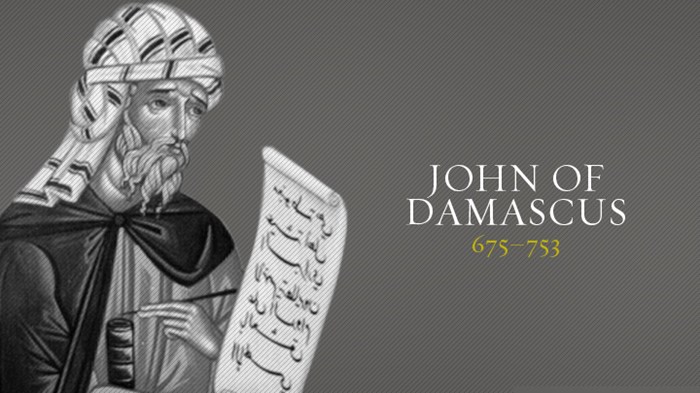


"I do not worship matter, I worship the God of matter, who became matter for my sake and deigned to inhabit matter, who worked out my salvation through matter. I will not cease from honoring that matter which works for my salvation. I venerate it, though not as God."
Visitors to an Orthodox Church are confronted with many unfamiliar elements of worship: for example, the use of incense and Byzantine chant and the custom of standing throughout the service. But perhaps the most perplexing element is the icons, especially when Orthodox worshipers bow before and kiss them. Isn't this idolatry?
This very question raged through the Christian world in the eighth and ninth centuries, and it occupied the attention of two of the seven ecumenical (worldwide) church councils. The strongest defense of the practice came from a Christian living in the heart of the Islamic empire, John of Damascus.
Timeline |
|
|
590 |
Gregory the Great elected Pope |
|
597 |
Ethelbert of Kent converted |
|
622 |
Muhammad's hegira: birth of Islam |
|
675 |
John of Damascus born |
|
753 |
John of Damascus dies |
|
800 |
Charlemagne crowned Holy Roman Emperor |
Responding to the imperial volcano
He was born John Monsur, into a wealthy Arab-Christian family of Damascus. Like his father, he held a position high in the court of the caliph. About 725 he resigned his office and became a monk at Mar Saba near Bethlehem, where he became a priest. In this secluded place at the relatively advanced age of 51, John's lasting legacy began to unfold. It began when Emperor Leo III, in 726, outlawed the veneration of icons.
The conflict had been brewing for decades. It wasn't a question of bowing and kissing icons; this was a culturally acceptable way to show respect. The basic question went deeper: are Christians allowed to paint pictures of Jesus, or other biblical figures, at all? As Islam spread through the Mediterranean region, bringing its absolute interdiction of images, Christianity was feeling pressure to rid itself of images.
The main threat to icons came not from the Islamic caliph but from the heart of the Byzantine Empire. A few bishops from Asia Minor (now Turkey) believed the Bible, particularly the second commandment, forbade such images:
"You shall not make for yourself an idol in the form of anything in heaven above or on the earth beneath or in the waters below. You shall not bow down to them or worship them."
The bishops' argument convinced Byzantine Emperor Leo III, who set about to convince his subjects to abandon iconography. But a natural disaster changed his approach. In 726 a violent volcano erupted in the middle of the Aegean Sea and terrorized Constantinople, the capital. Afterward, tidal waves buffeted the shores and volcanic ash extinguished the sunlight. Leo reasoned that God was angry about icons. That's when he outlawed their use.
In 730 Leo commanded the destruction of all religious likenesses, whether icons, mosaics, or statues, and iconoclasts ("image smashers" in Greek) went on a spree, demolishing nearly all icons in the Empire.
From his distant post in the Holy Land, John challenged this policy in three works. He argued that icons should not be worshiped, but they could be venerated. (The distinction is crucial: a Western parallel might be the way a favorite Bible is read, cherished, and treated with honor—but certainly not worshiped.)
John explained it like this: "Often, doubtless, when we have not the Lord's passion in mind and see the image of Christ's crucifixion, his saving passion is brought back to remembrance, and we fall down and worship not the material but that which is imaged: just as we do not worship the material of which the Gospels are made, nor the material of the Cross, but that which these typify."
Second, John drew support from the writings of the early fathers like Basil the Great, who wrote, "The honor paid to an icon is transferred to its prototype." That is, the actual icon was but a point of departure for the expressed devotion; the recipient was in the unseen world.
Third, John claimed that, with the birth of the Son of God in the flesh, the depiction of Christ in paint and wood demonstrated faith in the Incarnation. Since the unseen God had become visible, there was no blasphemy in painting visible representations of Jesus or other historical figures. To paint an icon of him was, in fact, a profession of faith, deniable only by a heretic!
"I do not worship matter, I worship the God of matter, who became matter for my sake and deigned to inhabit matter, who worked out my salvation through matter," he wrote. "I will not cease from honoring that matter which works for my salvation. I venerate it, though not as God."
Eastern theologian for the whole church
While the controversy continued to rage, John spent his days at Mar Saba monastery in the hills 18 miles southeast of Jerusalem. There he wrote both theological treatises and hymns; he is recognized as one of the principal hymnographers of Eastern Orthodoxy. His most important theological work, The Fount of Wisdom, is a summary of Eastern theology.
Tradition says that his fellow monks grumbled that such elegant writing was a distraction and prideful; so John was sometimes sent to sell baskets humbly in the streets of Damascus, where he had once been among the elite.
After more dissension and bloodshed over icons (the decade after John's death, over 100,000 Christians were injured or killed), the issue was finally settled, and icons are an integral part of Orthodox worship to this day. His other writings were major influences on Western theologians such as Thomas Aquinas. In 1890 he was named a doctor of the church by the Vatican, and in this century, his writings have become a fresh source of theological insight, especially for Eastern theologians.

Support Our Work
Subscribe to CT for less than $4.25/month