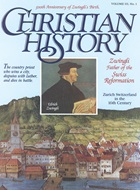
Zwingli and Luther: The Giant vs. Hercules


The Colloquy at Marburg was called in hopes of reconciling the two centers of the German Reformation—Zurich and Wittenburg, but conflict over the Lord’s Supper split their common cause.
November 10, 1983 was the 500th anniversary of the birth of Martin Luther. During the 500th anniversary year Luther made quite a splash in the media with full length articles in Time, Newsweek, the New York Times Magazine, and National Geographic. An abundance of church celebrations and scholarly conferences took place. There were pilgrimages by Lutherans and other Protestants to East Germany to visit the sites of his living and working.
Not nearly as well-known is the fact that January 1, 1984 was the 500th birthday of another Protestant Reformer, Ulrich Zwingli, of Zurich. Except for Zurich and its environs, Zwingli did not receive nearly the same amount of attention during his 500th anniversary year as Luther.
It was Zwingli’s fate to have been cut down in mid-career at the battle of Kappel in 1531 and to have been cast in the shadow of Luther’s gigantic stature. But he is an important figure in his own right. He was the father of the Reformed tradition which spread out in many directions—across Switzerland and southern Germany, to France among the Huguenots, Holland, England and Scotland among the Congregationalists and Presbyterians, across to the New World among the Congregationalists of New England and the Presbyterian, Dutch and German Reformed Churches of the Middle Colonies.
Although Zwingli is the originator of this tradition, his role in the shaping of it has been eclipsed by that of John Calvin, the second generation Reformer who, at Geneva on the other side of what is now modern Switzerland, took over the chief leadership of this Reformed tradition a few years after Zwingli’s death. German Swiss scholars, in particular, would want to qualify this judgment by insisting that Zwingli’s successor at Zurich, Henry Bullinger, also played an important role in molding this tradition.
Older scholarship on Zwingli, especially German, tended to view him through the eyes of Luther and saw him as largely dependent on the great Saxon Reformer though as diverging from him on a few important points. Recent scholarship, especially Swiss, has sought to study Zwingli for his own sake and has come to the conclusion that he was quite independent from Luther in his theological and Reformational development.
Two Paths to Reformation
Luther and Zwingli, born within seven weeks of one another, were co-originators of the Protestant Reformation. Though neither one intended it from the beginning, the reforming movements which they started would lead inexorably to a division in Western Christendom. In addition, though neither one desired it, their differences on the Eucharist would tragically lead to the first major split in Reformation Protestantism between the Lutherans and the Reformed. Though they had much in common—and more often the differences are emphasized rather than the similarities—they were indeed adversaries.
Zwingli, like other Renaissance humanists that were enamored of classical allusions, called Luther in tribute “that one Hercules … who slew the Roman boar.” In this same passage Zwingli will also attribute Biblical titles to Luther: “Here indeed you were the only faithful David anointed hereto by the Lord and furnished likewise with arms.” Zwingli would not always be so adulatory in his words to and about Luther. But Luther never spoke so warmly of Zwingli. He called him the “Giant of Zurich” not in tribute but to ridicule. Luther always was of the view that Zwingli thought too highly of himself, that he was a show-off with his display of learning in Greek and Hebrew and the classics.
Though they opposed one another, Luther and Zwingli had a number of traits in common. They were both born of peasant stock but of relatively well-to-do parents. Luther’s father was a prosperous miner in Saxony and Zwingli’s was a successful farmer and first citizen of his village of Wildhaus in the Toggenburg Valley of the eastern lower Alps. They both became accomplished scholars and developed extraordinary musical talents. They spoke German and were excellent preachers, though Luther spoke in Saxon dialect and Zwingli spoke in “Schweizerdeutsch”—Swiss German. The Germans despised the Swiss, and the Swiss resented the Germans.
They both studied at fine universities, Luther at Erfurt and Zwingli at Vienna and Basel, but their philosophical perspectives were quite different. Luther was educated in the theories of William of Occam, known as “the Razor”, because of his principle of economy in argumentation: No more parts than are necessary, the simpler, the better. Zwingli was educated in Thomism after the so- called Angelic Doctor of the Thirteenth Century, Thomas Aquinas.
First, Thomas and Thomism tended to think of the truths of revelation and of reason to be more harmonious than did Occam who thought the truths of revelation lie entirely beyond reason, indeed may even seem to be contradictory to reason. One cannot at all explain the reasonableness of the truths of revelation. Second, Thomas stressed the priority of divine grace and man as the instrument of the divine predestination. In contrast, Occam and his followers stressed the freedom and dignity of man to cooperate with God in working out his own salvation. Man is not the instrument of but the partner with God.
A further difference in their intellectual training was that Zwingli absorbed much more of Renaissance humanism than did Luther. Although Luther probably owed more to Erasmus than he liked to admit, Zwingli freely acknowledged his great debt to Erasmus. When Erasmus’ New Testament appeared in 1516, Zwingli immediately purchased it to copy out the Pauline letters in Greek, and then carried his little pocket edition around with him and memorized it. Erasmus’ views on peace, his reliance on common sense reasoning, and the spiritualistic, antiritualistic tendency of his thought would make a deep impression on Zwingli.
Before his break with Rome, Luther was a monk trying to work out his salvation with fear and trembling and would become for his whole career professor of theology at Wittenberg. Zwingli was a parish priest before becoming a reformer and throughout his days as a reformer would remain a pastor at the Grossmunster in Zurich. Luther was something of a monarchist and a social conservative who sided with the princes and came down hard on the peasants when they revolted in 1525. Zwingli was more of a radical and a republican who was also very much a Swiss patriot. Whereas Luther did not think that the Gospel should be defended with the sword but only with the preaching of the Word, Zwingli in spite of an early pacifism would not only advocate the use of the sword for defense both of Fatherland and the Gospel but would die in battle with sword and helmet in hand. On hearing of Zwingli’s death, Luther commented: “All who take the sword will die by the sword.”
Luther’s Struggle As a Monk
The starting point for Luther’s Reformation was his own inner struggle for salvation as a monk. Luther entered the monastery in 1505 at Erfurt against the wishes of his father who wanted him to become a successful lawyer. As a monk Luther tried the path of ascetical works—prayer, fasting, self-beatings, but he found that he could never be sure whether he had enough of them or the right ones. He said that if a monk ever had gotten to heaven through monkery, it would have been he, for he was a most dutiful and obedient monk. He also tried the route of the sacraments, but again he could not be certain, when he made confession or took communion, that he had truly been cleansed of his sins.
But Luther, however much he tried, did not see himself making any progress along the route toward salvation. Rather than sensing that he loved God above all things, he said he hated a God who demanded that, in order to be saved, we love him with whole heart and mind, but who did not provide the ability to do so.
It was in the midst of this spiritual anguish and struggle that he experienced his so-called “breakthrough” as he was reading Paul’s letter to the Romans. “For in it (the Gospel) the righteousness of God is revealed through faith for faith; as it is written, ‘The righteous shall live by faith.’ ” (Romans 1:17). He came to the realization that the righteousness of God is not the active righteousness by which God judges and punishes miserable sinners, but is rather God’s passive righteousness by which he mercifully justifies sinners through faith. It is not the righteousness on the basis of which God condemns sinners but the righteousness given in the Gospel and received in faith on the basis of which he forgives sinners. With this new understanding, Luther “felt myself straightway born afresh and to have entered through the open gates into paradise itself.” At last he found joy and release.
Zwingli: Pastor and Patriot
The starting point for Zwingli’s Reformation was different. Zwingli was not a monk troubled by the predicament of his own soul. He does not seem to have the same intense soul-searching struggle that Luther had, though he did engage in a battle with his own lusts. He confessed that he had great difficulty in maintaining the requirement of clerical celibacy, but he knew he was not alone in his failure.
He said: “Out of one hundred, nay out of one thousand, there is scarcely one chaste priest.” At the earliest opportunity, he sought out a wife when he came to Zurich, although he kept their marriage secret for a while. On behalf of eleven other priests and himself, Zwingli would draft a petition to the Bishop of Constance “to allow priests to marry or to at least wink at their marriage.”
Rather than a monk concerned for his own salvation, Zwingli was a parish pastor and Swiss patriot who was concerned for the salvation of his own people. His fear was not for his personal plight, but for the plight of his people.
From the beginning he had a deep love for his native Switzerland with its towering mountains and beautiful valleys. His surroundings shaped his speech and his translation of the Scriptures. Green pastures in Psalm 23 became lovely Alpine meadows. In schoner Alp weidet er mich (“In the beautiful Alps he tends me”). He compared the Word of God to the Rhine River: “For God’s sake do not put yourself at odds with the Word of God. For truly, it will persist as surely as the Rhine follows its course. One can perhaps dam it up for a while, but it is impossible to stop it.”
He likewise was a strong partisan of Swiss independence. The Swiss states, Cantons as they were and are stilled called, gradually bound themselves together in a confederacy in order to get freedom from their Hapsburg overlords. Because of their fierce love of liberty and individualism and because of their valor as soldiers, the Swiss were successful in wresting their independence from these rulers of Austria and much of Germany. Zwingli remembered that already as a child he was a zealous patriot: “Even as a child, if anyone teased us Confederates and upbraided or slandered us, I resisted them and even ran into danger on that account; for anyone who dishonours the Confederation also dishonours me.”
As a pastor he took his duties seriously. He writes in 1523 about his attitude as a young pastor: “Though I was young, ecclesiastical duties inspired in me more fear than joy, because I knew, and I remain convinced, that I would give account of the blood of the sheep which would perish as consequence of my carelessness.”
He showed himself to be a courageous pastor when he gave no thought to his own safety as he ministered to victims of the plague that hit Zurich shortly after he began his ministry there. He himself was smitten and nearly died. This experience, no doubt, led to a maturing in his religious development. While in the grip of this illness, he wrote the Song of the Plague in which he shows a sturdy faith in the all sufficiency of divine grace in Christ.
He would agree completely with Luther about the matter of justification by faith. But his reflections during his illness went beyond himself and his own misery. They included also his people. He compared his own mortal illness with the sickness of his people which could lead to spiritual death. Conversely, Zwingli compared his recovery to the reformation of Church and society.
Zwingli’s Social Preaching
Zwingli’s patriotic convictions and his pastoral concern for his people are manifest in his attitude toward mercenary service. He had become increasingly disturbed by the involvement of many of the Swiss in this profession. The Swiss were excellent soldiers who would hire themselves out to the highest bidders among the kings and princes of other nations. While he was a pastor at Glarus, Zwingli began to deplore the spilling of Swiss blood on foreign soil under the command of foreign generals.
At first, oddly enough, he was opposed not to mercenary service as such, but only to service under the king of France. It was all right for the Swiss to hire themselves out to the Pope. Undoubtedly influenced in part by Erasmus’ pacifism, he would eventually turn entirely against the mercenary system, even though, because Switzerland was a poor country, foreign service had been for a long time an important source of revenue for the country. He criticized not only the waste of young manhood through senseless violence, but also the corruption of men’s souls through avarice and pride and the pillaging of helpless civilians. He saw the entire country as having deteriorated spiritually and morally under the lure of the gold from foreign princes. He had himself once accompanied the troops from Glarus down to Italy and knew whereof he spoke.
He preached: “The situation is very serious, we are already contaminated. Religion is in danger of ceasing among us. We despise God as if he were an old sleepy dog … Yet it was only by his power that our fathers overcame their enemies because they went to war for their liberties, and not for money … Now, puffed with pride, we pretend that nobody can resist us, as if we were strong as iron and our foes slack as pumpkins.”
His outspoken preaching against this lucrative profession would cost him his pulpit in Glarus. Fortunate for Zwingli, he was able to secure other pulpits— first at the village of Einsiedeln and then in the big city of Zurich at the Great Cathedral where under his preaching the Reformation was introduced and where he continued to preach against mercenary service so powerfully and convincingly that he was able to persuade the City Council to put an end to it in Zurich.
On the whole, his preaching and the Reformation which it introduced had more of a social dimension than that of Luther. It was concerned not just with personal religious reform but also with the reform of society. Heinrich Bullinger, his friend and successor, gives us this report concerning the content of Zwingli’s sermonizing: “He praised God the Father, and taught men to trust only in the Son of God, Jesus Christ, as Saviour. He vehemently denounced all unbelief, superstition and hypocrisy. Eagerly he strove after repentance, improvement of life and Christian love and faith. He insisted that the government should maintain law and justice, and protect widows and orphans. That people should always seek to retain Swiss freedom.” With that last point it is clear that Zwingli, even though he was an advocate of peace, did not favor peace at any price which would threaten the independence of his native land.
In his preaching he was concerned not just with Christian faith and love exercised by individuals but with justice established by the laws of the community. Calvin will inherit this Zwinglian concern for social justice and it will characterize much of the Reformed tradition all the way down to the present.
Where They Differed
As Reformers, Zwingli and Luther had much in common. They both rejected the authority of the Pope and held to the authority of Scripture alone; they both agreed to the principle of justification by faith alone; they both rejected the sacrifice of the Mass.
But Zwingli did not think Luther’s Reformation went far enough: “You would have cleansed the Augean stable, if you had had the images removed, if you had not taught that the body of Christ was supposed to be eaten in the bread.”
Luther for his part was harsher in his judgment of Zwingli. He regarded Zwingli as a Schwärmer, a fanatic, because of his rejection of the bodily presence of Christ in the Eucharist. Luther linked Zwingli with other fanatics such as Andreas Carlstadt, his former colleague at Wittenberg, who, while Luther was holed up in the Wartburg Castle, radicalized Luther’s Reformation by throwing out the Mass, destroying images, removing his clerical garb, donning the peasant’s sombrero and demanding to be addressed as Bruder Andreas. When Luther returned to Wittenberg, he put an end to the revolution set in motion by Carlstadt and other like-minded prophets, and would eventually drive them out and brand them as rebellious spirits and false prophets who were instruments of the devil. Because of Zwingli’s rejection of the real bodily presence of Christ in the Supper, Luther would place Zwingli in the same camp.
Christ in Communion
Although Luther attacked the medieval Catholic doctrine of transsubstantiation (which holds that the bread and the wine are changed into the very body and blood of Christ), he continued to maintain that the body and blood are present “in, with and under” the bread and the wine, a view called later “consubstantiation.” Luther rests his argument on a literal reading of the words of institution: “This is my body.”
Zwingli, on the other hand, came to think of this view as crass materialism which he saw as little different from the papist doctrine. Such an understanding goes counter to John 6:63: “It’s the spirit that gives life; the flesh is of no avail.” To Zwingli this text clearly contradicts the necessity and the usefulness of a physical presence of Christ in the Eucharist, and in the debate Zwingli cites it constantly as proof of his position. Besides, according to Acts 1:9, Christ ascended into heaven and now sits at the right hand of God, and since it is characteristic of a body to be limited by space, Christ cannot both be in heaven and in the elements of the Eucharist. Therefore, the words of institution, “This is my body” must be interpreted in a figurative manner as “This signifies my body.” For Zwingli the Lord’s Supper was essentially a sacred feast at which Christ’s death was commemorated and contemplated in faith and in which Christians enjoy a transforming fellowship with one another. Christ is present not physically, but spiritually in the hearts of the believers only.
Luther countered by rejecting Zwingli’s interpretations of these biblical texts. The words “spirit” and “flesh” in John 6:63, as elsewhere in the Bible, do not refer to spiritual and fleshly things but spiritual and fleshly acts. To be of the flesh is to do anything without faith. To be of the spirit is whatever we do when God’s Word is added and it is done through faith.
“Spiritual,” as Luther says. “is nothing else than what is done in us and by us through the spirit and faith, whether the object with which we are dealing is physical or spiritual.” If Zwingli’s view were true that “the flesh is of no avail” means physical objects are of no use to faith, then he undercuts the Incarnation and its necessity for our redemption. On the basis of this understanding of flesh and spirit, Luther turns the tables on Zwingli’s favorite argument: “Our fanatics, however, are full of fraud and humbug. They think nothing spiritual can be present where there is anything material and physical, and assert that flesh is of no avail. Actually, the opposite is true. The spirit cannot be with us except in material and physical things such as the Word, water, and Christ’s body and his saints on earth.” In the Eucharist God has arranged for the redemption not just of man’s soul, but of the whole man, soul and body. “… the mouth eats physically for the heart and the heart eats spiritually for the mouth, and thus both are satisfied and saved by one and the same food.”
As to the other text concerning Christ’s ascension, Luther argues that Zwingli is too literal in his understanding of “right hand of God.” It refers not to some place in heaven but to God’s “almighty power” which makes it possible for Christ’s body to be present anywhere he chooses. Zwingli’s argument concerning the necessity of a body to be circumscribed by place and time Luther rejects as an offspring of that whore, Reason.
Christ: Human and Divine
Underlying their differences on the Eucharist at this point are also differences in their understandings of Christ. Luther insists on the complete unity of the two natures of Christ, the human and the divine. On the basis of this unity he will argue, as did some of the ancient Greek Fathers, that what is normally to be attributed to the human may be attributed to the divine and vice versa. Because God and man are one in Christ, it is possible to say, “God was born of Mary,” “God died on the cross,” but it is also possible to say that the human body of Christ is ubiquitous. Christ’s body is present everywhere, but he is not present for believers everywhere. He is present for believers when He adds His Word and binds Himself, saying, “Here you are to find me.” Such is the case in the supper, when Christ said, “This is my body.”
For Zwingli such a view of Christ horribly confuses the human and the divine. Though Zwingli does not deny that in the Incarnation the two natures are united, he puts the emphasis on their distinction. After the Resurrection, Christ ascends bodily into heaven and sits at the right hand of God. Christ is omnipresent only in his divinity, not in his humanity. It is principally by virtue of his divine nature that he is the Saviour of human beings.
“Christ is our salvation by virtue of that part of his nature by which he came down from heaven, not of that by which he was born of an immaculate virgin, though he had to suffer and die by this part; but unless he who died had also been God, he could not have been salvation for the whole world.” In the supper we remember Christ’s death upon the cross and feed upon his divinity in our hearts with faith.
Marburg Debate Ends
It is astonishing that with such fixed positions and harsh language that they ever chose to sit down with one another at the famous Colloquy of Marburg. Actually, they would not have done so then except for the political and the powerful persuasion of the Landgrave, Philip of Hesse, at whose castle high on the hill in Marburg they would meet.
Philip, himself a Lutheran, was very eager for a political and military alliance between the North German Lutherans and the Swiss and South German Zwinglians because by the end of the 1520’s all of Protestantism was being threatened by the powerful forces of the staunchly Catholic Holy Roman Emperor, Charles V who, having become free from entangling wars with the French and the Turks, was now in a position to deal with the Protestant heresy in his empire. Philip was determined to bring Luther and Zwingli with their fellow theologians together in order to forge a theological union that could be the basis of an alliance. As a result, invitations were sent to both Zwingli and Luther to take part in a doctrinal discussion at Marburg. Zwingli accepted eagerly; Luther, only most reluctantly. They agreed on fourteen of the fifteen articles of faith set forth, but disagreed vehemently on the Eucharist.
At the outset of the Colloquy, Luther challenged Zwingli to prove to him that the body of Christ was not present in the Eucharist. Luther wrote with chalk on the table the words, “This is my body,” a quote to which he constantly returned throughout the debates. When Zwingli argued that the passage had to be understood as a metaphor (as in “I am the vine” and “I am the bread of life”), Luther countered that any metaphorical interpretation had to be proven, not assumed, and that the burden of proof must fall on those who prefer the nonliteral rendering.
Thus, while Luther was a literalist concerning his favorite text, “This is my body,” so was Zwingli about his, “Christ ascended into heaven,” and “The spirit gives life, the flesh is of no avail.”
At several points the debate was harsh and acrimonious. At other points the parties appeared to seek each other’s forgiveness for namecalling and for their breakdown of charity.
The Marburg Colloquy only proved what was already clear from the earlier written debate that no meeting of the minds on this central issue was possible for two theologians with such different interpretations of Scripture, Christ, and Sacrament. To be sure, at the conclusion of the Colloquy at Marburg, agreement was quickly reached at fourteen articles of faith, but not on the fifteenth.
Perhaps Luther’s comment to Martin Bucer, the reformer from Strassburg, summed up the grounds on which he and Zwingli parted: “We are not of the same spirit.”
With such an attitude it is no wonder Philip did not get the religious and political unity he wanted and that Protestantism would remain split into these two major camps.
Zwingli’s Social Concern
Some scholars, who have studied Zwingli as a liturgist, have spoken of the transsubstantiation, not of the bread and wine and of the body and blood of Christ, but the transsubstantiation of the whole people of God into a new people and their unity and love exhibited.
To Zwingli the chief matter in the Eucharist was not the subject which he debated with Luther—mainly the communion elements and their relationship to the true body and blood of Christ. The chief matter to Zwingli in the Eucharist was that it was a meal eaten in celebration, in remembrance, and in thanksgiving for what God has done in Christ, but also to exhibit the transformed fellowship of believers. That point is often neglected. Perhaps Zwingli became sidetracked by the debate with Luther on Zwingli’s central views of the Eucharist.
Zwingli’s sense of Christian community was a most important contribution to his day. It was at the heart of his Swiss Reformation. The Church is not just a collection of individuals, each going about doing their own thing, even receiving grace in different ways from one another. But the Church is a geniune community, one in body and in spirit, having the grace of Christ in common and bearing the fruits of the spirit, the fruits of Christ and the spirit of God. This unity extends beyond just the matters of the spirit, but also to the matters of the body—that is to say, to the social concern of the whole community.
For Zwingli, the actual observance of the Lord’s Supper took place around a table in the midst of the fellowship and the bread and wine were passed from the pastor to the assistants and then from one worshiper to another, symbolic of the horizontal dimension of the Eucharist, the greater sense of community. With Luther, the elements containing Christ’s body and blood came directly from the priest or pastor to each individual worshiper, symbolic of the vertical dimension, the forgiveness of sins.
In Sunday worship, Zwingli reduced the number of Eucharistic services to four times a year, while Luther’s Eucharistic services were every Sunday. For Zwingli, the preaching of the Word was highly important, and so Zwingli developed his Liturgy of the Word, or order of service, more around the sermon than around the Eucharist. For Zwingli, the preaching of the Word was a kind of sacramental act. Luther, on the other hand, maintained the unity of Word and Sacrament in the service of worship, or the Mass.
But the Eucharist never lost its importance to Zwingli. Toward the end of his career, he said that the sacraments bring increase and support to faith and that the Eucharist does this above all others.
Because of the issues posed in the debate with Luther, it has often been alleged that Zwingli did not believe in the real presence of Christ in the Eucharist. He would not want to be understood that way and emphasized that “I believe that the real body of Christ is eaten in the Supper sacramentally and spiritually by the religious, faithful and pure mind, as also Saint Chrysostom holds.”
Further, for Zwingli, the Lord’s Supper is a feast of love where the faithful are to exhibit the transformed fellowship of believers bound together in love, mutual concern and service. When they do that, Christ is there, in the midst, by his Spirit.
How ironical that the service of communion, which most dramatically depicts Christ’s prayer for Christian unity, would be the one point on which Luther and Zwingli would bitterly divide. But, that was unfortunately not the first, nor the last time for such division among Christians.
One can only conjecture how the face of Protestantism, the map of Europe, and the political and religious configurations of the Sixteenth Century might have been redrawn had the German Hercules and the Swiss Giant been able to find another way to handle their differences on the subject of the Eucharist.
Dr. John B. Payne is Professor of Church History at Lancaster Theological Seminary and also president of the Evangelical and Reformed Historical Society in Lancaster, Pennsylvania
Copyright © 1984 by the author or Christianity Today/Christian History magazine.
Click here for reprint information on Christian History.

Support Our Work
Subscribe to CT for less than $4.25/month