Of Mass Baptisms, National Churches, and the Great Commission


The “conversion” of Kievan Rus’ was a king-commanded, soldier-implemented “Christianization” of a people. So was it valid? Kemmerer says it was, and offers a rationale that focuses on problems with the stereotypical Western concept of salvation and how to carry out the Great Commission.
To come appropriately to this millennium of the Christianization of Rus’ is to come respectfully, to come in awareness that one is contemplating the wellspring of a thousand years of rich spirituality and Christian culture among one of the great families of mankind. All protestations of various nationalists notwithstanding, the Christianization of the Kievan Rus’ c. 988 is, in point of fact, a milestone belonging to all the Eastern Slavs: the Ukrainians, the Byelorussians, and the Great Russians. It is not just a single event, but the fountainhead of a vast historic flow of faith.
It is a living legacy, first for the Orthodox believers who are its original children, but also for the enrichment of all Christians and other men and women of humanity and culture. Those who have a mind to appreciate such things must acknowledge that here are a subject and an occasion worthy of the effort to appreciate them. Yet for all of that, many a Western Christian will find certain difficulties in relating to this millennium of the Christianization of a nation.
Reasons for Misunderstanding
The first and most obvious reason for our difficulties is simply our relative ignorance of the lands, cultures, and histories of the Eastern European peoples. In this regard, Russian history has been rendered more or less alien to us by its cultural isolation from the West. In its early years it drew richly from the magnificent civilization and religion of Byzantium, which played its most vital role in our cultural and religious evolution during late antiquity and the period we tend to denigrate and dismiss as the Dark Ages. It is perhaps the single largest blind spot in our historical education.
More particularly, Western Christians are largely ignorant of how much of their own theology and rite comes from this source. Since the Byzantine connection is so much more significant in the East and in Russia, our ignorance of the one immediately sets us at greater distance from the other.
Then, too, the Mongol invasions which destroyed Kiev in 1240, drew a cultural curtain across the Russians lands, isolating them from the West for more than 200 years. Thereafter, Russia only slowly turned away from its eastern orientation, which left a mark on all of Russian society including religion. Writing in The Historical Road of Eastern Orthodoxy, the late Fr. Alexander Schmemann can say, “The Russian character was completely coarsened and poisoned by ‘Tatarism’,” which he goes on to describe as “lack of principle and a repulsive combination of prostration before the strong with oppression of everything weak.” Unfortunately, as Moscow began to rise to dominance, this quality became imprinted more deeply in its culture and the strong religious nationalism of “Holy Russia.”
When westernization came it came forcibly, in the early years of the 18th century under Peter the Great. By that time, of course, so much of the Western religious tradition had already been formed without any reference to the East or Russia. And in Russia the westernization went only so far. In one sense, it did not deeply touch the Russian soul. The characteristics of autocracy and a type of monolithic, state-sponsored orthodoxy were deeply ingrained, and they continue on even into the present totalitarian regime.
This in particular presents a barrier to Western sympathy, which has been conditioned by liberal and democratic revolutions and our current pluralism. Of course, to point out this grimmer side of Muscovite Orthodoxy takes nothing away from those examples of deep Christian spirituality that interlace Russian history and literature. Still, to put it plainly, Russia stands outside our own cultural and religious traditions. It is not a major player in the Renaissance, Reformation, or Enlightenment periods.
The problem, however, is not that the difficulties for our understanding are so great, but rather that we fail to recognize our own prejudices and lack of sympathy for what is simply foreign to us. It is a problem of historical naivete, an undetected myopia. And there is a particularly marked tendency toward this among Christians, who assume that what is a heavy spiritual issue for them must be the same weight of issue for other Christians in different historical and cultural contexts.
The Mass-Baptism Question
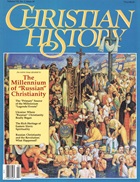
Perhaps there is no better example of this for modern Western Christians than the whole connection between church and state or nation. In the Russian tradition we are presented with this problem from the very beginning, in Prince Vladimir’s mass baptisms in the Dnieper.
According to history, the Kievan-Rus’ people were “converted” after Vladimir delivered an edict that all the citizens of his realm would be baptized or risk becoming enemies of the state and of the prince himself.
What are we to think of such a “conversion”?
To what extent were the common people coerced by threat of the prince’s displeasure? To what extent had they been sufficiently informed? If we have reservations about such a beginning, how shall we view the Christianization that follows? For it does not appear to be evangelism as we think of it in the West.
Here we run up against two frequent characteristics of the Western Christian mind: first, a simplistic and artificial separation between church and state or nation, one that eschews any such government sponsorship; and second, a simplistic insistence on an individualistic salvation, with its corollary being a suspicion of any en masse conversions.
What can be said in defense of this sort of “conversion”? Of course we must admit that politics were part of the motivation for this edict—but how seldom are they not in this world? Christ’s kingdom ultimately is not of this world, but it is in it; and the faithful may often look to God to move the heart of a prince, politician, or leader of public opinion. In this instance, there was a political catalyst, a proposed dynastic marriage, in which Constantinople insisted upon Vladimir’s baptism as a condition for the royal union.
But certainly more was involved here than just politics. The time was right; pagan Kiev was ripe for conversion. Apparently there had been a growing dissatisfaction with the old paganism and a realization that the Kievan state needed to embrace one of the major faiths pressing upon its borders: Islam, Judaism, Western or Eastern Christianity (these last two were distinct and competitive, though as yet not in schism). Adherents of these religions were urging their faiths upon the prince. So, Vladimir sought the advice of “his boyars (the leading nobles) and the city elders,” who suggested that he “inquire about the ritual of each and how he worships God.” Here the Chronicle is quite specific in saying that this counsel pleased not only the prince, but “all the people.” There was a process of popular consultation here, and a careful albeit primitive, inquiry followed.
The Chronicle tells us that of all the different faiths they observed, the envoys were only impressed positively with the Greek Orthodox services they observed in Byzantium. Back in Kiev, it was also noted that the prince’s grandmother Olga, who had been baptized 30 years before, would not have accepted that faith if it had been evil. Thus, the matter was settled for prince, nobility, and people. But it was left with the prince as to how to proceed, which he did about a year later.
The important thing to note is that the prince’s decision did not occur in a vacuum or hastily. Christianity had already been preached in Kievan territory. In fact, a church had existed in the city for more than 40 years. Even the royal house had already been touched (through Olga, who at one time had been regent). Vigorous trade, as well as missionaries, had for decades maintained contact between Kiev and both Eastern and Western Christian communities. However, Kiev was not ready to embrace the new faith until its prince, with the apparent approbation of the nobles and many of the people, set the corporate process in motion.
But if this still seems to bode too great a danger of compromise or domination by Caesar, we may ask, what was the alternative in Kiev c. 988? It is unlikely that that society would have responded to the type of individualistic evangelism practiced by 19th- and 20th-century American Protestant churches. Moreover, the favor of princes and nobles has been a vital part of the advancement of religion from Old Testament times, particularly the advancement of Christianity through both Eastern and Western Europe. Millions have come to a faith in Christ through such doors of opportunity. So, for better or worse, Vladimir stands in the tradition of Constantine and Clovis.
We should also bear in mind that missionaries from St. Patrick to St. Augustine of Canterbury to the present have not tended to pass up opportunities to baptize and teach people, just because they were influenced by their leaders. And, in those cases where Christianity failed to take advantage of such openings, we have perhaps had reason since to regret it. At any rate, the subsequent history of the Kievan Church shows that it was not dominated by the state, but was able to act with Christian integrity, freedom, and power.
Still, there remains the question of nominalism, which many associate with a baptized but unregenerate paganism. Do mass baptisms like that in the Dnieper lead inevitably to an adulteration of the gospel, superstition, and syncretism? Not necessarily.
A Biblical “People Movement”?
There can be valid “people movements” to Christianity. (For that matter, there can be people movements for religious reform or protestations as well. It is highly questionable whether the Protestant Reformation could ever have occurred without such a phenomenon.) This is a fact which has been brought to the attention of Western Christians of late by the “Church Growth Movement.”
Vladimir’s decision, of course, could not guarantee a true evangelization of his people, but it did open the door to the process. What was important was how the opportunity was pursued. As Waskom Pickett’s mission studies in India in the 1930s revealed, a convert’s eventual maturity or weakness had more to do with the quality of his subsequent pastoral care than even his initial motive for conversion.
In all of this, we do well to remember that Christ’s Great Commission to evangelize the earth was framed in terms of discipling, not individuals, but nations. This recognizes the human bond that exists between a man and his family, his community, and his people. The redemption of man’s full humanity requires a type of Christianizing of the whole life and community of man: his work, his law, his culture, and all his relationships.
So Christ spoke of “making disciples of all the nations, baptizing them in the name of the Father and of the Son and of the Holy Spirit” (just as the work was begun in the waters of the Dnieper), and “teaching them to observe all that I have commanded you.” In one sense, that final phrase suggests an unending work, extending the impact of the gospel into every aspect of the nation’s life—culture, law, and politics—throughout history.
For Kiev and the Russian peoples, the process of penetrating the masses and transforming the soul of the people would have to take time. There was no strong, organized pagan resistance from any quarter. In fact, the people seem to have supported the change, at least on the surface, but on another level the old ways died slowly. Fr. Schmemann writes candidly about this:
“Its external elements—the divine service, the ritual—were easily accepted; it charmed the people and won their hearts; but there was danger that they would not see, or even try to see, the meaning or logos behind these externals, without which the Christian rite would in fact become pagan in becoming an end in itself. The soul of the people continued to feed upon the old natural religious experiences and images.”
The task begun among the Eastern Slavs was formidable and ongoing, but the effort to Christianize the people, the expanding nation (the ethnos of Matt. 28:19), was sincere and dedicated. Children from the best families were sent to schools for instruction, and Greek and Bulgarian priests, along with some from the West, labored to lay the foundations of Russia’s own Christianity.
Their success can only be evaluated by the historical record. And by that measure it would seem that Kievan Christianity was indeed marked by a high evangelical ideal and an undoubted spiritual vitality, which has passed on a rich and living tradition to subsequent generations.
Writing in the mid-’70s from within the Soviet Union, the dissident Evgeny Barabanov looks upon this great stream of Russian spirituality and Christian culture:
“In the feats of its saints and pious men, the Russian people have never ceased to behold the unfading light of a higher moral truth, which became the object of a quest that permeates the whole of great Russian literature. And looking back we realize that Christian ideas and ideals lay beneath even those aspects of life and culture which, would seem, were not related to them on the surface.
“We need not mention the heritage which has become an inalienable part the spiritual life of all mankind: the cathedrals and icons, especially the icons of Andrei Rublev; the prayers of Sergious of Radonezh (see The Country-Saving Monk); the archpriests Awakum and Serafim Sarovsk the authors Gogol and Dostoyevsky, Tolstoy and Solovyov; the pleiade of 20th century thinkers; and, finally, those recent innumerable martyrs whose hagiographics have not yet been written an who are remembered by only a few surviving eyewitnesses.”
This is all part of the millennium of the Christianization of Rus’. Although it is outside the Western tradition, the world has grown smaller in these last thousand years and that other great stream of Christianity need no longer seem so far away. For the Westerner who draws from its life and learning, there is much richness to be found, and correctives also for some of the distortions of our own limited perspective.
David M. Kemmerer is the editor of Touchstone, a journal produced by B'rith Christian Union, a Chicago-based organization that encourages a re- examination of the continuity of historic Christian orthodoxy.
Copyright © 1988 by the author or Christianity Today/Christian History magazine.
Click here for reprint information on Christian History.

Support Our Work
Subscribe to CT for less than $4.25/month