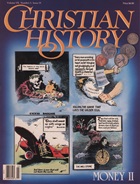
Money in Christian History (II): A Gallery of Good Examples Not to Follow


Simon Magus
First Century A.D.
Simon Magus set the precedent for the misuse of money that has plagued the Church for two millennia. His practice of sorcery in Samaria was upstaged by the miracles accompanying the preaching and baptisms of Philip the Evangelist. When Peter and John arrived, they placed their hands on the new converts, and Simon witnessed the power of the Holy Spirit.
“Give me this ability!” Simon pleaded, offering the apostles money.
“To hell with you and your money!” is a literal rendering of Peter’s reply. The biblical account breaks off with Simon’s plea that the curse not be fulfilled; one early Church tradition claims that the unrepentant Simon traveled to Rome and founded Gnosticism. Today we call the purchase of Church offices “simony,” in memory of this greedy magician.
The Passing of Peregrinus
Second Century A.D.
Secular Journalists exposing Christian charlatans: A modern phenomenon? Not really. Lucian wrote satire in the mid-second century, and he loved to pick on Christians—especially when he smelled a fraud. In one of his works, he reports on a huckster named Peregrinus, a murderer and child molester who fled to Palestine and got involved with the Christians.
“In a trice he made them all look like children; for he was prophet, cult leader, head of the synagogue, and everything, all by himself. He interpreted and explained some of their books and even composed many, and they revered him as a god, made use of him as a lawgiver, and set him down as a protector, next after that other, to be sure, whom they still worship, the man who was crucified in Palestine because he introduced this new cult into the world.”
Peregrinus was imprisoned for his involvement with the Christians. This, Lucian says, was an “asset to his future career” as a charlatan. Christians traveled from all around to visit him; some tried to rescue him.
“Much money came to him from them by reason of his imprisonment, and he procured not a little revenue from it.” Lucian comments on the strange beliefs of “these poor wretches,” the Christians, who “despise all things indiscriminately and consider them common property, receiving such doctrines traditionally without any definite evidence. So if any charlatan or trickster, able to profit by occasions, comes among them, he quickly acquires sudden wealth by imposing upon simple folk.”
Released from prison, Peregrinus wandered for a while, “possessing an ample source of funds in the Christians, through whose ministrations he lived in unalloyed prosperity.” But his defrauding of the Christians would not last forever. Lucian says he “transgressed in some way even against them (he was seen, I think, eating some of the food that is forbidden them) they no longer accepted him.”
Lucian’s tale continues, culminating in Peregrinus’s spectacular suicide. Before a crowd of Greeks at the Olympic festival, he jumped into a burning pyre. “So ended that poor wretch [Peregrinus], a man who (to put it briefly) never fixed his gaze on the verities, but always did and said everything with a view to glory and the praise of the multitude.”
Of course Lucian treated this story in his classic satirical fashion; he may have overstated the facts. A fraud like Peregrinus could never dupe Christians so thoroughly… could he?
(900s)
The Tigress of Rome
Marrying for money was a way of life for Marozia, the woman who dominated the papacy during the 10th century. When barely beyond puberty, she was already the mistress of Pope Sergius, bearing him a son. When Sergius died, Marozia embarked upon a series of marriages to successively wealthier husbands, enriching herself with their estates upon their untimely deaths. Using her beauty and promiscuity, she continued to control the papacy, eventually winning that office for the illegitimate son she had born to Sergius.
Ultimately, Marozia married one rich man too many. Her final husband Hugh of Province, tried to kill Alberic, her son from a previous marriage. Alberic retaliated and not only drove Hugh from the city but also imprisoned his mother—still young, beautiful and very rich—in the lowest dungeon of her own castle, where she died.
(1400s)
The Poison Pope
When the incredibly wealthy Rodrigo Borgia was named Pope Alexander VI in 1492, some accused him of buying the office. But direct bribery was hardly necessary, since his vast fortune already wielded great power throughout Europe.
Rodrigo started out as a law student in Bologna. He was made a cardinal and sent on a highly successful mission to pacify the province of Ancona. The grateful Pope had then made him Vice-Chancellor of the Church and Commander-in-Chief of the papal armies. Rodrigo used this position to amass his fortune, and the influence that went with it. (It was Rodrigo Borgia who masterminded the marriage between Ferdinand and Isabella of Spain.)
As Pope Alexander, he continued to peddle his influence. He dished out favors especially to his own family (he had ten illegitimate children by four mistresses): His son Cesare became a cardinal at age 18; daughter Lucrezia married Giovanni Sforza, Lord of Pesaro, in an elaborate Vatican ceremony; son Juan inherited the Duchy of Gandia.
Utterly unscrupulous, Alexander used every device imaginable to wield his power, including the “white powder” of the Borgia, a crude preparation of arsenic used to poison enemies. Yet he has been called the “luckiest of popes,” for he died a natural death—most unexpected for one of his moral character.
(1500s)
The Indulgence Huckster
Johann Tetzel was a monk with a mission. He was to oversee the sale of indulgences—promises of divine forgiveness for the living and deceased loved ones—in the German regions of Madgeburg and Halberstadt. The revenue from the sales would finance a new holy war against the Turks in Germany, solve the personal financial problems of young Albert of Brandenburg, and provide Pope Leo X with cash to build the new basilica of St. Peter’s in Rome. Leo also wanted money to fight the Urbino war, transform the Vatican into a work of art, and meet the incidental expenses of a court four times as big as the emperor’s.
Tetzel met these needs using the marvelous new printing press, whereby indulgence slips could be mass-produced and delivered door to door. This efficiency eliminated the need for long and costly journeys to sacred shrines. Success was further assured by Tetzel’s skill at reducing the highly complex doctrine on indulgences to a simple formula:
As soon as the coin in the coffer rings,
The soul from purgatory springs.
The money poured in, but a few believers gave their little slips of paper to the 34-year-old doctor of theology at Wittenberg University, Martin Luther, seeking his comment on the validity of this way of salvation. His response: The 95 Theses.
Tetzel counter-attacked with his own theses. However, even Pope Leo had to agree that the doctrine of indulgences had been grossly oversimplified. Tetzel was castigated and sidelined as a force in the recruitment of ecclesiastical venture capital.
(1800s)
The Shady Benefactor
A major Philanthropist of the 19th century, Daniel Drew founded Drew Seminary and headed several religious committees in New York.
Yet these public acts of charity thinly veiled Drew’s lifelong pursuit of ill-gotten gain. In 1815 Drew, then chief drover of Ohio cattle herds, mixed salt with the feed and did not allow the cattle to drink water for three days. Upon arrival at Henry Astor’s station the cows drank their fill, and then were weighed. “That’s the finest-looking herd of cattle I’ve seen,” remarked Mr. Astor. Drew collected and departed.
Years of shady dealings made Drew a tycoon. In 1867 he, with Jay Gould and James Fiske, bilked Cornelius Vanderbilt out of $7 million. Drew controlled the Erie Railroad, which Vanderbilt craved to add to his New York Central line. As Vanderbilt snapped up huge chunks of Erie stock, Drew again “watered stock” by printing thousands of extra shares on a small press. The value of Erie stock had reached $57 million when a broker noticed that the certificates smeared easily—Drew was printing stock so fast the ink was still wet! The market crashed, Vanderbilt lost millions.
Drew went on to net about $20 million in an 1869 attempt to corner the gold market. However, former “partners” Fiske and Gould tricked him out of part of his fortune; soon after, in 1873, a selling panic ruined his empire. By 1876 Daniel Drew was bankrupt.
(1900s)
The Revivalist’s Husband
Bebe Harrison Patten preached a great revival service, much like her mentor, Aimee Semple McPherson. Bebe’s husband, Carl Thomas Patten, took up the collections, his money-raising talks often lasting longer than Bebe’s sermons.
After ten years on the revivalist circuit, the Pattens moved to a rundown district of Oakland, California. With the help of heavy advertising, the small church overflowed until only the 8,000-seat Oakland Arena could hold the crowds.
Collections became profitable and the Pattens purchased the City Club for more than $250,000. They then opened a religious school, falsely claiming that it was accredited by the University of California. Carl Patten also announced bogus projects and is said to have raised $10,000 in 30 minutes to build a ten-story tabernacle. Heavy donations were also accepted for a theological seminary, a hospital, a refuge for retired evangelists, and an orphanage. The programs never materialized, yet payments poured in.
The Pattens lived in luxury with donations approaching a million dollars by 1947, but that summer they made the mistake of selling the church, school, and grounds to the Loyal Order of the Moose for $450,000. Members grumbled, support vanished, and the district attorney investigated. After a four-and-a-half-month trial, the jury found Patten guilty of five counts of grand theft. He received a sentence of five to fifty years in prison. Paroled after three years under the condition that he never again take up a collection, Carl Patten returned to Bebe’s small evangelistic operation until his death in 1959.
Copyright © 1988 by the author or Christianity Today/Christian History magazine.
Click here for reprint information on Christian History.

Support Our Work
Subscribe to CT for less than $4.25/month