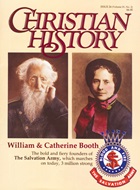
William Booth's Officers


In his teens, William Booth encouraged a group of destitutes and roughs to attend his Wesleyan Chapel. Their visit—and their sitting in a conspicuous position—greatly offended the elders and congregation. Booth was strongly cautioned against a repetition.
This and similar acts made him unpopular in the Chapel. But from early on William Booth was not prepared to be dictated to on religious questions he felt strongly about. Booth felt himself to be of the poor, so he believed he could attract the poor; preachers should preach to their own class.
Upon taking charge of the Christian Revival Association in 1865, Booth employed, where possible, members of the working-class. He considered these the most likely to gain a hearing from their fellow workers. Thus, in 1870, when Booth was asked where his preachers for the Christian Mission would come from, he replied: “From the public houses. Men who have felt the fire will be the best men to rescue others.”
The Working-Class
The use of working-class ministers was not a new concept. The Nonconformist denominations had for many decades accepted such ministers (though in considerably varying numbers). Church, chapel, and independent city missions were often led by men of working-class origin. The most recent research shows, however, that The Salvation Army had the greatest percentage of working-class people in its officer/minister ranks: 94 percent. (The next greatest percentage was among the Primitive Methodists, 56 percent of whose leaders came from the working-class. Numerically, however, the Primitive Methodists were the larger denomination.) Clearly The Salvation Army did not suffer from middle-class domination and the resulting social division between officers and people, as was the case in the majority of churches.
Urban, Industrial Regions
Outside London itself, the counties contributing the largest numbers of officers were in the industrial regions of England, mainly in the north. In these regions, coal-mining, iron and steel production, and textile manufacturing dominated. The textile industry employed as many women as men and contributed a substantial number of female officers. In addition, domestic indoor servants, found in vast numbers in the industrial conurbations, flocked to the Army, and many became officers. Since few officers were recorded as coming from agricultural communities, it is clear that the movement drew its main support from the industrial communities.
Disaffected Methodists
A large proportion of officers had previous allegiance to one of the numerous branches of Methodism. Superficially, this suggests a direct “poaching” of members rather than a successful campaign to reach the masses. However, evidence from a variety of studies suggests that Methodist was sometimes used as a common label, with little, if any, attendance at religious meetings meant by it. The name simply reflected the most powerful religious tendency in an area. Booth stated that the Army “openly avows its objection to accept as members any who belong to any of the churches, preferring the uncared for.” Thus, although the Army was perhaps not altogether reaching the unconverted, many officers had, in fact, had no previous religious experience, or they had neglected religion.
Conversely, the Army provided a spiritual haven for the many Methodists who disliked the increasing feeling among them of being at home in the world and losing Wesley’s all-consuming desire to save the unsaved. The Christian Mission magazines record a growing number of paid evangelists under Booth’s control, reaching a total of approximately sixty in 1878; of the sixty, seventeen are known to have had some previous experience of church or chapel. The majority of these had Methodist connections and appear to have been attracted by Booth’s Methodistic approach, by his previous reputation in the chapels, and by his present success.
Both Men and Women
About one-fourth of these sixty early evangelists were women, but the Home Mission Movement (triggered by a religious revival in 1859 and resulting in a widespread desire to help the masses) and Methodism were essentially male biased. It is, in fact, surprising that so many women were actively involved. After the Christian Mission’s first few years, women joined in increasing numbers, no doubt inspired by the writings and leadership of Catherine Booth. The Appointments of Officers, 1883 lists personal information on 723 male and 746 female officers. Analysis of this material shows that the largest number of women joining came from the 17–21 age group (with two girls age 14 recorded). Among male recruits, the largest numbers came from those aged 20 to 23.
Singles, Primarily
The vast majority of female officers were single, as were four-fifths of the men. However, The Appointments of Officers, 1883 lists 127 married men. This number is important, because wives were expected to help run the corps. Since wives were not compelled to attend the officers’ course at the Training Home, they were not given a commission and, therefore, did not appear in the list. They were at the corps, however, and thus the Army had nearly 7 percent more “officers” than shown.
A successful officer must have had some financial and social security, if this number of family men is taken as an indicator. The majority of male officers who married remained in officership. Indeed, General Booth had an active policy of encouraging officers to intermarry. The Appointments of Officers, 1883 lists thirty-six couples who had done so, the women resigning their own rights of officership to become joint officers with their husbands.
The loss of the women officers’ rights when marrying contradicts the constant statement regarding equality. The Army leaders were clearly not so radical as to lose the concept of man’s conjugal superiority. They also carried this social policy into pay; the husband, as head of the household, received the pay for the couple. This policy remains today. (The idea that single female officers could manage on less money than their male counterparts, however, has been abolished since before the Second World War. Until that time, male officers received a third more pay than their female counterparts.)
The early officers’ reports and biographies reveal a common conviction of having a cause. The long-serving evangelists had a determination to work hard regardless of their “dissolute” pre-Mission days. (Dissolute is a relative term that could mean anything from debauchery to the occasional drink; to the Booths any of this was evil.) After conversion, the determination became imbued with the Protestant work ethic— hard work to get a reward—in this case, translated into spiritual terms. Long hours were spent preaching and “saving souls” for a heavenly reward.
In some cases, the possibility of a regular salary and the regular status of an evangelist were lures, but arguably the main reason people joined was a determination to work hard in a cause they passionately believed in.
Other clearly important factors in attracting new officers included the following:
• the Army’s apparent equality of men and women, as opposed to the subjugation of women in religion generally
• the clear sense of direction (autocratic control)
• the unritualized, basic Methodism of free-style worship and “hell-fire” preaching
• the seemingly insatiable demand for officers
• the ease of entry into the officer ranks, as compared to that of any other religious group.
Initially, training took but a few weeks and consisted of the most elementary knowledge of the Bible; skills necessary for Army administration (simple arithmetic and basic reading); and drill (marching and physical exercises) every morning. Gradually the training time lengthened into several months, and more details were added, especially in Bible studies and general knowledge. This is not to say that the officers had a great deal of theological training. They were required only to wholeheartedly agree with Booth’s basic beliefs in God and Satan; heaven and hell; Christ’s death to save sinners; and in the concept that without conversion no sinner could be saved. Their success was marked not in terms of their learning but in the numbers of sinners they could save. Officers were instructed to preach to all people whether they would listen or not. Booth felt that the vast majority of ministers hindered themselves in reaching the people by not making them listen.
Why Some Resigned
Resignations apparently plagued The Salvation Army throughout many of its early years. No obvious reasons for this suggest themselves, although the officers sometimes experienced brutal opposition. The frequent moves from one location to another (usually every four or five months), and the general pressure of work on the young single officers were also to blame.
Expulsions from the officer ranks, sometimes after a “Court Martial,” took place for a number of reasons such as “light and frivolous conduct and conversation … contracting a matrimonial engagement without the consent of Headquarters … (and) … misbehavior in the presence of the enemy” (War Cry, December 29, 1879). Reasons would also include a return to drink and a refusal to obey orders or organize the corps according to Booth’s strict instructions.
Captain Gipsy Smith, upon his farewell from the corps in Hanley, England, in 1882, received a gold watch from the Free Churches in recognition of his services. By receiving the watch, Gipsy Smith erred, and despite several entreaties and apologies by the Free Churches, the Booths dismissed the man. (Later he developed an international reputation as an evangelist.)
Such exercise of power by the Booth family might be considered tyrannical, but one must remember that it produced results. Unfortunately, these results were not always the desired ones. There was no stopping William and Catherine Booth in their work, and even after the death of “The Army Mother” on October 4, 1890, William was always right! This tenacious belief caused the loss of a number of well-educated and brilliant officers. These included his second son, Ballington, who, while Territorial Commander of the United States of America, seceded in January 1896 to form the Volunteers of America. Another was Frank Smith, a high-ranking official whose tendencies to protect workers through labor movements and politics earned him rebukes from the General. Undoubtedly, though, many of Smith’s schemes formed the base for Booth’s great social work, In Darkest England and The Way Out. It was perhaps inevitable that the two men would clash over the control of the Army’s Social Reform Wing. Smith resigned but continued to champion the workingman and eventually became a Member of Parliament.
The Swelling Ranks
Undisputably, whatever drawbacks there were in becoming an officer, many hundreds rushed to do just that.
The autocratic control and organizational abilities of William Booth meant that, from 1865 to mid-1878 (when the Christian Mission became The Salvation Army), the movement grew from a single tent to thirty-one stations. Most British records concerning the early officers were destroyed on the night of May 10/11, 1941 when German bombers hit The Salvation Army’s International Headquarters in London. Two of the surviving three lists, however, show rapid growth from 190 officers and 124 corps, in December 1879, to 233 officers and 135 corps less than eight months later. The Salvation Army’s most rapid growth in England and Wales took place in this period from the War Congress of 1878 to the end of 1883. A total of 519 corps (centers of worship) had been successfully established by the latter date, and each corps needed at least one officer to command it.
Despite the apparent harshness of the Army’s supreme command, more and more officer recruits presented themselves to the Army’s Training Home during the 1880s and 1890s. They came in approximately equal numbers from each sex, although the recruits were generally older, and more were married, by the latter decade. This may be taken as a sign of the increasing “respectability” with which the Army was held.
The success of William Booth in attracting officers, who in turn were capable of gathering large audiences, lay in his adoption of Methodist first principles: a determined effort to attract people’s attention; a stress on an individual’s choice to be saved or damned; and freedom in worship. The Army succeeded in touching the hearts of tens of thousands of working-class men and women. Many of these became officers and dedicated themselves to a life of self-sacrifice in the service of humanity.
Glenn K. Horridge, a lifelong Salvantionist, is assistant housemaster and teacher of history at Wellingborough School, Northamptonshire, England. The author of three history books, he is currently a Ph.D. candidate at the University of London.
Copyright © 1990 by the author or Christianity Today/Christian History magazine.
Click here for reprint information on Christian History.

Support Our Work
Subscribe to CT for less than $4.25/month