The Story Behind Salvation Army Music

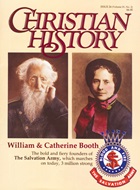
William Booth saw music as a means to an end. Christian music should attract people and speak the message of salvation to their hearts.
To Booth, music in and of itself had no moral force. The spiritual power of the associated texts, regardless of the tunes chosen (the contrast ranged from revivalist hymns to tavern-room ballads), made all the difference. Booth’s approach to music was direct, simple, and practical. He advocated music that is attractive, carries a solid message, and, in the process, avoids the dangers of “sophisticated” church music making.
At its Fourth International Congress (1914), held two years after the founder’s death, The Salvation Army could boast 1,674 brass bands (26,000 players) and 13,000 “songsters” (choir members) in 56 countries. The brass and vocal music of The Salvation Army was becoming a vast repertoire of published literature unmatched in the twentieth century by any other Protestant denomination. Today, many Army musicians and composers hold professional status at the top of their fields, and the best of their bands and songster brigades are truly excellent.
Army Music’s Early Explosion
This was not part of William Booth’s early vision for “salvation music.” As in so much of Salvation Army history, growth occurred with no true human planning. Followers of Booth caught his dream of evangelizing the world and developed musical endeavors to aid in this holy task. Booth provided administrative controls, many times improvising as he and his staff kept pace with the phenomenal explosion of musical activity that accompanied the growth of his mission.
Beginning in 1865, William Booth’s East London Christian Mission used musical tactics that would become inseparable from the idea of a “Salvation Army” (particularly with the addition of brass bands in 1878). Writing in his journal in the fall of 1865, Booth described his pioneer work and the role of music in it:
“Evening [Service], from half past five to seven. Mile-end-road; excellent service. Hundreds appeared to listen with undivided attention. The Word was with power. Every sentence seemed to penetrate the hearts of the listening throng. We then formed a procession and sang down White-chapel Road to the Room [a rented ‘Dancing Room’]. We had an efficient band of singers, and as we passed along the spacious and crowded thoroughfare, singing, ‘We’re bound for the land of the pure and the holy,” the people ran from every side. From the adjacent gin palaces the drinkers came forth to hear and see; some in mockery joined our ranks, some laughed and sneered, some were angry, the great majority looked on in wonder, while others turned and accompanied us, as on we went, changing our song to ‘There is a Fountain filled with blood,’ and then to ‘With a turning from sin, let repentance begin.’ ”
Booth’s Christian Mission, as it was called by September of 1869, grew large enough by the early 1870s for Booth and his wife, Catherine, to compile several hymnbooks: The Christian Mission Hymnbook, Hymns for Special Services, The Penny Revival Hymn Book, and The Children’s Mission Hymn Book. In 1876 The Christian Mission Hymn Book contained 531 standard hymns, spirituals, and songs set to popular and national tunes.
In 1878, the Fry family brass quartet aided Army evangelists in the city of Salisbury. Brass bands sprang up within the next few years all over the country—a natural consequence of the musical interests of many of the converts. There was no systematic organization at first. While William Booth cautiously pondered the impact of this new evangelistic tool, his enthusiastic followers went forward.
Booth’s Ambivalence
William Booth was suspicious of organized music groups and solo singing, despite his effective use of both. While he allowed bands to flourish in outdoor evangelism, he only begrudgingly allowed them a role in indoor services. As for choirs, he did not allow the formation of “songster brigades” in Army corps until 1898! He gave mixed signals, however, as he constantly used “musical specials” wherever he traveled; his own children were particularly gifted performers and song writers. In reality, music became Booth’s best help in the growth of his fledgling movement, despite his reservations about the potential evils of music that was not carefully controlled.
Booth’s ambivalence must be traced to trouble with trained choirs in his first ministerial appointments. While he supported hearty congregational singing, he did not approve of people gaining prominence in a fellowship merely because they had pleasant voices. In 1877, as general superintendent of The Christian Mission, he once delivered a remarkable address on “Good Singing” that contained the essence of his practical approach to music, as well as his fears about structured music groups:
“[I have] ever found choirs to be possessed of three devils, awkward, ugly and impossible to cast out. They are the quarrelling devil, the dressing devil, and the courting devil, and the last is the worst of the three.…
“Merely professional music is always a curse and should you ever find a choir in connection with any hall in this mission, I give you my authority to take a besom [broom] and sweep it out, promising that you do so as lovingly as possible.
“You must sing good tunes. Let it be a good tune to begin with. I don’t care much whether you call it secular or sacred. I rather enjoy robbing the devil of his choicest tunes, and, after his subjects themselves, music is about the best commodity he possesses. It is like taking the enemy’s guns and turning them against him.
“However, come it whence it may, let us have a real tune, that is, a melody with some distinct air in it, that one can take hold of, which people can learn, nay, which makes them learn it, which takes hold of them and goes on humming in the mind until they have mastered it. That is the sort of a tune to help you; it will preach to you, and bring you believers and converts.”
Priority on Saving Souls
Booth’s priority was soul saving, whatever the means. Choirs and brass bands, whatever his personal reactions, should be mustered in Salvation warfare. His first “Order for Bands” from The War Cry (1880) captures this obsession with practical results, regardless of the long-range consequences: “Whereas … we have proved the great utility of musical instruments in attracting crowds to our open-air and indoor meetings, we do here express our desire that as many of our Officers and Soldiers generally, male or female, as have the ability for so doing, learn to play on some suitable instrument.
“And as in many instances the obtaining of an instrument is a difficulty, we shall be glad if any friends who may have such instruments lying idle will consecrate them to this service, and send them to Headquarters. This includes violins, bass viols, concertinas, cornets or any brass instruments or anything that will make a pleasant sound for the Lord.”
The whirlwind of musical activity this unleashed was unprecedented. Booth immediately needed an organizational staff to administer the groups and to publish music for them. His second General Order for Brass Bands (February 24, 1881) established the first regulations, primarily to do with authority (no democracy!), membership requirements, and ownership of equipment. Within another four years (1885) he would restrict music used by Army bands to music published by the movement. (See "Major Events", in this issue, for further details.)
This band music was limited to pieces transcribed from vocal works—music with a specific textual reference. Not until 1901 did General Booth allow his music editorial department some latitude in exploring “original” music for brass bands. Even then, these new, daring works would have to make reference to “salvation” songs in the course of their development to insure they remained “soul-saving” music. Salvation Army music continues to this day to be primarily referential, stressing communication of spiritual ideas or words as wedded to specific melodies.
In the midst of this carefully controlled “evolution,” William Booth was encouraged by his sons to “loosen his reins.” Herbert and Bramwell soon established training courses for Army music leaders and provided programs and councils to raise standards and maintain evangelical zeal. Booth’s loathing of professionalism, however, became a fixed policy. Salvation Army local officers, bandsmen, songsters, and their conductors continued (as they do today) to serve as volunteers only, without remuneration for their service. Army music, which developed as an effective evangelical tool, grew in the tension between Booth’s autocratic control and the gifted enthusiasm of his followers.
Utilitarian and Universal
Booth did not have a developed philosophy of music in worship or evangelism. His approach stressed basic Christian outreach via dedicated volunteers rendering “sanctified” music. In large part, his utilitarian strategy continues to be followed by Army bands and songster brigades world-wide. The raison d’etre of the Salvationist musician remains as given by the founder: “All his beating and blowing is to get people first into the barracks and then to the Penitent Form.”
Following this approach, Salvation Army music has spread worldwide. One day in 1907, as he reviewed the New York Staff Band on parade in Washington, D.C., William Booth turned to Commissioner Alexander Nicol and proudly exclaimed over the din of a happy “war song”: “The music of the Army is, or will be, everywhere!”
Dr. Ronald W. Holz is chair of the division of fine arts at Asbury College in Wilmore, Kentucky, and author of several studies of Salvation Army music.
Copyright © 1990 by the author or Christianity Today/Christian History magazine.
Click here for reprint information on Christian History.

Support Our Work
Subscribe to CT for less than $4.25/month