







The Rest of the Stories


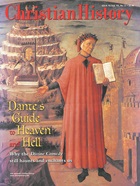
The works of Dante are not many. They consist of prose and poetry, the former comprising the so-called "Banquet" (Convivio) and the essay on "Universal Monarchy" (De Monarchia). The "Banquet" was to have been finished in fifteen books or chapters, but is only a fragment of four. It is a sort of encyclopedia of knowledge, such as were so popular in the Middle Ages, but written in Italian, in order to bring it within the reach of the unlearned reader. It is full of the scholastic learning of the time, and while not attractive to the ordinary reader, is of great importance for a complete understanding of the Divine Comedy.
Likewise important in this respect is the political treatise on the "Monarchy," in which Dante sums up his theory of world politics. This book, written in Latin, is divided into three parts: in Book I, the author shows the necessity of a universal empire; in Book II, he shows the right of Rome to be the seat of this empire; in Book III, he shows the independence of the emperor in his relations to the pope. This theory of the separation of the church and state runs like a thread through the whole of the Divine Comedy, in which Dante constantly attributes the sufferings of Italy to the lust for temporal power on the part of the pope and clergy.
For the general reader, however, the most interesting of Dante's writings, after the Divine Comedy, is the "New Life" (Vita Nuova), a strange and beautiful little book that serves as a prologue to the Divine Comedy. It is the story of Dante's love for Beatrice Portinari, the daughter of Folco, a neighbor and friend of the poet's father. It is a simple story, containing but few actual events, the details consisting for the most part of repetitions of the theory of love propounded by Guido Guincelli, of analyses of Dante's own state of mind, and of mystical visions. The form of the book is peculiar, part prose, part poetry, the latter being accompanied by a brief commentary. Yet there is a truth and sincerity in the book that proves it is no mere allegory or symbol, but the record of an actual love on the part of Dante for the fair young Florentine girl who is its heroine.
—Oscar Kuhns, The Great Poets of Italy
Copyright © 2001 by the author or Christianity Today/Christian History magazine.
Click here for reprint information on Christian History.

Support Our Work
Subscribe to CT for less than $4.25/month