




Jonathan Edwards: Christian History Timeline - Passing the Torch

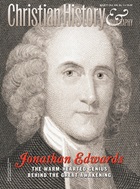
While Jonathan Edwards's intellectual agenda dominated America's formal religious thought until the mid-nineteenth century, his renovation of Calvinism and his writings on revival have continued to be read, debated, contested, and admired. He remains one of the few American theologians who has always been read intensely in the U.K. and other far-flung parts of the Christian world.
New Divinity
"New Divinity" was originally a term of reproof denoting the supposedly unwarranted innovations of Edwards's students and closest professional friends. Chief among these first-generation Edwards interpreters were Joseph Bellamy and Samuel Hopkins. Bellamy's True Religion Delineated (1750) and Hopkins's System of Doctrine (1793) extended Edwards's teachings on, respectively, the nature of genuine godliness and the interaction of divine and human motives in redemption. But they modified Edwards. Bellamy made God's character as lawgiver central. Hopkins refocused Edwards's main ethical principle ("love to Being in General") from God to earthly usefulness. Hopkins's phrase was "disinterested benevolence"; it meant selfless, universal charity. For Hopkins sinfulness should not be viewed as residing in human character, but rather in sinful actions.
The next generation of students made more adjustments. Jonathan Edwards, Jr., who studied with Bellamy and Hopkins, defended a "governmental" view of the atonement, in which the work of Christ restored balance in God's justice rather than placating the divine wrath. Nathanael Emmons was known as an "exercise" theologian, because, although he exalted God as the absolute determiner of all events (as had Edwards), he reduced human morality to what humans did. By contrast, Asa Burton argued that actions did proceed from an underlying "nature" or "heart" ("taste") oriented for or against God.
Overlapping this generation were some leading theological educators. Founders of Andover Seminary (1808) like Jedidiah Morse wanted to revive Edwards's orthodox Calvinism. Later professors at Andover, especially Edwards Amasa Park, were eager to track and defend what they considered the proper interpretation of Edwards. By contrast, the founders of Connecticut's East Windsor Seminary, Asahel Nettleton and Bennet Tyler, were more concerned with evangelism.
New Haven
The most accomplished nineteenth-century theologians who viewed themselves as followers of Edwards were a president of Yale College, Timothy Dwight, and his two most famous students, Nathaniel William Taylor, a strong proponent of revival and the first theological professor at the Yale Divinity School, and Lyman Beecher, an energetic revivalist and social reformer. Taylor in particular combined, as Edwards had, an ability to reason metaphysically about human nature in subtle philosophical terms and a deep commitment to evangelism and church renewal. They modified Edwards considerably, especially by defending a modern concept of freedom (the power to choose among potential actions) as opposed to the view that Edwards upheld (the power to do what you have chosen to do—but only in consistency with your character).
Second Great Awakening
Edwards's greatest impact on the public came as leader and chronicler of the American colonies' first great revivals. Eager to preach for conversion, willing to try new methods for revival, and clearly dependent upon the power of God to change lives, Edwards remained a steady inspiration to the leaders of "the Second Great Awakening" of the early nineteenth century. Congregationalists like pastor Benjamin Trumbull and historian Joseph Tracy, no less than Presbyterian theologian of revival William Sprague, found inspiration in Edwards. The most important nineteenth-century revivalist, Charles G. Finney, made no secret of both how little he regarded Edwards's formal theology and how much he admired Edwards's evangelistic work.
Brainerd's Life
Edwards influenced a large circle of serious Christian readers by his work as editor and publisher of the diary of David Brainerd. As a grieving friend and would-be father-in-law, Edwards found in the late missionary's diary a perfect instance of what he had taught about the ideal Christian life. Editing a bit to cut out Brainerd's occasional lapses into despair, Edwards produced a work that has never been out of print. It was read with deep appreciation by leaders of domestic evangelism (like the Methodist Francis Asbury), domestic reform (the Baptist Francis Wayland), and missionary service (Samuel J. Mills, Adoniram Judson, Mary Lyon, A. J. Gordon). The work's great appeal remains its living testimony to what Samuel Hopkins styled "disinterested benevolence" in Brainerd's missionary labors among Native Americans.
Endland
Edwards's important revival writings were published first in England, where they attracted considerable interest among Calvinist and evangelical believers. When, in the 1770s, the Baptist Andrew Fuller read Edwards on the will, he found a way to affirm both inherited Calvinism and a new evangelistic urgency. The key was Edwards's distinction between natural human ability (unimpaired by the fall) and moral human ability (damaged so as to require the quickening work of the Spirit). Edwards's influence on Fuller and others helped launch William Carey as the pioneer English missionary to India and his age's chief spokesman for foreign missionary service.
Scotland
As early as the late 1730s, Edwards was corresponding with a circle of ministers in Scottish towns that later experienced revivals. These included William McCulloch of Cambuslang and James Robe of Kilsyth. Younger ministers like John Erskine soon joined in promoting Edwards's ideas. Edwards was praised as a subtle metaphysician by leading members of the Scottish Enlightenment, including Henry Home, Lord Kames, and Dugald Stewart, the major force behind the Encyclopedia Britannica. Thomas Chalmers, the leader of Scottish evangelicalism in the early nineteenth century, testified that Edwards's Freedom of Will played a key role in his own conversion. John McLeod Campbell (on the nature of Christ's work) and James Edwin Orr (on the comprehensive sovereignty of God over all of life), two of nineteenth-century Scotland's most creative theologians, also paid tribute to Edwards's influence.
Calvinist Presbyterians
Mid-state Presbyterians always thought New England Congregationalists were too enamored with metaphysics. But despite that opinion, they also held Edwards in highest regard. To the first professor of Princeton Seminary, Archibald Alexander, Edwards was an honored predecessor as theological evangelist. To later Princeton theologians Charles Hodge and Lyman Atwater, Edwards represented the triumph of historic Calvinism over idle philosophy (a victory they thought Edwards's New England successors had forfeited in modifying his theology). To Henry Boynton Smith, who in the mid-nineteenth century advocated a more romantic, Christ-centered theology, Edwards represented the best kind of theologian, since he was able to reason subtly while maintaining his humble trust in God's sovereign wisdom and in the saving power of the Holy Spirit.
20th-c. Academic
The opinion of Edwards among elite academics had sunk very low until a brilliant Harvard professor of English, Perry Miller, set out in the 1930s to rehabilitate his reputation. Miller, an agnostic who could not share Edwards's faith in God, argued in a 1949 biography that Edwards had addressed the world in the most realistic terms imaginable. An "Edwards revival" began at mid-century, as the Yale philosopher John E. Smith and many other first-rate academics joined Miller in studying the great theologian. Since that time, doctoral dissertations on Edwards have been doubling in number every decade. The Works of Jonathan Edwards from Yale University Press began in 1957 under the editorship of Perry Miller and has continued to now more than 20 volumes under his successors John Smith and Harry Stout.
20th-c. Neo-Orthodox
Fresh attention and respect for Edwards came from the mainline Protestant churches. Here the pioneer was Joseph Haroutunian, a Turkish-born theologian at McCormick Seminary in Chicago, who in 1932 published Piety Versus Moralism. He argued that supposed improvements made by Edwards's New England successors had in fact obscured Edwards's own enthralling vision of the greatness and goodness of God. Haroutunian was soon joined by theologian-historian H. Richard Niebuhr, whose Kingdom of God in America (1935) likewise held Edwards up for special commendation, and ethicist Paul Ramsay of Princeton Seminary, who edited several key contributions to the Works of Edwards. To these and now many others, Edwards became not a brooding presence to flee but a landmark to recover.
20th-c. Evangelical
Evangelicals came late to the modern recovery of Edwards. Key pioneers were Richard Lovelace of Gordon-Conwell Seminary, who in Dynamics of Spiritual Life (1979) described Edwards as practicing the thoughtful activism that modern evangelicals should imitate, and John Gerstner of Pittsburgh Theological Seminary, who in years of lecturing introduced thousands of students to what he considered Edwards's impeccable version of classical Calvinism. The Banner of Truth Trust, led by its editor, distinguished Edwards biographer Iain Murray, has also been a formidable force in bringing Edwards back to life for contemporary evangelicals. John Piper, a Baptist theologian-pastor from Minneapolis, has emphasized Edwards as a trusted guide in seeking God's own glory as the highest purpose of human life (e.g., Desiring God, 1986). At the start of the twenty-first century, the modern constituency that is in fact closest to Edwards's own concerns has at last begun to learn from him themselves.
Mark Noll holds the McManis Chair of Christian Thought at Wheaton College, Wheaton, Illinois
Basic Bibliography
Conforti, Joseph A. Jonathan Edwards, Religious Tradition, and American Culture (University of North Carolina Press, 1995).
Guelzo, Allen C. Edwards on the Will: A Century of American Theological Debate (Wesleyan University Press, 1989).
Kuklick, Bruce. Churchmen and Philosophers from Jonathan Edwards to John Dewey (Yale University Press, 1985).
Noll, Mark A. "Jonathan Edwards and Nineteenth-Century Theology," in Jonathan Edwards and the American Experience, ed. Nathan O. Hatch and Harry S. Stout (Oxford University Press, 1988), 260-88.
Sweeney, Douglas. Nathaniel Taylor, New Haven Theology, and the Legacy of Jonathan Edwards (Oxford University Press, 2002).
Copyright © 2003 by the author or Christianity Today/Christian History magazine.
Click here for reprint information on Christian History.

Support Our Work
Subscribe to CT for less than $4.25/month