




Scripture on the Ceiling


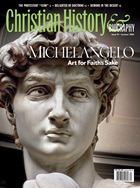
Every year more than 3,000,000 pilgrims and tourists from around the world flock to the Vatican in Rome and crane their necks to peer upwards at one of the most famous artistic masterpieces in Western culture: the ceiling of the Sistine Chapel.
From God's creation of the world to Adam and Eve's expulsion from Eden to Noah's Ark, Michelangelo's frescoes (art made by painting in wet plaster) are some of the most dramatic and inspiring representations of Genesis ever imagined. Surrounding the nine central scenes that run the length of the chapel are frescoes of Hebrew prophets and ancient seers. In niches and corners between painted columns and arches are even more biblical scenes. In this vast visual drama, Michelangelo presents a storyline of grace foretold through the prophets, incarnate in Christ, and present in the sacraments of the church. His frescoes are a magnificent example of how a Christian artist can interpret Scripture through art.
"The Sistine Chapel is one of the best known, the most studied and the least understood of great works of art," writes John W. Dixon in his book The Christ of Michelangelo. In order to understand fully why Michelangelo painted what he did, we need to keep in mind that what has become a temple to art in the minds of tourists and art historians was designed to be a place of worship to God.
For Michelangelo, faith and creativity—liturgy and art—are inseparably linked by a shared power to transform the viewer/worshiper. As Dixon notes, "Michelangelo's work in the Sistine Chapel is participant in the liturgy, an instrument of the liturgy. … in ways we are only timidly beginning to understand, great paintings shape the imagination of those who participate in them." During the four years he was painting the ceiling, Michelangelo would have been able to observe how the liturgy was practiced in that specific space. He looked for imaginative ways to connect the ceiling frescoes to the worship in the chapel.
The focal point of the Roman Catholic Mass celebrates and reenacts Christ's redeeming sacrifice. Michelangelo was not concerned to show all of the significant scenes from Genesis, but to tell a specific story of divine and human action through creation, fall, and redemption. The fresco cycle depicts the Genesis narrative through the lens of the gospel.
Christ foretold
Michelangelo's designs for the Sistine Chapel ceiling were the conclusion of a chapel decoration campaign that had spanned 35 years. When Julius II commissioned Michelangelo to decorate the ceiling, the pope suggested frescoes of the twelve apostles. But Michelangelo conceived a much grander program and later wrote in a letter that the pope "gave me a new commission to do whatever I wished." Fully grounded in Renaissance concepts of art, theology, and philosophy, and with access to the pope's own theological advisors, Michelangelo designed a series of frescoes depicting the Genesis narrative as an epic history of divine action.
His ceiling frescoes complemented (and surpassed) two older fresco cycles on the chapel's north and south walls painted by other artists—one on the life of Christ and the other on the life of Moses. This parallelism between the Old and New Testament set a precedent for Michelangelo to represent the Genesis creation narrative as a foretelling of the New Testament and the worship of the church.
Michelangelo framed his nine central scenes, which portray key moments in the book of Genesis, with a company of witnesses composed of Old Testament prophets and classical sibyls (prophetesses). These are the Jewish and Gentile seers who anticipated Christ. The Hebrew prophets foretold the coming of the Messiah to Israel. The pagan sibyls, according to the early church father Augustine, also received glimpses of truth that prepared the way for Christ within the Gentile world. The idea that God would work through both Jewish and non-Jewish, biblical and non-biblical, people was in harmony with Renaissance humanist theology, which attempted to unite Christian doctrine with the philosophy of classical antiquity.
As they get closer to the altar, the figures of the male prophets and female sibyls increase in size until they are nearly spilling out of their niches—only the graceful precision of Michelangelo's line holds their forms in check. Their postures show anticipation as they ponder the grace that lies ahead. These figures not only frame the Genesis narrative visually, but they also act as historical and conceptual bridges from creation to Christ, linking the Genesis scenes to the rest of the chapel.
Alternating between the prophets and sibyls are the ancestors of Christ recorded in the first chapter of Matthew. They represent Christ's human lineage from Abraham and form yet another bridge to the Genesis story.
Emanating grace
The nine scenes that run the chapel's length—The Separation of Light and Darkness, The Creation of Land and Vegetation and The Creation of the Sun and Moon, The Bringing Forth of Life from the Waters, The Creation of Adam, The Creation of Eve, The Temptation and Expulsion, The Faithfulness of Noah, The Flood, and The Drunkenness of Noah—are thematically grouped into three triads. The first triad, nearest the altar, portrays God's creative character as he shapes the universe out of nothingness. In these scenes, God the Father is the central protagonist. The second three scenes show how humans were created for a perfect relationship with God and how they broke that relationship. Several images, such as the cross-like tree in The Temptation and Expulsion, foreshadow Christ's passion. The final triad depicts the faithfulness, deliverance, and transgression of Noah. These scenes demonstrate how the Holy Spirit, symbolically present as the dove, supported Noah's life and faith. The entire sequence is thus deeply Trinitarian, showing God as creator, redeemer, and sustainer of the universe.
Michelangelo's intention of using the Genesis narrative to prefigure Christ, the redeemer of creation, may explain why he chose to represent such lesser known subjects as Noah's sacrifice (in The Faithfulness of Noah) and not more popular or dramatic scenes such as Cain's murder of Abel and the Tower of Babel. Each of the nine central scenes that span the ceiling makes symbolic reference to Christ's death and/or resurrection. Additional scenes in the corners—such as David defeating Goliath or Moses raising up the brazen serpent—explicitly connect the theme of sacrifice and salvation to the redemptive sacrifice of Christ celebrated at the altar below.
The order of Michelangelo's frescoes is also significant. As a worshiper walks into the chapel, he passes the Genesis scenes in reverse chronological order, entering directly below The Drunkenness of Noah. In this image, Noah's shame is being covered over, just as the sins of humanity can be covered over by the death of Christ. Michelangelo seems to suggest that we must approach God naked, in full awareness of our shame, and seeking his covering.
The altar is below the cycle's "eternal" end, from which the dynamic and transforming power of creation emanates. As the priest holds up the bread at the pivotal point in the service, enacting the mystery of transubstantiation according to Catholic doctrine, he sees above him the image of God initiating the mystery of creation. The placement of The Separation of Light and Darkness over the altar connects that moment to creation's ultimate completion in Christ's struggle and triumph over darkness and death. It also impresses on us the fact that God's purposes for salvation and the church were part of his plan at the beginning of the world.
The prophets, sibyls, ancestors, and other figures surrounding the ceiling are visually and theologically connected to the nine central scenes by the illusion of a single light source—not the natural light from the windows along the chapel's side walls—emanating from the scene of God separating the light from the darkness directly above the altar. This light not only unifies the entire ceiling, it also symbolizes how the light of God that now flows out of the church and its sacraments connects Jew and Gentile, East and West, man and woman—all who live in the light of the gospel.
As Christ's redeeming sacrifice is celebrated during the service, the present grace represented in the Eucharist and the eternal reality of God's acts represented above in Michelangelo's art become one chorus of worship.
The image of God
Michelangelo's Creation of Adam is one of the most famous and theologically complex images in the history of art. Adam, the most spectacular of God's creations, has been wonderfully formed, but his limp body still stretches across the earth from which it was made. God is about to give Adam the final touch of life. This will cause Adam to stand up, setting him apart from the material out of which he was made and from the rest of creation.
In keeping with the foreshadowing theme, Adam prefigures Christ, the second Adam. Just as Adam was the first man created and raised to life from the earth, Christ was the first man resurrected from the tomb in a restored relationship with God. All those who worship in the Sistine Chapel find themselves between these two creative acts. Adam's body is almost completely enveloped by the earth; this reminds us that we were formed from the earth and will return to it, where we will wait to be resurrected at the Last Judgment. Michelangelo, who probably did not foresee being called back to the Sistine Chapel 24 years later to paint The Last Judgment on the altar wall, made his Creation of Adam a picture of humanity's origin and end.
There is something unusual about The Creation of Adam, however: Adam appears to be alive before God has endowed him with life. If he already has a living body, what is he about to receive from God? This problem has troubled many scholars, but it is possible that Michelangelo was very consciously not depicting the physical creation of Adam in order to evoke a profound theological question: What does it mean to be created "in the image of God"?
Michelangelo's representations of the human figure are so brilliant that they can distract us from the artist's underlying purpose. Adam has the perfect human form, but is it his physical beauty alone that shows that he is created in the image of God? Though the artist is symbolically portraying God in human form, it would be wrong to think Michelangelo believed God, the Father, had a physical body. He avoids the theological blunder that Adam was created to look like God. The image of God is spiritual and creative, not physical. Therefore, instead of showing the moment when God forms Adam's body out of the dirt, Michelangelo shows God giving Adam the spirit of his creativity. Adam receives this gift with an expression of adoration. God creates man, before the fall, not as a toiler but as a creative being.
In this masterpiece, Michelangelo is doing more than representing the moment of creation. He is employing his own creativity as a means of studying God's creative nature. If our creative capacity is a part of the image of God in us, then exploring and exercising our creativity can be a means of better knowing him. Art-making can be a form of visual theology. The Genesis narrative attracted Michelangelo because it resonated with him as a Christian and an artist. It laid out a biblical, Trinitarian understanding of creativity that he found necessary to his art.
Through his composition and forms, Michelangelo conveys a reciprocal love and longing between God and Adam as they reach for each other. The Bible describes God breathing into Adam to give him life; we ourselves are breathless in anticipation of their touch.
By causing us to anticipate God's touch, which will awaken Adam's creativity and make him more fully human, Michelangelo arouses those same qualities in us and inspires us to a more creative, dynamic, and living faith. And in exercising his own massive artistic gifts, Michelangelo brings the theme of divine grace, foretold and fulfilled from the very first moments of creation, into the present moment of the church's worship.
James Romaine is an instructor of art history at the New York Center for Arts and Media Studies and a doctoral candidate at the Graduate Center of the City University of New York. This essay is adapted from his article "Creator, Creation, and Creativity" in It Was Good: Making Art to the Glory of God and is reprinted with permission of Square Halo Books Inc. The article is found on page 87 of the second edition, published in 2006.
Copyright © 2006 by the author or Christianity Today/Christian History & Biography magazine.
Click here for reprint information on Christian History & Biography.

Support Our Work
Subscribe to CT for less than $4.25/month