


Getting the Word Out





In the stairwell that leads to my study, there stands a six-foot tall bookshelf stuffed with all manner of Bibles. The Bible is, of course, God's word to all people. But it does not come to all people in the same form. The cornucopia of formats and translations in even my modest collection reminds me of the many creative ways the Bible has reached people in different places and cultural moments.
My smallest Bible weighs just a hair over 2 ounces. It is a 1961 vest pocket New Testament of the New English Bible from Oxford University Press. It is clearly produced for people who travel or who want to have a New Testament always available in pocket or purse.
The largest Bible in my collection weighs seven and one-half pounds. It measures eight and one-half inches by 12 inches, and is 2 and three-quarters inches thick. Carry it around for a few minutes, and you'll know that this Bible is not something to be taken lightly.
This weighty copy of the Word is a 1970 printing of Jerusalem Bible. The translation is Roman Catholic, and unlike most earlier Catholic Bibles, it is based on the original languages. It is also a Readers Edition, that is, it has footnotes that help explain the text or the translator's choices. But this Bible's large dimensions were designed to present 32 uncharacteristically abstract prints by surrealist painter and provocateur Salvador Dali. This is the Bible as coffee-table book.
Last week I looked at about 150 Bibles from the collection of the Huntington Library in San Marino, California. The Huntington's Stephen Tabor and Claremont School of Theology Reformation scholar Lori Ann Ferrell have culled these from the library's rare book collections to create a nine-room exhibit entitled The Bible and the People. (The exhibit includes a doubly rare Gutenberg Bible. Rare because only 48 copies the Gutenberg Bible survive, and doubly rare because this copy is one of only 12 surviving copies on vellum.)
The Huntington's largest Bible is way bigger than mine: It is bound in 60 volumes. What sets this Bible apart is the amount of illustration. English printseller James Gibbs took apart one of John Kitto's annotated Bibles, and, according to the exhibit's brochure "underlined its key passages, assembled more than thirty thousand prints, drawings and watercolors, and rebound the whole." Now why did the exhibit's co-curator, Stephen Tabor tell me he thought Gibbs was "obsessive"?
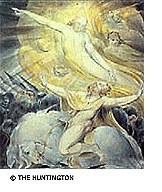
conveys the Saul of Tarsus's life-changing turnabout
The size of the Kitto Bible, like that of my Dali-fied Jerusalem Bible, serves the purpose of art. The Huntington has removed from one of the volumes and framed an original watercolor by William Blake. The painting conveys the Saul of Tarsus's life-changing turnabout through Blake's dizzying, swirling composition.
But size serves Scripture in other ways. Among the smallest Bibles exhibited at the Huntington are four of the earliest mass-produced single-volume Bibles. These revolutionary volumes came into being 200 years before Gutenberg applied the invention of moveable type to the printing of Bibles. An enterprising businessman in 13th-century Paris realized that theological students at the Sorbonne needed practical portable Bibles. Before this time, Bibles were large, unwieldy and (in the case of heavily glossed Bibles) bound in up to 20 volumes. This prevented Bible students from easily comparing passages and tracing threads of meaning through the Bible.
The cost of commissioning small single-volume Bibles from copyists would have been prohibitive for most students, but some enterprising soul realized that he could mass produce such items by creating teams of copyists, each of whom would specialize in writing out a particular sections of Scripture. This Henry Ford of Holy Writ brought down the price and pushed up the volume of production.
I found a similar Bible for sale on the James and Devon Gray Booksellers website ($80,000 if you want to buy it). The descriptive copy said that "Bibles were produced in such huge quantities between about 1240 and 1280 that copies served the needs of all the rest of the Middle Ages: fourteenth and fifteenth century Bibles are remarkably rare because the ubiquitous thirteenth century copies must still have been easily available."
These Bibles also standardized the format and feel of Bibles that we recognize today: the chapter divisions, the thin pages, small type, a double-column format, and the arrangement of books we know today.
The collection at the Huntington touches on the many ways the Bible was adapted to reach the people.
Translation: The exhibit features a stunning digital color reproduction of the Lindisfarne Gospels (the original is kept in the British Library). Tabor told me this was the first English translation of the Bible—though not in the normal sense of translation. The manuscript (written between 715 and 720) places an English gloss between the lines of Latin. Compare it instead to the Interlinear New Testament your pastor uses when his seminary Greek fails him. You can see 40 digitized pages of the Lindisfarne Gospels on the "Turning the Pages" section of the British Library website (requires Macromedia Shockwave), but the reproduction in the Huntington exhibit gives you an even clearer view.
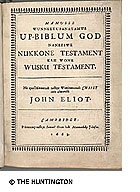
Algonquin Bible
Other landmark translations in the exhibit include Wycliffe, Tyndale, King James, and John Eliot's Up-Biblum God, a translation into the native Algonquin dialect and the first Bible published in America (120 years before the first American English Bible).
Illustration: Pictures are an important way of helping people engage the Scriptures—and helping those who don't read to get the message. The exhibit contains an exquisite set of Albrecht Durer's small passion (1508-1511). It also features a copy of the Biblia Pauperum, 50-leaf illustrated "comic books" from the 14th and 15th centuries that connect Old Testament scenes with the New Testament events they prefigure. And if you have only experienced Gustave Doré;'s engravings of biblical scenes in cheap muddy reproductions, the Huntington's letterpress version is a revelation of clarity.
Charts: Because the Bible spans thousands of years of human history and because its prophecies overlap in confusing ways, readers have always found charts helpful. The Huntington collection includes a 1643 foldout "Key of the Revelation" chart that readers could insert into their own Bibles for ready reference.
Explanatory notes: Among the influential sets of explanatory notes in the Huntington exhibit are the Geneva Bible and the Scofield Reference Bible. The first shaped the English Reformation of the 16th century and the second shaped American evangelicalism of the early 20th century. The margins of the 1560 Geneva Bible were crammed with notes of a Calvinist flavor, and the King James translation was in part an attempt to counter its Protestantizing influence. Where the Geneva Bible had made translation choices that favored the rule of congregations by local elders, for example, the King James chose terms that reflected a more institutional and hierarchical understanding of church and its historic administration by bishops. Nearly forgotten today, the Geneva Bible was for 50 years a bestseller in England, and was the Bible from which Shakespeare quoted.
All through the exhibit, I was reminded of the ways that Bibles are produced for the people. Despite the efforts of King James to produce a translation that would reinforce the hierarchical structures of church and state, the translation and dissemination of the Bible had an inevitably leveling effect. The study of the Bible by the masses has been a strong democratic force both within society and within the church.
Such proletarian sentiment is wonderfully captured in this exhibit by page bearing the handwriting of mystic poet and painter William Blake. Adjacent to a 19th-century attempt to at a scholarly translation of the Lord's Prayer, Blake objected: "Christ and his apostles were illiterate men. Caiaphas, Pilate and Herod were learned."
Ah, the leveling influence of Scripture.
Information about "The Bible and the People" is available at the Huntington Library's website. The exhibit can be viewed through January 5, 2005.
Copyright © 2004 Christianity Today.Click for reprint information.

Support Our Work
Subscribe to CT for less than $4.25/month