
Jump directly to the content
Subscribe:
magcover

Already a subscriber?

Home > Issues > 2007 > Fall > 5 Kinds of Christians

Jennifer Hua identifies herself as a Christian. A 35-year-old former attorney studying Christian counseling at the Wheaton College Graduate School (Illinois), she has gone to church all her life and is a lay leader in her suburban Chicago congregation. She furthers her spiritual development by daily Bible reading, prayer, listening to and singing worship songs, and interacting with other Christians. And every few months, she carves out time for a silent retreat. "I do all of these things because I know from past experience I need to recalibrate my mind and my heart to be in tune with God," she says.

James Smith also identifies himself as a Christian. He attended church as a child, but his attendance was minimal as a young adult. He believes in God, occasionally attends Redeemer Presbyterian in Manhattan when his time-consuming job in the finance district allows, but he does not often participate in other activities to further his spiritual life. He has a Bible but rarely opens it; what leisure time he has he spends with friends, most of whom are of different faiths, and he does not necessarily believe that his God is any different from the one his Muslim friend worships.

"I don't think that God would be a God who would shut others out of heaven because they don't use the word 'Christian' to describe themselves," he says.

The United States is described in mainstream media as largely Christian (between 70 and 80 percent, depending on the study, identify themselves as "Christian"), and compared to the rest of the world, this is certainly the case. However, not all within this vast group of Christians are alike.

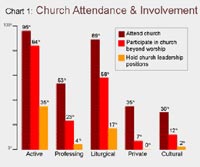
To understand the range and differences among American Christians, Christianity Today International (publisher of Leadership) recently partnered with Zondervan Publishers to commission Knowledge Networks to conduct attitudinal and behavioral research of U.S. Christians. In September 2006, more than 1,000 self-identified Christians 18 years of age and older were surveyed on their religious beliefs and practices. The results reveal a number of significant differences, illustrated by the examples of Hua and Smith. In fact, portraits of five distinct segments emerged from the study. We have named them Active, Professing, Liturgical, Private, and Cultural Christians.

Each group represents about one-fifth of those identifying themselves as Christian, with Active Christians (such as Hua) most likely to have a personal commitment to Jesus Christ that affects their beliefs and inspires an active church life; Cultural Christians (such as Smith) are least likely to align their beliefs or practices with biblical teachings, or attend church. Between the two is a range of beliefs, commitment levels, and public practice of the faith.

Leadership discussed the survey results with leading pastors and religious experts to ascertain the ramifications for church leaders. Three critical issues emerged:

  1. The local church is no longer considered the only outlet for spiritual growth.


log in

To view the rest of this article, you must be a subscriber to LeadershipJournal.net. Activate your online account for complete access.

or
From Issue:On the Margins, Fall 2007 | Posted: October 1, 2007

Related Training

from BuildingChurchLeaders.com
What Keeps Leaders from Loving?

What Keeps Leaders from Loving?

Identify the obstacles that keep you from fully loving others.
10 Keys to Sustaining the Ministry Life

10 Keys to Sustaining the Ministry Life

These essential practices will prepare you for the long haul.

Subscribe to read more

Subscribe Today!

  • One risk-free issue
  • Instant access to all Leadership Journal web content
  • OFFER DETAILS

Print subscriber? Activate your online account for complete access.

rating & comments

Average User Rating: Not rated

You must be a Leadership Journal subscriber to post comments
(on articles open to the public, you must at least register for a free account).
Login
or
Subscribe
or
Register
God Behind the Veil

God Behind the Veil

His ways are hidden from ordinary eyes, but not from the eyes of faith.

Home Improvement Meets the Gospel

This Is Our City

Home Improvement Meets the Gospel

How two co-founders of the home-supply store TreeHouse infuse their business with environmentally sound faith.

more | current issue

Books & Culture

A Measure of Forgiveness

A Measure of Forgiveness

Memories of a British...

Today's Christian Woman

Amy Grant: How Mercy Looks from Here

Amy Grant: How Mercy Looks from Here

The Queen of Christian...

Small Groups

Mental Illness Is Mainstream

Mental Illness Is Mainstream

We must help the one...

Shopping