When does a church look like a church? How should a church look?
In a definitive address at the twenty-fifth National Conference on Church Architecture in Dallas last month, delegates were told to “get rid of the notion that we are glorifying God by building elaborate and magnificent churches.”
“We do not build a church to house God,” said Edward Anders Sovik, noted architect from Northfield, Minnesota. “We build it to be the house of God’s people. It is in serving them that we honor God.”
Sovik, a son of Lutheran missionaries, was a student of painting and theology before specializing in architecture. He belongs to both the Church Architectural Guild of America and the National Council of Churches Architecture Commission. The two groups jointly sponsored the conference.
He stressed that above all other considerations, the church building should be “good art, for if it is not it cannot properly represent the mystery of our faith.” And all good art, Sovik added, “becomes in a sense religious.…”
Church architecture has been strongly influenced, he said, by two groups—the “symbolists,” who emphasize the “theological imagery” of man’s encounter with God, and the “functionalists,” who base the form of church buildings on “the action that takes place within the church—the events that we will call liturgy.”
“When these functionalists speak about church design they speak a fairly lucid language. ‘Make the space fit the action contained in the space.’ If the action of worship finally centers at the altar, why then be reasonable—put the altar at the center, not half a block down against a remote wall.”
But function alone is not enough, he said; if it were “the essential value, we might as well complete the destruction of the Parthenon, because it has no further function at all.”
Sovik also declared that symbolism in itself is insufficient: “It doesn’t take an artist to make a cross-shaped building, a groined vault signifying hands joined in prayer, indirect lighting for mystery, or symbols of the apostles, and they don’t make good architecture.”
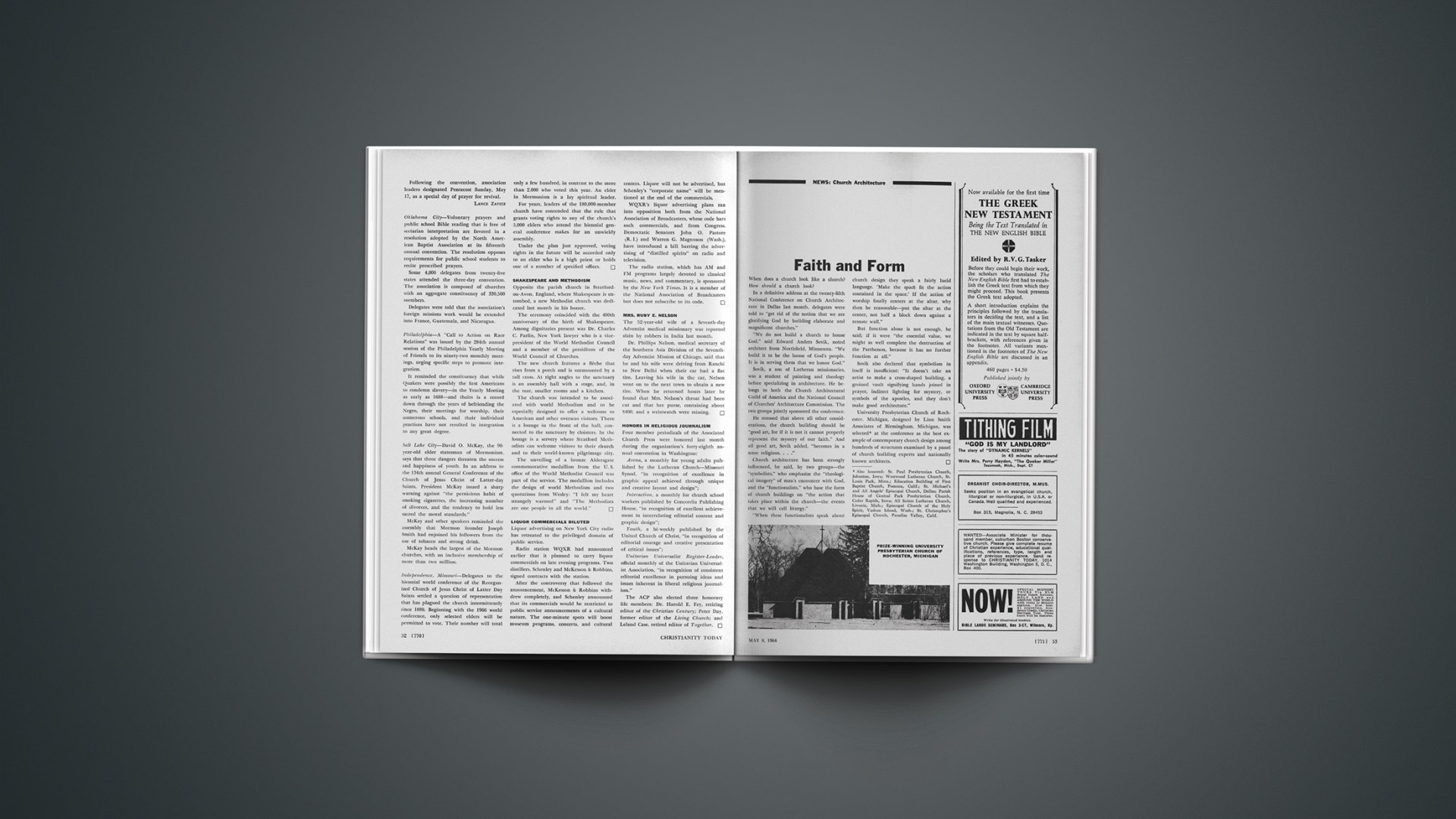
University Presbyterian Church of Rochester, Michigan, designed by Linn Smith Associates of Birmingham, Michigan, was selected1Also honored: St. Paul Presbyterian Church, Johnston, Iowa; Westwood Lutheran Church, St. Louis Park, Minn.; Education Building of First Baptist Church, Pomona, Calif.; St. Michael’s and All Angels’ Episcopal Church, Dallas; Parish House of Central Park Presbyterian Church, Cedar Rapids, Iowa; All Saints Lutheran Church, Livonia, Mich.; Episcopal Church of the Holy Spirit, Vashon Island, Wash.; St. Christopher’s Episcopal Church, Paradise Valley, Calif. at the conference as the best example of contemporary church design among hundreds of structures examined by a panel of church building experts and nationally known architects.