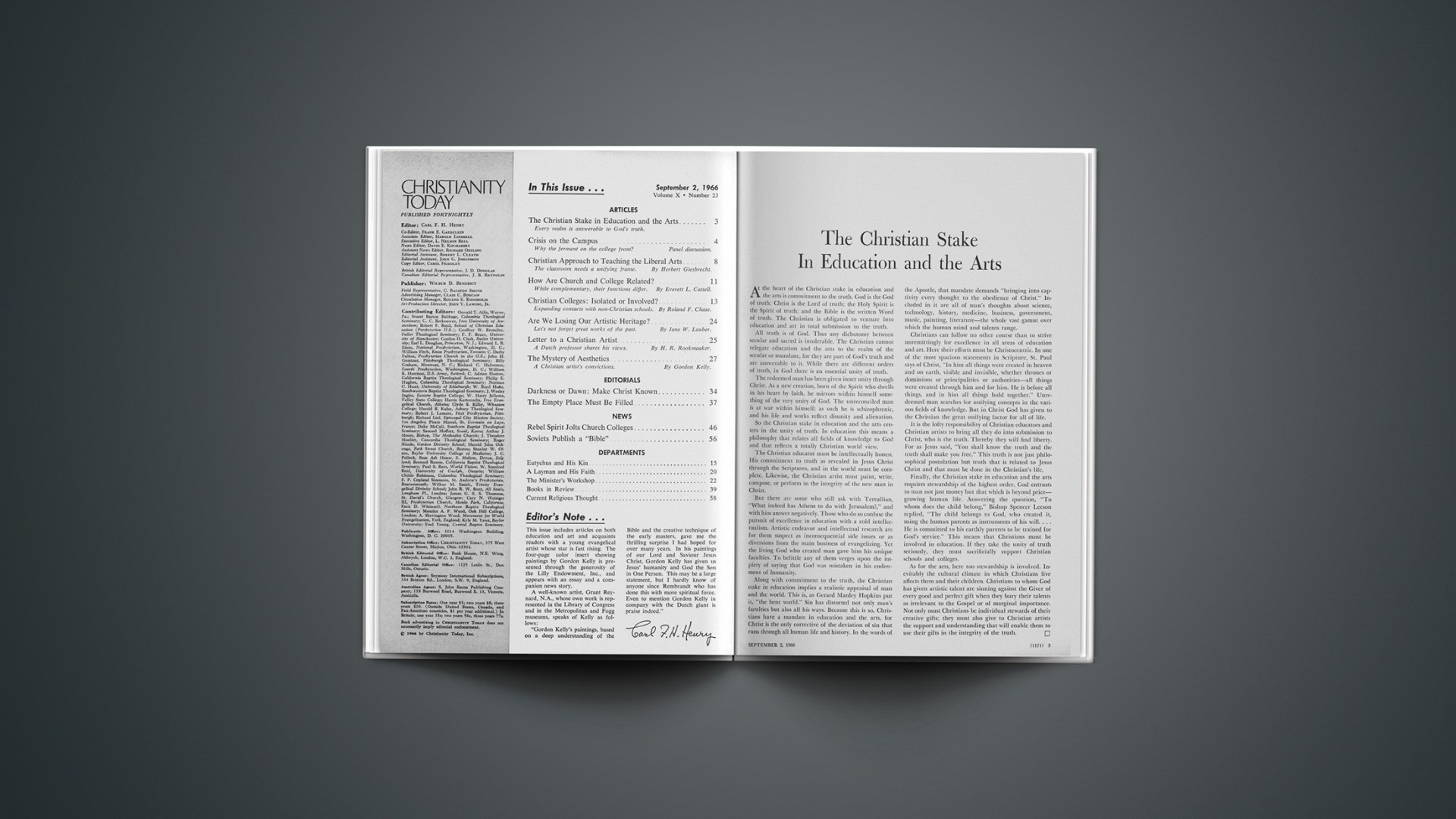
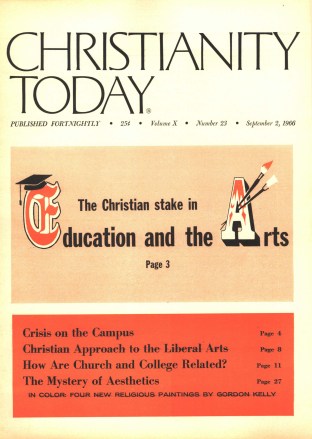
At the heart of the Christian stake in education and the arts is commitment to the truth. God is the God of truth; Christ is the Lord of truth; the Holy Spirit is the Spirit of truth; and the Bible is the written Word of truth. The Christian is obligated to venture into education and art in total submission to the truth.
All truth is of God. Thus any dichotomy between secular and sacred is intolerable. The Christian cannot relegate education and the arts to the realm of the secular or mundane, for they are part of God’s truth and are answerable to it. While there are different orders of truth, in God there is an essential unity of truth.
The redeemed man has been given inner unity through Christ. As a new creation, born of the Spirit who dwells in his heart by faith, he mirrors within himself something of the very unity of God. The unreconciled man is at war within himself; as such he is schizophrenic, and his life and works reflect disunity and alienation.
So the Christian stake in education and the arts centers in the unity of truth. In education this means a philosophy that relates all fields of knowledge to God and that reflects a totally Christian world view.
The Christian educator must be intellectually honest. His commitment to truth as revealed in Jesus Christ through the Scriptures, and in the world must be complete. Likewise, the Christian artist must paint, write, compose, or perform in the integrity of the new man in Christ.
But there are some who still ask with Tertullian, “What indeed has Athens to do with Jerusalem?,” and with him answer negatively. Those who do so confuse the pursuit of excellence in education with a cold intellectualism. Artistic endeavor and intellectual research are for them suspect as inconsequential side issues or as diversions from the main business of evangelizing. Yet the living God who created man gave him his unique faculties. To belittle any of them verges upon the impiety of saying that God was mistaken in his endowment of humanity.
Along with commitment to the truth, the Christian stake in education implies a realistic appraisal of man and the world. This is, as Gerard Manley Hopkins put it, “the bent world.” Sin has distorted not only man’s faculties but also all his ways. Because this is so, Christians have a mandate in education and the arts, for Christ is the only corrective of the deviation of sin that runs through all human life and history. In the words of the Apostle, that mandate demands “bringing into captivity every thought to the obedience of Christ.” Included in it are all of man’s thoughts about science, technology, history, medicine, business, government, music, painting, literature—the whole vast gamut over which the human mind and talents range.
Christians can follow no other course than to strive unremittingly for excellence in all areas of education and art. Here their efforts must be Christocentric. In one of the most spacious statements in Scripture, St. Paul says of Christ, “In him all things were created in heaven and on earth, visible and invisible, whether thrones or dominions or principalities or authorities—all things were created through him and for him. He is before all things, and in him all things hold together.” Unredeemed man searches for unifying concepts in the various fields of knowledge. But in Christ God has given to the Christian the great unifying factor for all of life.
It is the lofty responsibility of Christian educators and Christian artists to bring all they do into submission to Christ, who is the truth. Thereby they will find liberty. For as Jesus said, “You shall know the truth and the truth shall make you free.” This truth is not just philosophical postulation but truth that is related to Jesus Christ and that must be done in the Christian’s life.
Finally, the Christian stake in education and the arts requires stewardship of the highest order. God entrusts to man not just money but that which is beyond price—growing human life. Answering the question, “To whom does the child belong,” Bishop Spencer Leeson replied, “The child belongs to God, who created it, using the human parents as instruments of his will.… He is committed to his earthly parents to be trained for God’s service.” This means that Christians must be involved in education. If they take the unity of truth seriously, they must sacrificially support Christian schools and colleges.
As for the arts, here too stewardship is involved. Inevitably the cultural climate in which Christians live affects them and their children. Christians to whom God has given artistic talent are sinning against the Giver of every good and perfect gift when they bury their talents as irrelevant to the Gospel or of marginal importance. Not only must Christians be individual stewards of their creative gifts; they must also give to Christian artists the support and understanding that will enable them to use their gifts in the integrity of the truth.