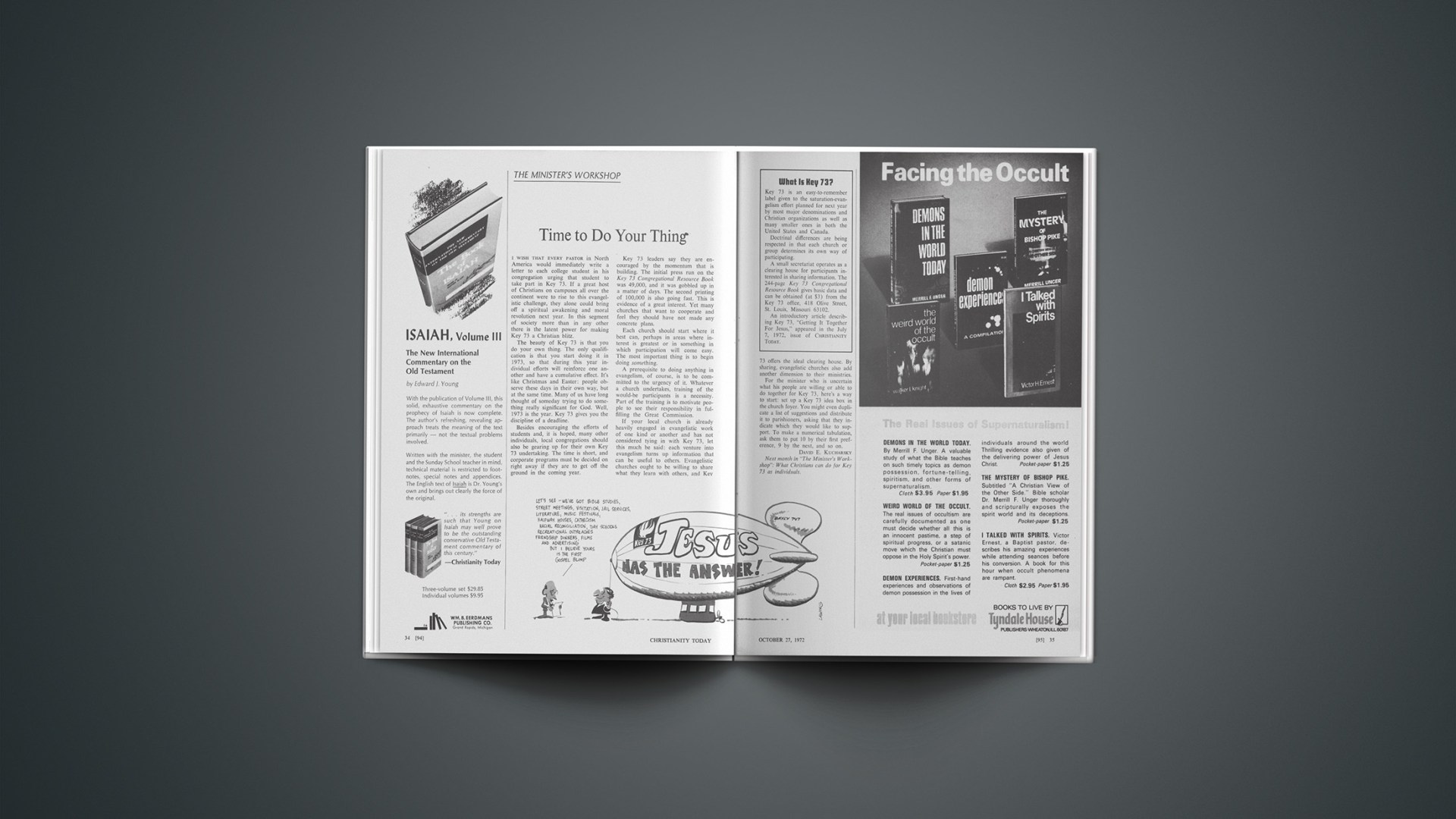

I wish that every pastor in North America would immediately write a letter to each college student in his congregation urging that student to take part in Key 73. If a great host of Christians on campuses all over the continent were to rise to this evangelistic challenge, they alone could bring off a spiritual awakening and moral revolution next year. In this segment of society more than in any other there is the latent power for making Key 73 a Christian blitz.
The beauty of Key 73 is that you do your own thing. The only qualification is that you start doing it in 1973, so that during this year individual efforts will reinforce one another and have a cumulative effect. It’s like Christmas and Easter: people observe these days in their own way, but at the same time. Many of us have long thought of someday trying to do something really significant for God. Well, 1973 is the year. Key 73 gives you the discipline of a deadline.
Besides encouraging the efforts of students and, it is hoped, many other individuals, local congregations should also be gearing up for their own Key 73 undertaking. The time is short, and corporate programs must be decided on right away if they are to get off the ground in the coming year.
Key 73 leaders say they are encouraged by the momentum that is building. The initial press run on the Key 73 Congregational Resource Book was 49,000, and it was gobbled up in a matter of days. The second printing of 100,000 is also going fast. This is evidence of a great interest. Yet many churches that want to cooperate and feel they should have not made any concrete plans.
Each church should start where it best can, perhaps in areas where interest is greatest or in something in which participation will come easy. The most important thing is to begin doing something.
A prerequisite to doing anything in evangelism, of course, is to be committed to the urgency of it. Whatever a church undertakes, training of the would-be participants is a necessity. Part of the training is to motivate people to see their responsibility in fulfilling the Great Commission.
If your local church is already heavily engaged in evangelistic work of one kind or another and has not considered tying in with Key 73, let this much be said: each venture into evangelism turns up information that can be useful to others. Evangelistic churches ought to be willing to share what they learn with others, and Key 73 offers the ideal clearing house. By sharing, evangelistic churches also add another dimension to their ministries.
For the minister who is uncertain what his people are willing or able to do together for Key 73, here’s a way to start: set up a Key 73 idea box in the church foyer. You might even duplicate a list of suggestions and distribute it to parishioners, asking that they indicate which they would like to support. To make a numerical tabulation, ask them to put 10 by their first preference, 9 by the next, and so on.
Next month in “The Minister’s Workshop”: What Christians can do for Key 73 as individuals.
What Is Key 73?
Key 73 is an easy-to-remember label given to the saturation-evangelism effort planned for next year by most major denominations and Christian organizations as well as many smaller ones in both the United States and Canada.
Doctrinal differences are being respected in that each church or group determines its own way of participating.
A small secretariat operates as a clearing house for participants interested in sharing information. The 244-page Key 73 Congregational Resource Book gives basic data and can be obtained (at $3) from the Key 73 office, 418 Olive Street, St. Louis, Missouri 63102.
An introductory article describing Key 73, “Getting It Together For Jesus,” appeared in the July 7, 1972, issue of CHRISTIANITY TODAY.