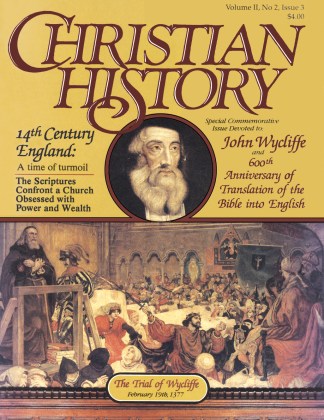
Wycliffe had been summoned to Rome by Pope Urban VI. Using Wycliffe’s poor health as an excuse, the king blocked the summons and Wycliffe wrote the following letter to the Pope. It was written just months before Wycliffe’s death on New Year’s Eve, 1384.
“I am happy to reveal fully to anyone and especially to the Roman pontiff the faith I hold, for I suppose if it is orthodox, he will graciously confirm this faith and if it be erroneous he will correct it. But I submit that the gospel of Christ is the body of the law of God, that Christ, indeed, who directly gave this gospel, I believe to be true God and true man, and in this the law of the gospel excels all other parts of Scripture. Again I submit that the Roman pontiff, inasmuch as he is Christ’s highest vicar on earth, is among pilgrims most bound to this law of the gospel. For the majority of Christ’s disciples are not judged according to worldly greatness, but according to the imitation of Christ in their moral life. Again, from out this heart of the Lord’s law I plainly conclude that Christ was the poorest of men during the time of his pilgrimage and that he eschewed all worldly dominion. This is clear from the faith of the gospel, Matthew 8 and 2 Corinthians 8. From all this I deduce that never should any of the faithful imitate the pope himself nor any of the saints except insofar as he may have imitated the Lord Jesus Christ. For Peter, Paul, and the sons of Zebedee, by seeking worldly dignity, brought that sort of imitation into disrepute, so that they are not to be imitated in those errors. From this I infer, as a counsel, that the pope should leave temporal dominion to the secular arm, and to this he should effectually exhort his clergy. For in such wise did Christ have signified through his apostles.
“If in the above I have erred, I am willing humbly to be corrected, even through death if necessary. And if I were able to travel at will in person, I should like humbly to visit the Roman pontiff. But God has obliged me to the contrary, and he has always taught me to obey God rather than men. But since God has given our pope true and evangelical instincts, we should pray that those instincts are not extinguished through deceitful counsel, nor that the pope or cardinals be moved to do anything contrary to the law of the Lord. Therefore, let us ask God, the lord of everything created, that he so inspire our pope, Urban VI, as he began, so that he and his clergy may imitate the Lord Jesus Christ in their moral lives, so that they may effectually teach the people to faithfully imitate them in this. And let us pray spiritually that our pope be preserved from malicious counsel, for we also know that a man’s enemies are of his household, and God does not suffer us to be tempted above that which we are able, much less does he require of any creature that he do that which he can not, for such is the manifest condition of Antichrist.”
From Milton’s “Areopagitica”
In defense of liberty of unlicensed printing, John Milton made a famous speech to the English Parliament in 1644, entitled Aeropagitica. In its published form, it has become a classic for freedom of speech and for individual rights. The following excerpt refers to John Wycliffe:
“Why else was this Nation chosen before any other, that out of her, as out of Sion, should be proclaimed and sounded forth the first tidings and trumpet of Reformation to all Europe? And had it not been the obstinate preverseness of our prelates against the divine and admirable spirit of Wickliff, to suppress him as a schismatic and innovator, perhaps neither the Bohemian Huss and Jerome, no nor the name of Luther or Calvin, had been ever known: the glory of reforming all our neighbors had been completely ours.”
Copyright © 1983 by the author or Christianity Today/Christian History magazine. Click here for reprint information on Christian History.