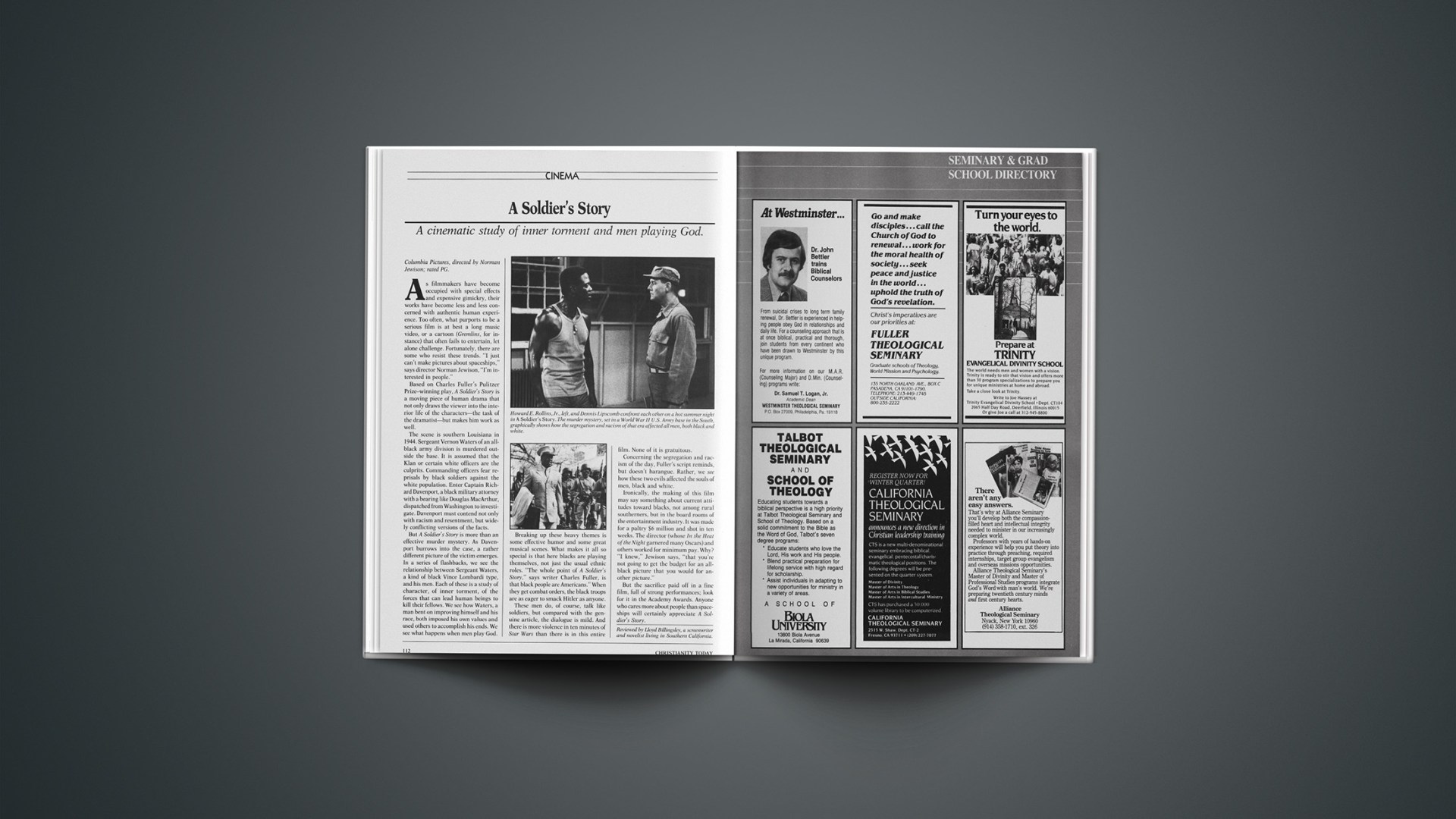
A Soldier’s Story

A cinematic study of inner torment and men playing God.

As filmmakers have become occupied with special effects and expensive gimickry, their works have become less and less concerned with authentic human experience. Too often, what purports to be a serious film is at best a long music video, or a cartoon (Gremlins, for instance) that often fails to entertain, let alone challenge. Fortunately, there are some who resist these trends. “I just can’t make pictures about spaceships,” says director Norman Jewison, “I’m interested in people.”

Based on Charles Fuller’s Pulitzer Prize-winning play, A Soldier’s Story is a moving piece of human drama that not only draws the viewer into the interior life of the characters—the task of the dramatist—but makes him work as well.

The scene is southern Louisiana in 1944. Sergeant Vernon Waters of an all-black army division is murdered outside the base. It is assumed that the Klan or certain white officers are the culprits. Commanding officers fear reprisals by black soldiers against the white population. Enter Captain Richard Davenport, a black military attorney with a bearing like Douglas MacArthur, dispatched from Washington to investigate. Davenport must contend not only with racism and resentment, but widely conflicting versions of the facts.

But A Soldier’s Story is more than an effective murder mystery. As Davenport burrows into the case, a rather different picture of the victim emerges. In a series of flashbacks, we see the relationship between Sergeant Waters, a kind of black Vince Lombardi type, and his men. Each of these is a study of character, of inner torment, of the forces that can lead human beings to kill their fellows. We see how Waters, a man bent on improving himself and his race, both imposed his own values and used others to accomplish his ends. We see what happens when men play God.

Breaking up these heavy themes is some effective humor and some great musical scenes. What makes it all so special is that here blacks are playing themselves, not just the usual ethnic roles. “The whole point of A Soldier’s Story,” says writer Charles Fuller, is that black people are Americans.” When they get combat orders, the black troops are as eager to smack Hitler as anyone.

These men do, of course, talk like soldiers, but compared with the genuine article, the dialogue is mild. And there is more violence in ten minutes of Star Wars than there is in this entire film. None of it is gratuitous.

Concerning the segregation and racism of the day, Fuller’s script reminds, but doesn’t harangue. Rather, we see how these two evils affected the souls of men, black and white.

Ironically, the making of this film may say something about current attitudes toward blacks, not among rural southerners, but in the board rooms of the entertainment industry. It was made for a paltry $6 million and shot in ten weeks. The director (whose In the Heat of the Night garnered many Oscars) and others worked for minimum pay. Why? “I knew,” Jewison says, “that you’re not going to get the budget for an all-black picture that you would for another picture.”

But the sacrifice paid off in a fine film, full of strong performances; look for it in the Academy Awards. Anyone who cares more about people than spaceships will certainly appreciate A Soldier’s Story.

Reviewed by Lloyd Billingsley, a screenwriter and novelist living in Southern California.

Also in this issue

The CT archives are a rich treasure of biblical wisdom and insight from our past. Some things we would say differently today, and some stances we've changed. But overall, we're amazed at how relevant so much of this content is. We trust that you'll find it a helpful resource.

Canada Seeks $130 Million in Fines and Taxes from Amway

Eutychus and His Kin: October 5, 1984

Editorial

The Glamorous Prostitute

How Happy Are Hookers?

When ‘Infidels’ Run for Office

Mark Noll

The Naked Public Square: Without Religious Ideals, Democracy Becomes Dangerous

Richard John Neuhaus

The Creator Creativity: The Arts Call Us to Celebrate God’s Glory in Sound, Color, and Words

Frank E. Gaebelein

New Ways to Honor Father & Mother: If We Don’t Act, We May Move into an Age of Resentment and Hostility toward the Elderly

William F. May

At Great Risk: Tyndale, Wycliffe, John Rogers, and Others Developed the English Bible despite Harassment and Enmity

Leslie R. Keylock

Election ’84 / Part 1: Republicans, Religion, and Reelection: For the First Time in Decades, People of Deep Religious Faith Are Ready Recruits in a Political War

A Perspective

Is Bible Knowledge Becoming Just Another Trivial Pursuit?

Randy Frame

An Appeals Court Upholds Christian Publisher’s Tax-Exempt Status

Did They Find Noah’s Ark? Explorers Can’t Agree

A Christian Arts Festival Attracts England’s ‘Rebels’

Christians Fall Victim to Terrorist Violence in Peru

NCC Won’t Allow a Watchdog Group to Examine Its Financial Records

Latin American Evangelicals Gear up for Overseas Missions

All Active-Duty U.S. Soldiers Are Expected to See Dobson Film

Protestants and Jews Debate the Merits of Tuition Tax Credits

Refiner’s Fire: Jane Fonda as Proverbs’ Virtuous Woman

Donn R. Wright

Frozen Fire

View issue

Our Latest

Christian Athletes to Cheer on at the 2026 Milan Cortina Winter Olympics

Annie Meldrum

Competitors in speedskating, bobsledding, the biathlon, and hockey speak about their faith.

Review

This ‘Screwtape for Our Times’ Will Challenge and Confound You

The Body of This Death is difficult to classify, difficult to read, and absolutely worth your time.

Being Human

Andrew Arndt: The Hidden Struggles of Public Figures and Why Real Community Matters

How do we identify coping mechanisms and begin a journey to wholeness?

The Russell Moore Show

Should I Leave My Church Over Calvinism and Arminianism?

Russell answers a listener question about whether a church’s differences over Calvinism and Arminianism mean it’s time to leave his church.

Was Abraham Lincoln a Christian?

In his younger years, Lincoln was a skeptic. But as he aged, he turned toward biblical wisdom—and not only when in the public eye.

Killing People Is Not the Same as Allowing Them to Die

And the church of Jesus Christ has to offer people a better way of thinking about life and dependence if we want to push against the horrors of euthanasia.

News

How CT Editors Carl Henry and Nelson Bell Covered Civil Rights

Michael D. Hammond

Trying to stake out a sliver of space for the “moderate evangelical,” the magazine sometimes left readers confused and justice ignored.

CT Reports from Nixon’s Trip to Communist China

In 1972, American evangelicals were concerned about religious liberty around the world and moral decline at home.

Apple PodcastsDown ArrowDown ArrowDown Arrowarrow_left_altLeft ArrowLeft ArrowRight ArrowRight ArrowRight Arrowarrow_up_altUp ArrowUp ArrowAvailable at Amazoncaret-downCloseCloseEmailEmailExpandExpandExternalExternalFacebookfacebook-squareGiftGiftGooglegoogleGoogle KeephamburgerInstagraminstagram-squareLinkLinklinkedin-squareListenListenListenChristianity TodayCT Creative Studio Logologo_orgMegaphoneMenuMenupausePinterestPlayPlayPocketPodcastprintRSSRSSSaveSaveSaveSearchSearchsearchSpotifyStitcherTelegramTable of ContentsTable of Contentstwitter-squareWhatsAppXYouTubeYouTube