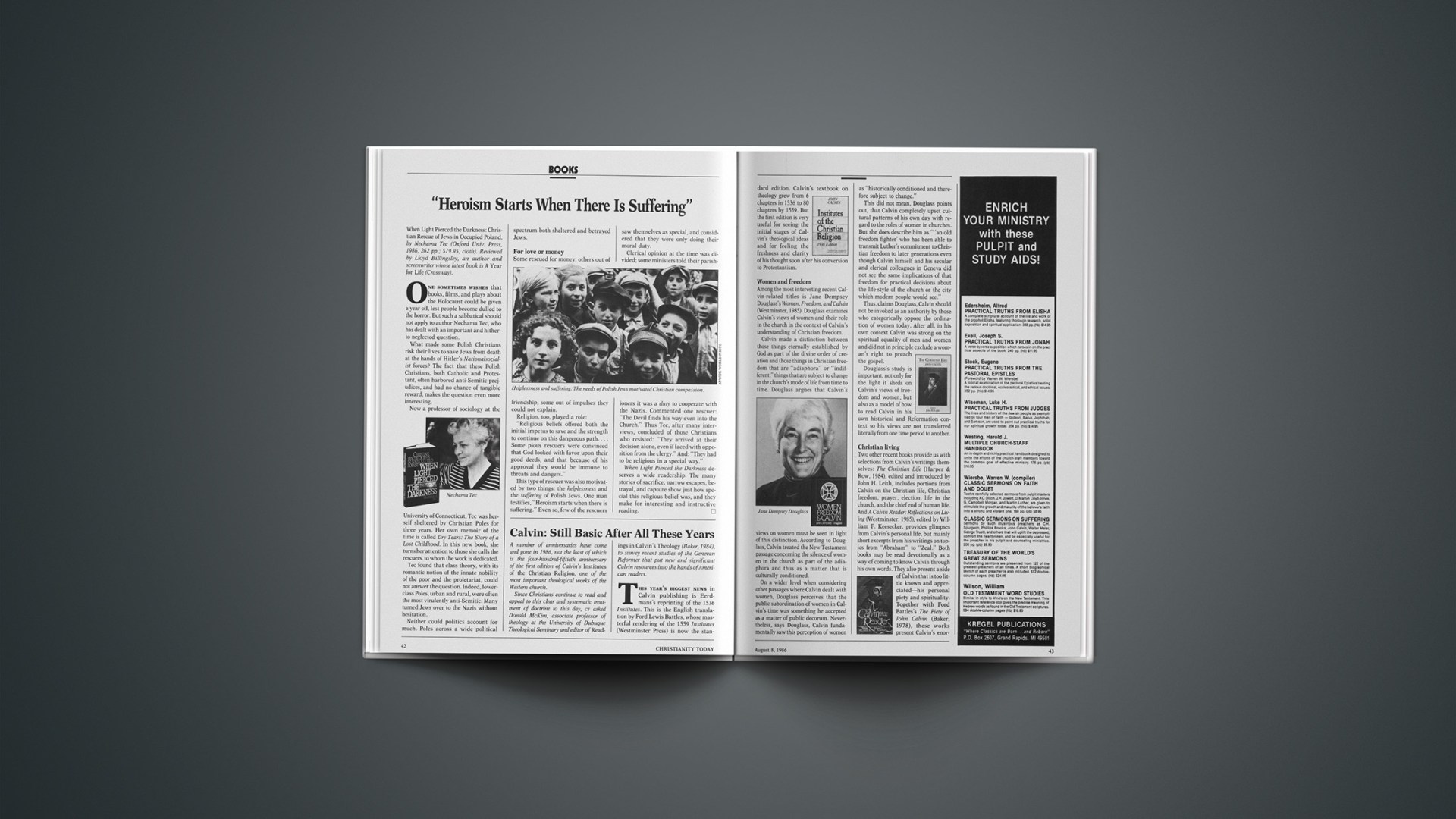

When Light Pierced the Darkness: Christian Rescue of Jews in Occupied Poland, by Nechama Tec (Oxford Univ. Press, 1986, 262 pp.; $19.95, cloth). Reviewed by Lloyd Billingsley, an author and screenwriter whose latest book is A Year for Life (Crossway).
One sometimes wishes that books, films, and plays about the Holocaust could be given a year off, lest people become dulled to the horror. But such a sabbatical should not apply to author Nechama Tec, who has dealt with an important and hitherto neglected question.
What made some Polish Christians risk their lives to save Jews from death at the hands of Hitler’s Nationalsozialist forces? The fact that these Polish Christians, both Catholic and Protestant, often harbored anti-Semitic prejudices, and had no chance of tangible reward, makes the question even more interesting.
Now a professor of sociology at the University of Connecticut, Tec was herself sheltered by Christian Poles for three years. Her own memoir of the time is called Dry Tears: The Story of a Lost Childhood. In this new book, she turns her attention to those she calls the rescuers, to whom the work is dedicated.
Tec found that class theory, with its romantic notion of the innate nobility of the poor and the proletariat, could not answer the question. Indeed, lower-class Poles, urban and rural, were often the most virulently anti-Semitic. Many turned Jews over to the Nazis without hesitation.
Neither could politics account for much. Poles across a wide political spectrum both sheltered and betrayed Jews.
For Love Or Money
Some rescued for money, others out of friendship, some out of impulses they could not explain.
Religion, too, played a role: “Religious beliefs offered both the initial impetus to save and the strength to continue on this dangerous path.… Some pious rescuers were convinced that God looked with favor upon their good deeds, and that because of his approval they would be immune to threats and dangers.”
This type of rescuer was also motivated by two things: the helplessness and the suffering of Polish Jews. One man testifies, “Heroism starts when there is suffering.” Even so, few of the rescuers saw themselves as special, and considered that they were only doing their moral duty.
Clerical opinion at the time was divided; some ministers told their parishioners it was a duty to cooperate with the Nazis. Commented one rescuer: “The Devil finds his way even into the Church.” Thus Tec, after many interviews, concluded of those Christians who resisted: “They arrived at their decision alone, even if faced with opposition from the clergy.” And: “They had to be religious in a special way.”
When Light Pierced the Darkness deserves a wide readership. The many stories of sacrifice, narrow escapes, betrayal, and capture show just how special this religious belief was, and they make for interesting and instructive reading.