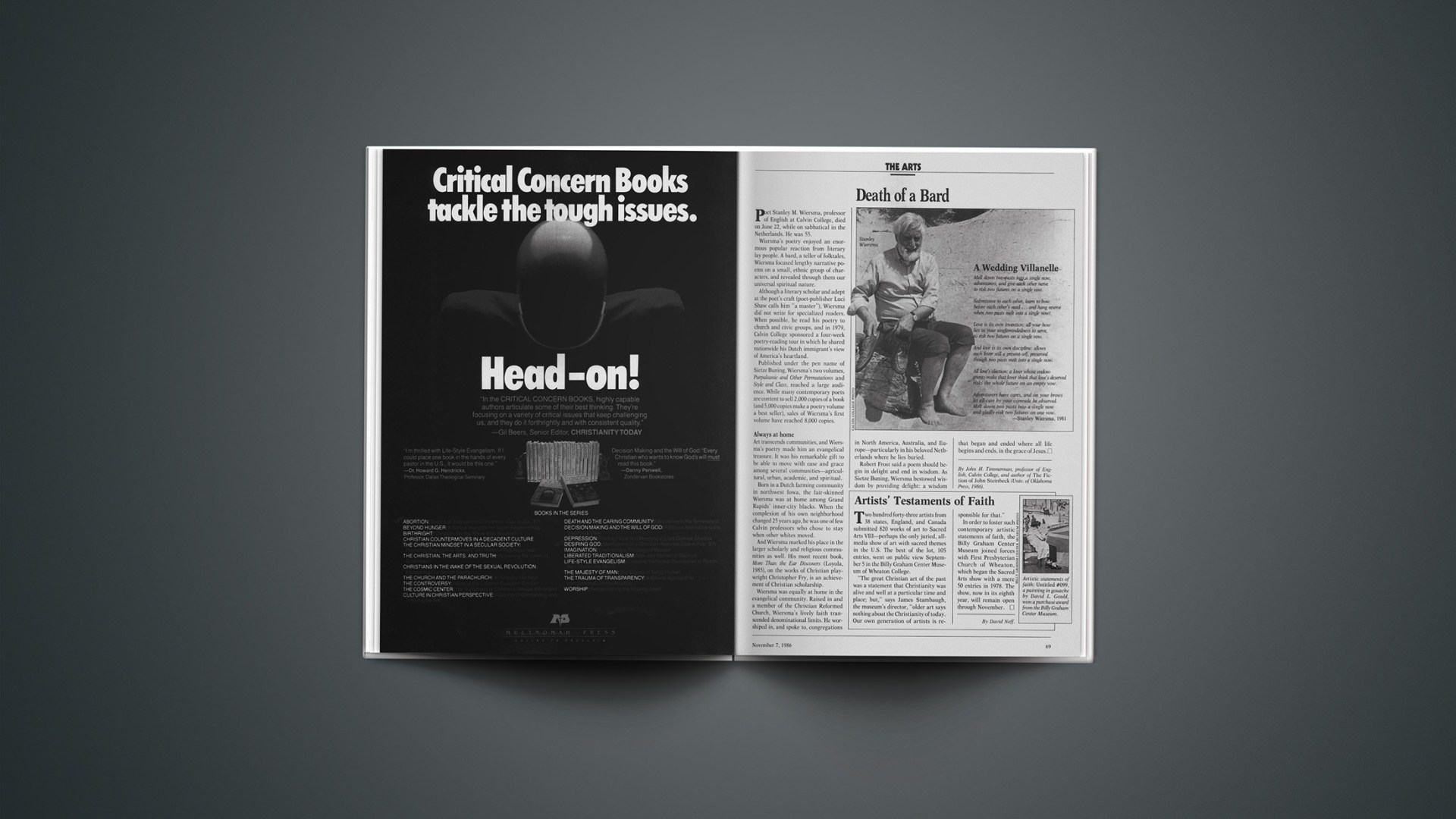

Poet Stanley M. Wiersma, professor of English at Calvin College, died on June 22, while on sabbatical in the Netherlands. He was 55.
Wiersma’s poetry enjoyed an enormous popular reaction from literary lay people. A bard, a teller of folktales, Wiersma focused lengthy narrative poems on a small, ethnic group of characters, and revealed through them our universal spiritual nature.
Although a literary scholar and adept at the poet’s craft (poet-publisher Luci Shaw calls him “a master”), Wiersma did not write for specialized readers. When possible, he read his poetry to church and civic groups, and in 1979, Calvin College sponsored a four-week poetry-reading tour in which he shared nationwide his Dutch immigrant’s view of America’s heartland.
Published under the pen name of Sietze Buning, Wiersma’s two volumes, Purpaleanie and Other Permutations and Style and Class, reached a large audience. While many contemporary poets are content to sell 2,000 copies of a book (and 5,000 copies make a poetry volume a best seller), sales of Wiersma’s first volume have reached 8,000 copies.
Always At Home
Art transcends communities, and Wiersma’s poetry made him an evangelical treasure. It was his remarkable gift to be able to move with ease and grace among several communities—agricultural, urban, academic, and spiritual.
Born in a Dutch farming community in northwest Iowa, the fair-skinned Wiersma was at home among Grand Rapids’ inner-city blacks. When the complexion of his own neighborhood changed 25 years ago, he was one of few Calvin professors who chose to stay when other whites moved.
And Wiersma marked his place in the larger scholarly and religious communities as well. His most recent book, More Than the Ear Discovers (Loyola, 1985), on the works of Christian playwright Christopher Fry, is an achievement of Christian scholarship.
Wiersma was equally at home in the evangelical community. Raised in and a member of the Christian Reformed Church, Wiersma’s lively faith transcended denominational limits. He worshiped in, and spoke to, congregations in North America, Australia, and Europe—particularly in his beloved Netherlands where he lies buried.
Robert Frost said a poem should begin in delight and end in wisdom. As Sietze Buning, Wiersma bestowed wisdom by providing delight: a wisdom that began and ended where all life begins and ends, in the grace of Jesus.
By John H. Timmerman, professor of English, Calvin College, and author of The Fiction of John Steinbeck (Univ. of Oklahoma Press, 1986).
Artists’ Testaments of Faith
Two hundred forty-three artists from 38 states, England, and Canada submitted 820 works of art to Sacred Arts VIII—perhaps the only juried, allmedia show of art with sacred themes in the U.S. The best of the lot, 105 entries, went on public view September 5 in the Billy Graham Center Museum of Wheaton College.
“The great Christian art of the past was a statement that Christianity was alive and well at a particular time and place; but,” says James Stambaugh, the museum’s director, “older art says nothing about the Christianity of today. Our own generation of artists is responsible for that.”
In order to foster such contemporary artistic statements of faith, the Billy Graham Center Museum joined forces with First Presbyterian Church of Wheaton, which began the Sacred Arts show with a mere 50 entries in 1978. The show, now in its eighth year, will remain open through November.
By David Neff.
A Wedding Villanelle
Melt down two pasts into a single now, adventurers, and give each other nerve to risk two futures on a single vow.
Submissive to each other, learn to bow before each other’s need … and hang reserve when two pasts melt into a single now!
Love is its own invention: all your how lies in your singlemindedness to serve, to risk two futures on a single vow.
And love is its own discipline: allows each lover still a present-self, preserved though two pasts melt into a single now.
All love’s election: a lover whose endowments make that lover think that love’s deserved risks the whole future on an empty vow.
Adventurers have cares, and on your brows let all care by your comrade be observed. Melt down two pasts into a single now and gladly risk two futures on one vow.
—Stanley Wiersma, 1981