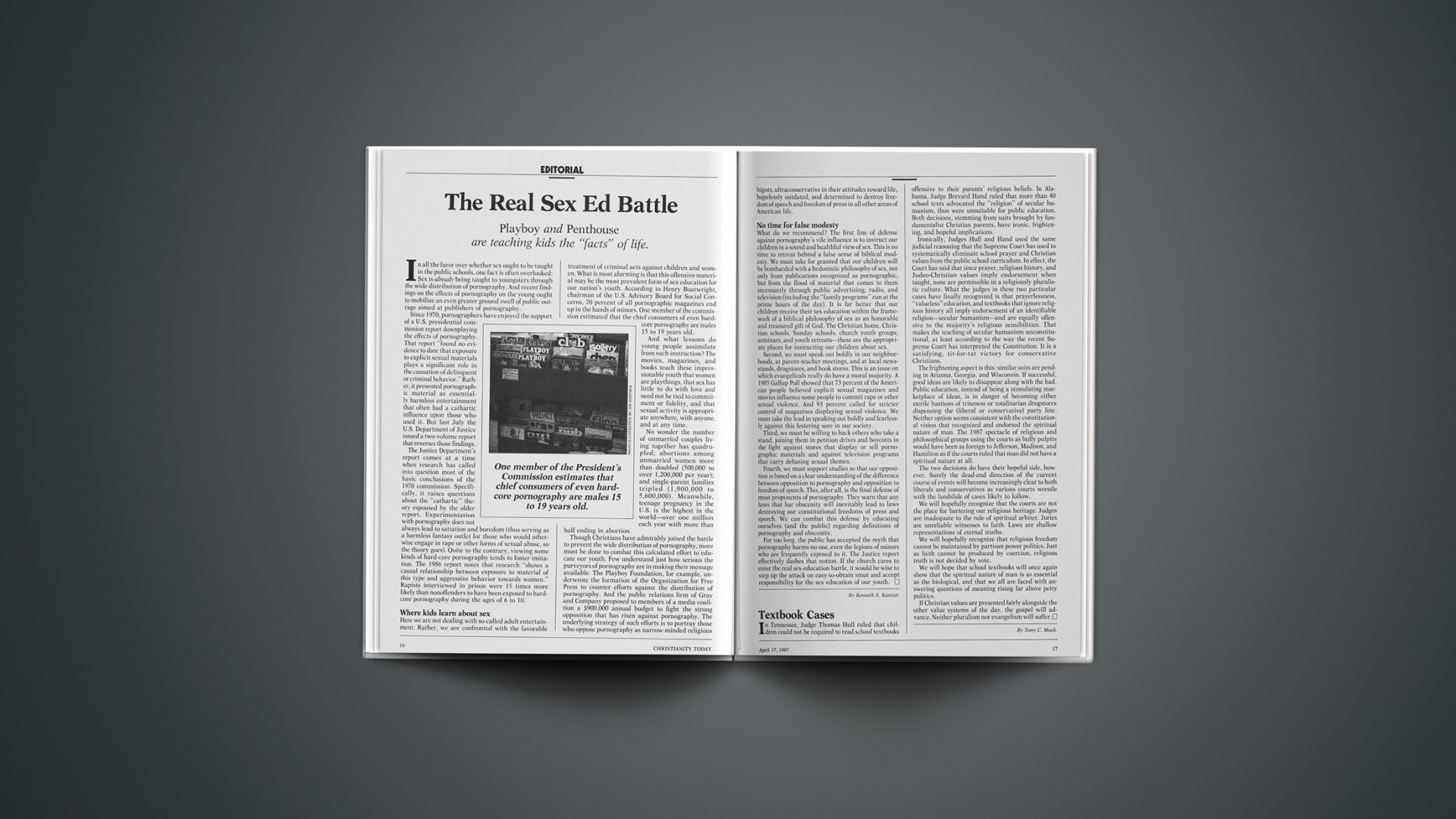

In Tennessee, Judge Thomas Hull ruled that children could not be required to read school textbooks offensive to their parents’ religious beliefs. In Alabama, Judge Brevard Hand ruled that more than 40 school texts advocated the “religion” of secular humanism, thus were unsuitable for public education. Both decisions, stemming from suits brought by fundamentalist Christian parents, have ironic, frightening, and hopeful implications.
Ironically, Judges Hull and Hand used the same judicial reasoning that the Supreme Court has used to systematically eliminate school prayer and Christian values from the public school curriculum. In effect, the Court has said that since prayer, religious history, and Judeo-Christian values imply endorsement when taught, none are permissible in a religiously pluralistic culture. What the judges in these two particular cases have finally recognized is that prayerlessness, “valueless” education, and textbooks that ignore religious history all imply endorsement of an identifiable religion—secular humanism—and are equally offensive to the majority’s religious sensibilities. That makes the teaching of secular humanism unconstitutional, at least according to the way the recent Supreme Court has interpreted the Constitution. It is a satisfying, tit-for-tat victory for conservative Christians.
The frightening aspect is this: similar suits are pending in Arizona, Georgia, and Wisconsin. If successful, good ideas are likely to disappear along with the bad. Public education, instead of being a stimulating marketplace of ideas, is in danger of becoming either sterile bastions of triteness or totalitarian drugstores dispensing the (liberal or conservative) party line. Neither option seems consistent with the constitutional vision that recognized and endorsed the spiritual nature of man. The 1987 spectacle of religious and philosophical groups using the courts as bully pulpits would have been as foreign to Jefferson, Madison, and Hamilton as if the courts ruled that man did not have a spiritual nature at all.
The two decisions do have their hopeful side, however. Surely the dead-end direction of the current course of events will become increasingly clear to both liberals and conservatives as various courts wrestle with the landslide of cases likely to follow.
We will hopefully recognize that the courts are not the place for bartering our religious heritage. Judges are inadequate to the role of spiritual arbiter. Juries are unreliable witnesses to faith. Laws are shallow representations of eternal truths.
We will hopefully recognize that religious freedom cannot be maintained by partisan power politics. Just as faith cannot be produced by coercion, religious truth is not decided by vote.
We will hope that school textbooks will once again show that the spiritual nature of man is as essential as the biological, and that we all are faced with answering questions of meaning rising far above petty politics.
If Christian values are presented fairly alongside the other value systems of the day, the gospel will advance. Neither pluralism nor evangelism will suffer.
By Terry C. Muck.