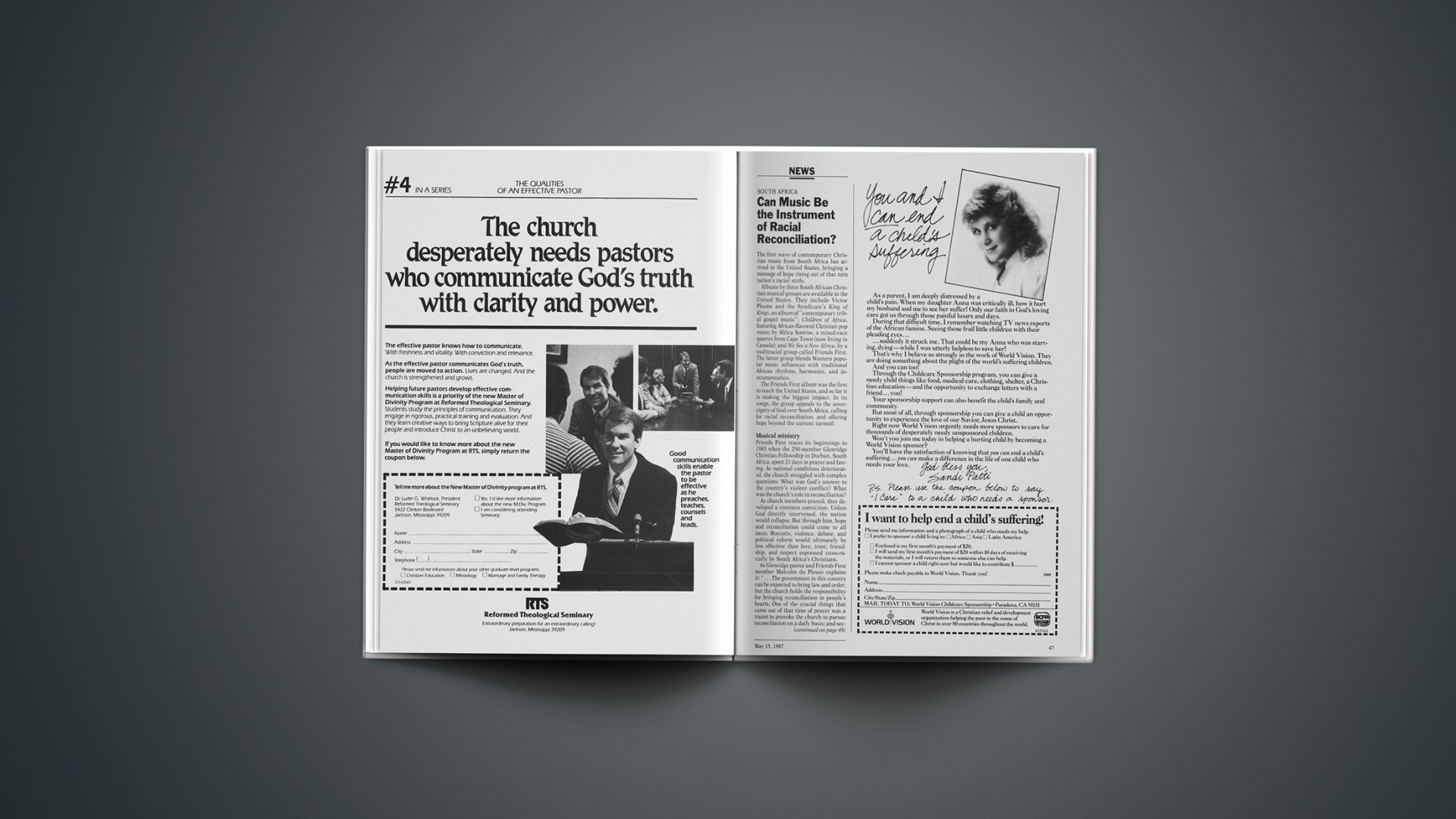

The first wave of contemporary Christian music from South Africa has arrived in the United States, bringing a message of hope rising out of that torn nation’s racial strife.
Albums by three South African Christian musical groups are available in the United States. They include Victor Phume and the Syndicate’s King of Kings, an album of “contemporary tribal gospel music”; Children of Africa, featuring African-flavored Christian pop music by Africa Sonrise, a mixed-race quartet from Cape Town (now living in Canada); and We See a New Africa, by a multiracial group called Friends First. The latter group blends Western popular music influences with traditional African rhythms, harmonies, and instrumentation.
The Friends First album was the first to reach the United States, and so far it is making the biggest impact. In its songs, the group appeals to the sovereignty of God over South Africa, calling for racial reconciliation, and offering hope beyond the current turmoil.
Musical Ministry
Friends First traces its beginnings to 1985 when the 250-member Glenridge Christian Fellowship in Durban, South Africa, spent 21 days in prayer and fasting. As national conditions deteriorated, the church struggled with complex questions: What was God’s answer to the country’s violent conflict? What was the church’s role in reconciliation?
As church members prayed, they developed a common conviction: Unless God directly intervened, the nation would collapse. But through him, hope and reconciliation could come to all races. Boycotts, violence, debate, and political reform would ultimately be less effective than love, trust, friendship, and respect expressed cross-racially by South Africa’s Christians.
As Glenridge pastor and Friends First member Malcolm du Plessis explains it: “… The government in this country can be expected to bring law and order, but the church holds the responsibility for bringing reconciliation in people’s hearts. One of the crucial things that came out of that time of prayer was a vision to provoke the church to pursue reconciliation on a daily basis; and secondly, to couple that with perpetual prayer for the nation.”
Members of Glenridge Christian Fellowship decided their most constructive effort would come as Christians built cross-racial relationships. The church’s integrated musical group, Friends First, became a tangible expression of that concern, a way to carry a message of hope throughout a country fragmented by apartheid’s racial barriers.
In The Wake Of Graceland
The group’s album reached the United States after Paul Simon’s album Graceland had focused attention on South African music. On Graceland, which has sold more than 1 million copies, Simon collaborated with black musicians from Johannesburg. The album was honored earlier this year with a Grammy Award as album of the year.
Du Plessis welcomes the success of Graceland. “For the first time, the nation [of South Africa] has had a chance to communicate some of its black culture, which has been outstanding,” he said. “… While everybody is giving their attention to South Africa’s music, the South African church may be given a platform to address the rest of the world, to challenge the hypocrisy, to use even this evil time as a pivotal point to express something of the kingdom of God.”
Members of Friends First, du Plessis included, continue to clarify their response to South Africa’s turmoil. This month, they are relocating to Johannesburg and affiliating with a group of Christians ministering to a squatter community in the black township of Soweto. Friends First also is pursuing further musical efforts, with a second album in the works.
By Jim Long.