





Is conversion the same for Asians as it is for Americans? Some say it is not, due to a shift in the evangelical center of gravity.
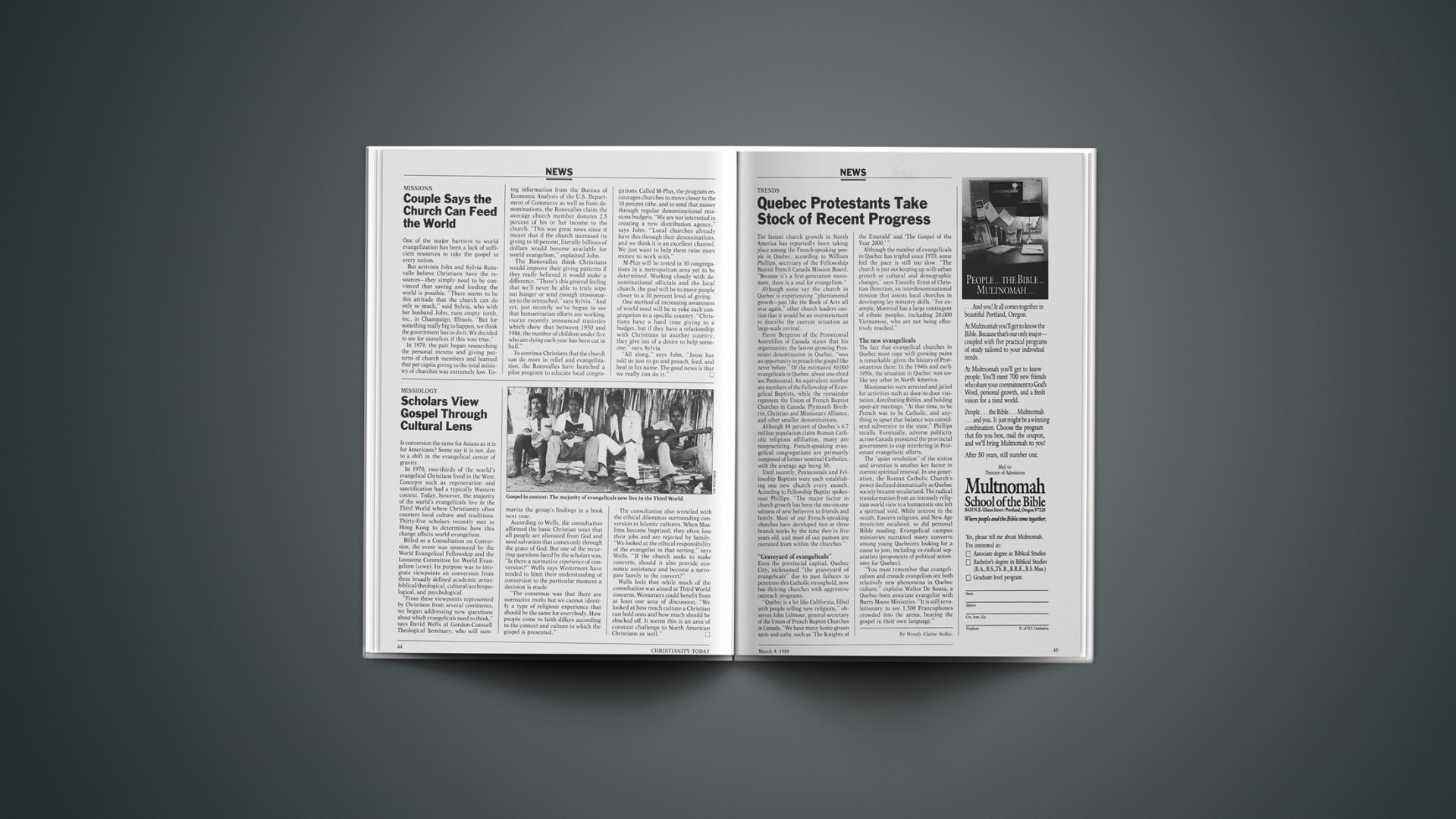
In 1970, two-thirds of the world’s evangelical Christians lived in the West. Concepts such as regeneration and sanctification had a typically Western context. Today, however, the majority of the world’s evangelicals live in the Third World where Christianity often counters local culture and traditions. Thirty-five scholars recently met in Hong Kong to determine how this change affects world evangelism.
Billed as a Consultation on Conversion, the event was sponsored by the World Evangelical Fellowship and the Lausanne Committee for World Evangelism (LCWE). Its purpose was to integrate viewpoints on conversion from three broadly defined academic areas: biblical/theological, cultural/anthropological, and psychological.
“From these viewpoints represented by Christians from several continents, we began addressing new questions about which evangelicals need to think,” says David Wells of Gordon-Conwell Theological Seminary, who will summarize the group’s findings in a book next year.
According to Wells, the consultation affirmed the basic Christian tenet that all people are alienated from God and need salvation that comes only through the grace of God. But one of the recurring questions faced by the scholars was, “Is there a normative experience of conversion?” Wells says Westerners have tended to limit their understanding of conversion to the particular moment a decision is made.
“The consensus was that there are normative truths but we cannot identify a type of religious experience that should be the same for everybody. How people come to faith differs according to the context and culture in which the gospel is presented.”
The consultation also wrestled with the ethical dilemmas surrounding conversion in Islamic cultures. When Muslims become baptized, they often lose their jobs and are rejected by family. “We looked at the ethical responsibility of the evangelist in that setting,” says Wells. “If the church seeks to make converts, should it also provide economic assistance and become a surrogate family to the convert?”
Wells feels that while much of the consultation was aimed at Third World concerns, Westerners could benefit from at least one area of discussion. “We looked at how much culture a Christian can hold onto and how much should be shucked off. It seems this is an area of constant challenge to North American Christians as well.”







