
NIGERIA
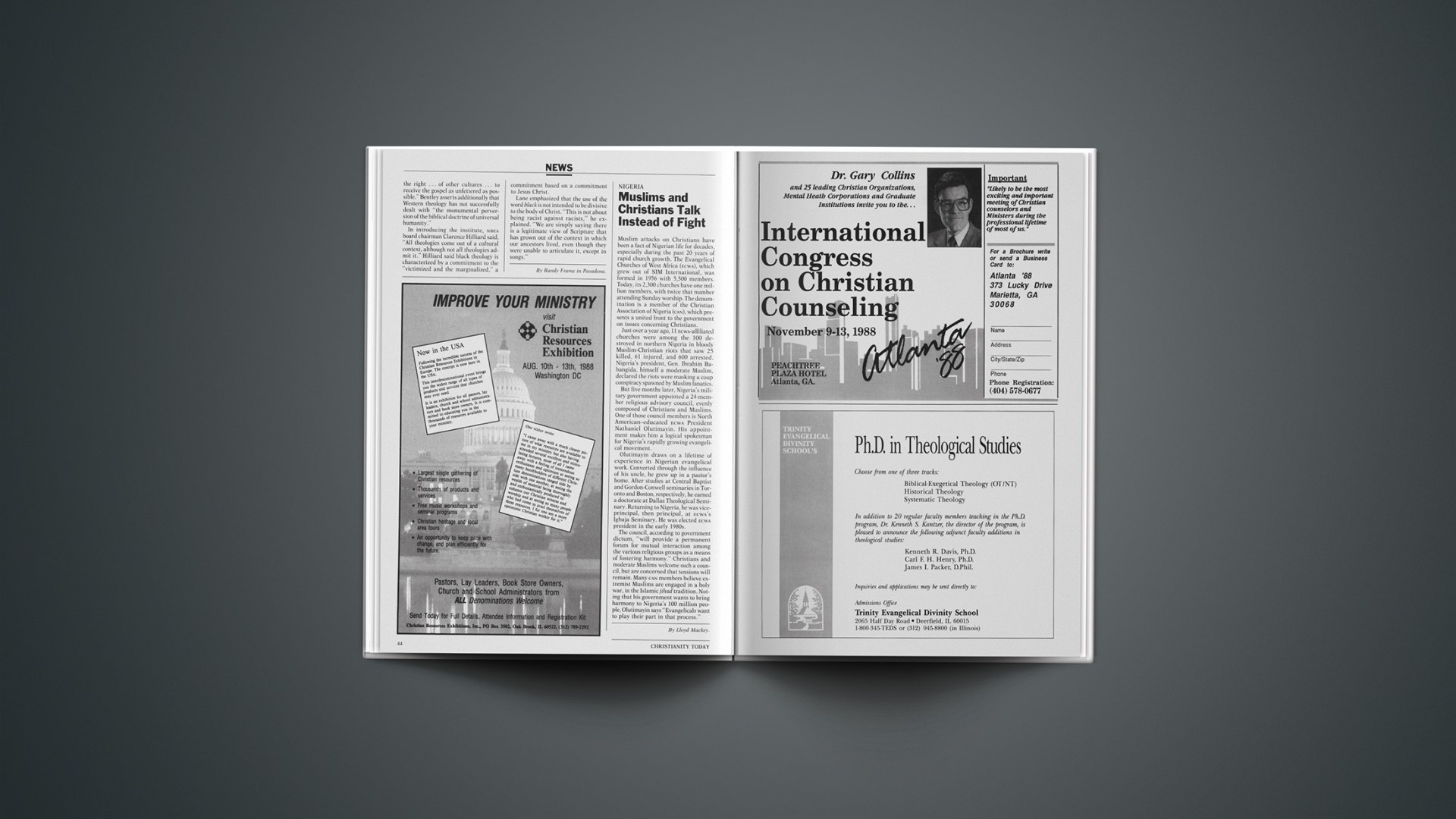
Muslim attacks on Christians have been a fact of Nigerian life for decades, especially during the past 20 years of rapid church growth. The Evangelical Churches of West Africa (ECWA), which grew out of SIM International, was formed in 1956 with 5,500 members. Today, its 2,300 churches have one million members, with twice that number attending Sunday worship. The denomination is a member of the Christian Association of Nigeria (CAN), which presents a united front to the government on issues concerning Christians.
Just over a year ago, 11 ECWA-affiliated churches were among the 100 destroyed in northern Nigeria in bloody Muslim-Christian riots that saw 25 killed, 61 injured, and 600 arrested. Nigeria’s president, Gen. Ibrahim Babangida, himself a moderate Muslim, declared the riots were masking a coup conspiracy spawned by Muslim fanatics.
But five months later, Nigeria’s military government appointed a 24-member religious advisory council, evenly composed of Christians and Muslims. One of those council members is North American-educated ECWA President Nathaniel Olutimayin. His appointment makes him a logical spokesman for Nigeria’s rapidly growing evangelical movement.
Olutimayin draws on a lifetime of experience in Nigerian evangelical work. Converted through the influence of his uncle, he grew up in a pastor’s home. After studies at Central Baptist and Gordon-Conwell seminaries in Toronto and Boston, respectively, he earned a doctorate at Dallas Theological Seminary. Returning to Nigeria, he was viceprincipal, then principal, at ECWA’s Igbaja Seminary. He was elected ECWA president in the early 1980s.
The council, according to government dictum, “will provide a permanent forum for mutual interaction among the various religious groups as a means of fostering harmony.” Christians and moderate Muslims welcome such a council, but are concerned that tensions will remain. Many can members believe extremist Muslims are engaged in a holy war, in the Islamic jihad tradition. Noting that his government wants to bring harmony to Nigeria’s 100 million people, Olutimayin says “Evangelicals want to play their part in that process.”
By Lloyd Mackey.