





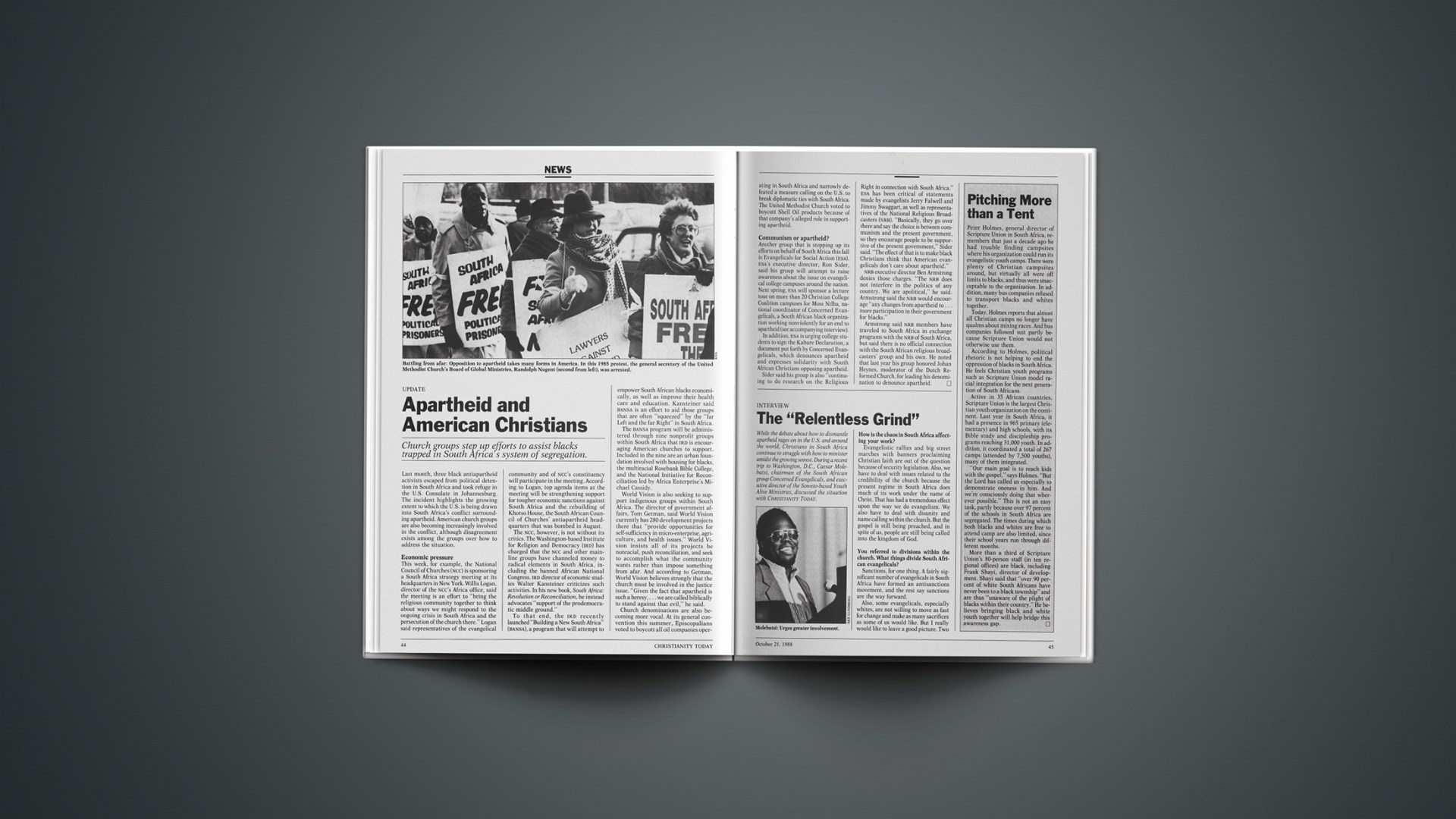
INTERVIEW
While the debate about how to dismantle apartheid rages on in the U.S. and around the world, Christians in South Africa continue to struggle with how to minister amidst the growing unrest. During a recent trip to Washington, D.C., Caesar Molebatsi, chairman of the South African group Concerned Evangelicals, and executive director of the Soweto-based Youth Alive Ministries, discussed the situation with CHRISTIANITY TODAY.
How is the chaos in South Africa affecting your work?
Evangelistic rallies and big street marches with banners proclaiming Christian faith are out of the question because of security legislation. Also, we have to deal with issues related to the credibility of the church because the present regime in South Africa does much of its work under the name of Christ. That has had a tremendous effect upon the way we do evangelism. We also have to deal with disunity and name calling within the church. But the gospel is still being preached, and in spite of us, people are still being called into the kingdom of God.
You referred to divisions within the church. What things divide South African evangelicals?
Sanctions, for one thing. A fairly significant number of evangelicals in South Africa have formed an antisanctions movement, and the rest say sanctions are the way forward.
Also, some evangelicals, especially whites, are not willing to move as fast for change and make as many sacrifices as some of us would like. But I really would like to leave a good picture. Two white-initiated and primarily white-led groups—the National Initiative for Reconciliation and Koinonia—have opened a channel of communication between whites and blacks. They are outstanding groups with a really strong evangelical thrust.
What aspects of the current situation do you find most difficult to deal with?
The relentless grinding on of the machine of apartheid sometimes seems unstoppable. A lot of prophets who are trying to stand up for God’s standards of righteousness and justice have become casualties. It is very sad.
What kind of support from American Christians is most helpful to you and other Christians in South Africa?
It would be a great help to us if Americans could take a deeper look at their own politics in terms of their theology. The South African government has very clearly identified itself as a Christian government, and this has unfortunately paralyzed some American evangelicals.
What concrete steps would you like to see taken in this area?
I wish the American evangelical community would very clearly declare its position against apartheid. In South Africa, white American evangelical support for apartheid is quite frankly taken for granted. We are shocked when American Christians come to South Africa and say they don’t believe in what the government is doing. American Christians should help empower people in South Africa who are most capable to bring about change; at this time, I believe those to be the blacks. The South African government has lost the will to change.
Some Christians have criticized you for being involved with some of the liberal church efforts in South Africa. How do you respond to those criticisms?
When other evangelicals and I go to the liberal meetings, we are always standing up saying, “Listen, what about the Bible? What are you saying about Christ and the Cross?” Those of us who are really evangelical and are concerned that the evangelical mission cannot be allowed to be swamped by liberal theology have to make our own clear-cut evangelical statement to show the depth of evangelical understanding.
Yes, people accuse me of being too soft on liberal theology. But I look at my accusers, and I see them fudging on so many things—like their lifestyle, for one thing. In South Africa, if you are an evangelical, you had better know your theology. If not, you cannot withstand the liberal onslaught.







