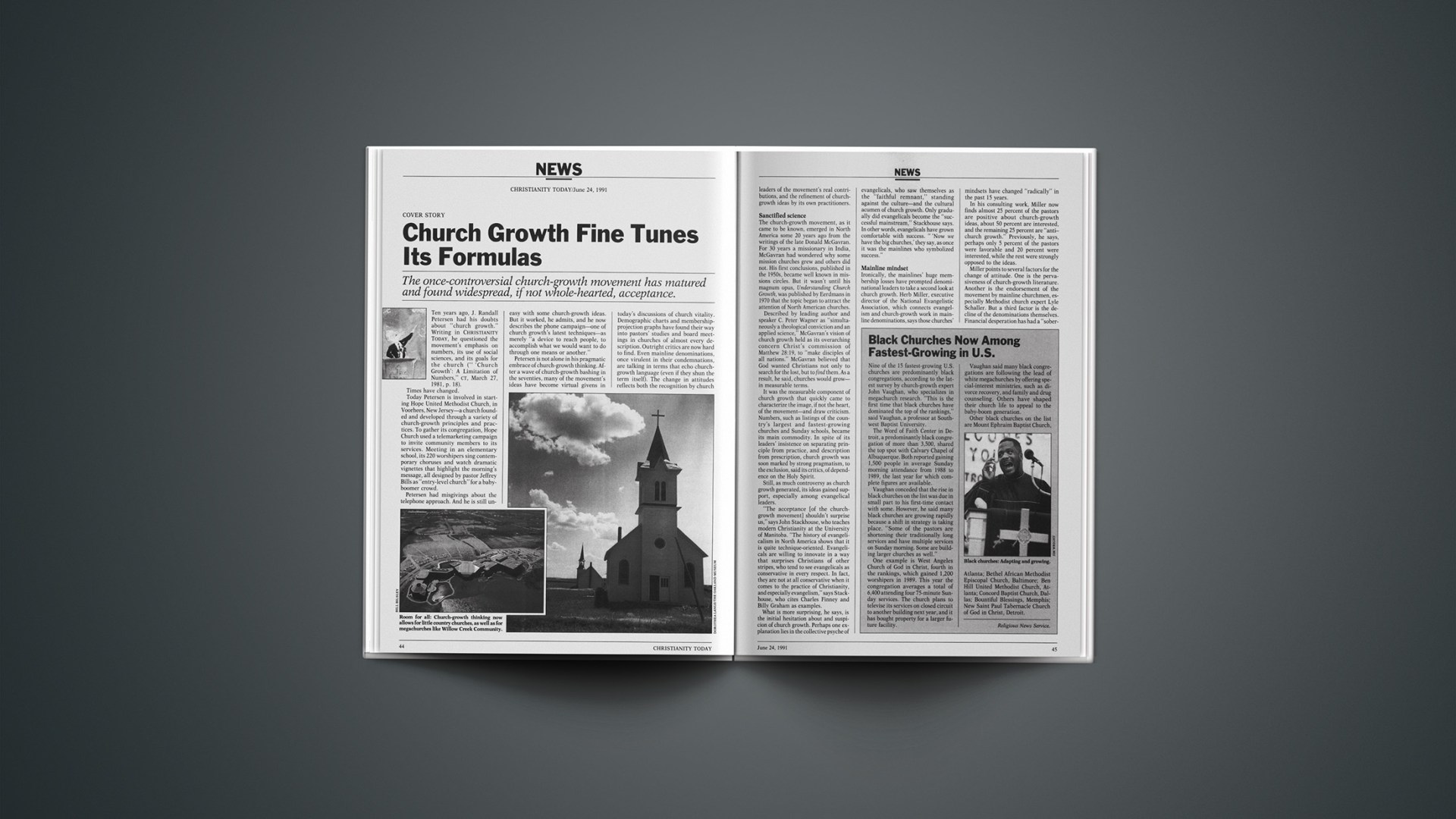

Nine of the 15 fastest-growing U.S. churches are predominantly black congregations, according to the latest survey by church-growth expert John Vaughan, who specializes in megachurch research. “This is the first time that black churches have dominated the top of the rankings,” said Vaughan, a professor at Southwest Baptist University.
The Word of Faith Center in Detroit, a predominantly black congregation of more than 3,500, shared the top spot with Calvary Chapel of Albuquerque. Both reported gaining 1,500 people in average Sunday morning attendance from 1988 to 1989, the last year for which complete figures are available.
Vaughan conceded that the rise in black churches on the list was due in small part to his first-time contact with some. However, he said many black churches are growing rapidly because a shift in strategy is taking place. “Some of the pastors are shortening their traditionally long services and have multiple services on Sunday morning. Some are building larger churches as well.”
One example is West Angeles Church of God in Christ, fourth in the rankings, which gained 1,200 worshipers in 1989. This year the congregation averages a total of 6,400 attending four 75-minute Sunday services. The church plans to televise its services on closed circuit to another building next year, and it has bought property for a larger future facility.
Vaughan said many black congregations are following the lead of white megachurches by offering special-interest ministries, such as divorce recovery, and family and drug counseling. Others have shaped their church life to appeal to the baby-boom generation.
Other black churches on the list are Mount Ephraim Baptist Church, Atlanta; Bethel African Methodist Episcopal Church, Baltimore; Ben Hill United Methodist Church, Atlanta; Concord Baptist Church, Dallas; Bountiful Blessings, Memphis; New Saint Paul Tabernacle Church of God in Christ, Detroit.
Religious News Service.
Meta-church: Cells + Celebration
Leading church-growth expert C. Peter Wagner calls the “meta-church” concept “the most important innovation developed in the church-growth movement since McGavran’s work.” But what is meta-church?
Carl George, director of the Charles E. Fuller Institute of Evangelism and Church Growth, who developed the model, says the term signifies both a change of church infrastructure and perspective. Meta-church life revolves around two events: the meeting of small groups, or cells; and corporate worship, or celebration.
Some 15 years ago, Peter Wagner’s equation read “Cells + Congregation + Celebration = Church.” What has changed most dramatically, George says, is the idea that a single pastor, or even pastoral staff, can provide the “high-touch” care needed by modern parishioners.
In the meta-church, “clergy are no longer the primary care givers,” says George, “except to fellow staff and to a group of key lay ‘coaches.’ What propels a meta-church is the work of the Holy Spirit through home discipleship centers. They are affinity based, spiritual-gift dependent, lay shepherded, supervised, evangelistic, and self-reproducing. Virtually all ministry is decentralized to these groups,” he explains.
Gone is the notion of congregation. “The key factor is now 10 [the size of a typical cell group], not hundreds,” George says. “With that as its basis, a church’s growth is virtually unlimited, yet it can maintain high-quality spiritual and emotional care for each individual.”