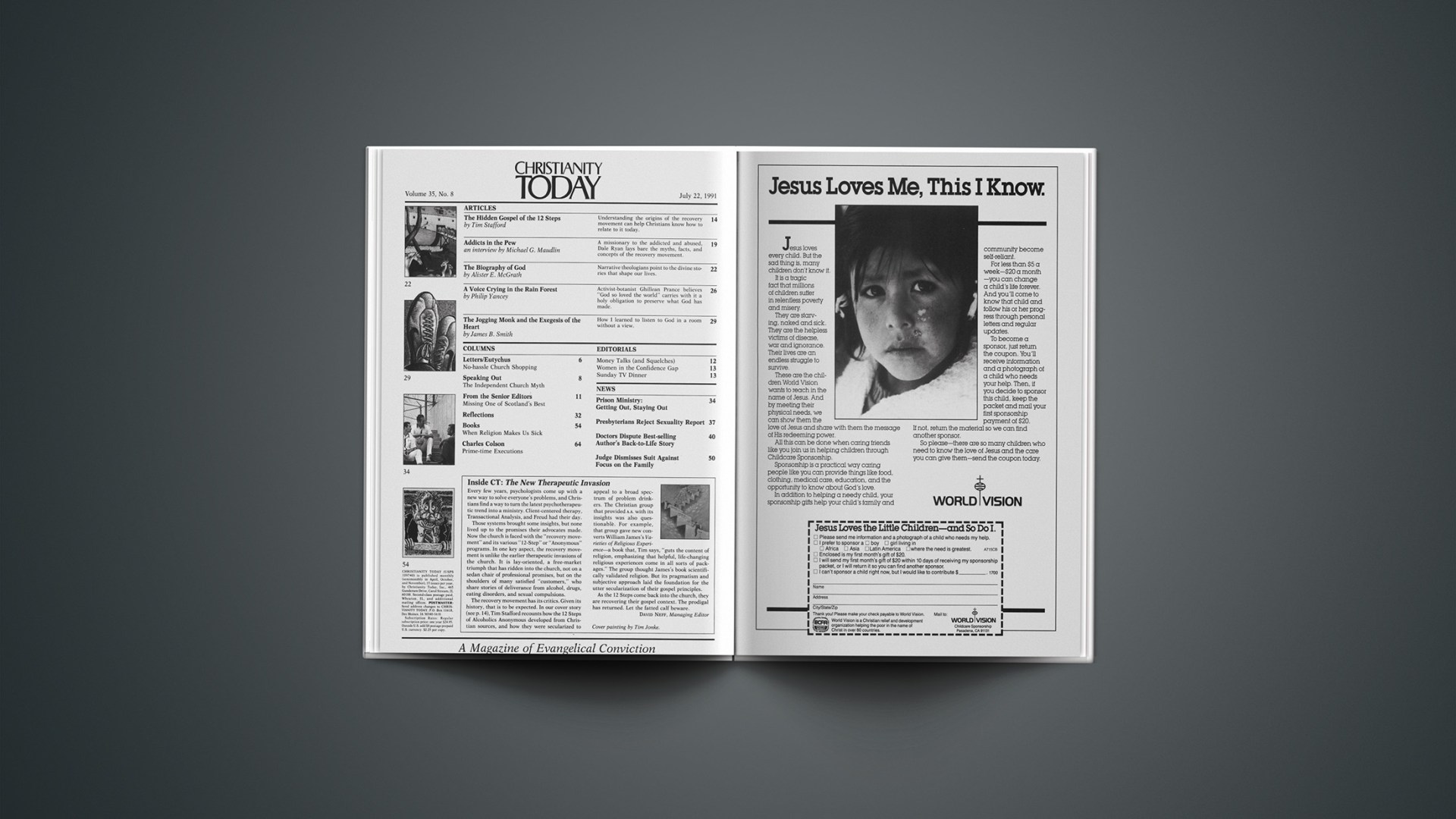
The New Therapeutic Invasion

Every few years, psychologists come up with a new way to solve everyone’s problems, and Christians find a way to turn the latest psychotherapeutic trend into a ministry. Client-centered therapy, Transactional Analysis, and Freud had their day.

Those systems brought some insights, but none lived up to the promises their advocates made. Now the church is faced with the “recovery movement” and its various “12-Step” or “Anonymous” programs. In one key aspect, the recovery movement is unlike the earlier therapeutic invasions of the church. It is lay-oriented, a free-market triumph that has ridden into the church, not on a sedan chair of professional promises, but on the shoulders of many satisfied “customers,” who share stories of deliverance from alcohol, drugs, eating disorders, and sexual compulsions.

The recovery movement has its critics. Given its history, that is to be expected. In our cover story (see p. 14), Tim Stafford recounts how the 12 Steps of Alcoholics Anonymous developed from Christian sources, and how they were secularized to appeal to a broad spectrum of problem drinkers. The Christian group that provided A.A. with its insights was also questionable. For example, that group gave new converts William James’s Varieties of Religious Experience—a book that, Tim says, “guts the content of religion, emphasizing that helpful, life-changing religious experiences come in all sorts of packages.” The group thought James’s book scientifically validated religion. But its pragmatism and subjective approach laid the foundation for the utter secularization of their gospel principles.

As the 12 Steps come back into the church, they are recovering their gospel context. The prodigal has returned. Let the fatted calf beware.

DAVID NEFF, Managing Editor

Also in this issue

The CT archives are a rich treasure of biblical wisdom and insight from our past. Some things we would say differently today, and some stances we've changed. But overall, we're amazed at how relevant so much of this content is. We trust that you'll find it a helpful resource.

Our Latest

News

Displaced Ukrainian Pastor Ministers to the War’s Lost Teens

“Almost everybody has lost somebody, and quite a few people have lost very much.”

So What If the Bible Doesn’t Mention Embryo Screening?

Silence from Scripture on new technologies and the ethical questions they raise is no excuse for silence from the church.

The Chinese Evangelicals Turning to Orthodoxy

Yinxuan Huang

More believers from China and Taiwan are finding Eastern Christianity appealing. I sought to uncover why.

Archaeology in the City of David Yields New Treasures

Gordon Govier

Controversial excavation in Jerusalem reveals new links to the biblical record.

Review

Apologetics Can Be a Balm—or Bludgeon

Daryn Henry

A new history of American apologetics from Daniel K. Williams offers careful detail, worthwhile lessons, and an ambitious, sprawling, rollicking narrative.

Hold the Phone?

Anna Mares

Faced with encouragement to lessen technology use, younger Christians with far-flung families wonder how to stay connected.

Norman Podhoretz Leaves a Legacy of Political Principle

Michael Cosper

The Jewish intellectual upheld the Judeo-Christian tradition.

The Russell Moore Show

Joseph Loconte on the War for Middle-Earth

What if the most decisive battles in our time aren’t fought with ballots or bombs—but with the imagination?

Apple PodcastsDown ArrowDown ArrowDown Arrowarrow_left_altLeft ArrowLeft ArrowRight ArrowRight ArrowRight Arrowarrow_up_altUp ArrowUp ArrowAvailable at Amazoncaret-downCloseCloseEmailEmailExpandExpandExternalExternalFacebookfacebook-squareGiftGiftGooglegoogleGoogle KeephamburgerInstagraminstagram-squareLinkLinklinkedin-squareListenListenListenChristianity TodayCT Creative Studio Logologo_orgMegaphoneMenuMenupausePinterestPlayPlayPocketPodcastRSSRSSSaveSaveSaveSearchSearchsearchSpotifyStitcherTelegramTable of ContentsTable of Contentstwitter-squareWhatsAppXYouTubeYouTube