
Pastors turning to corporate America for help.
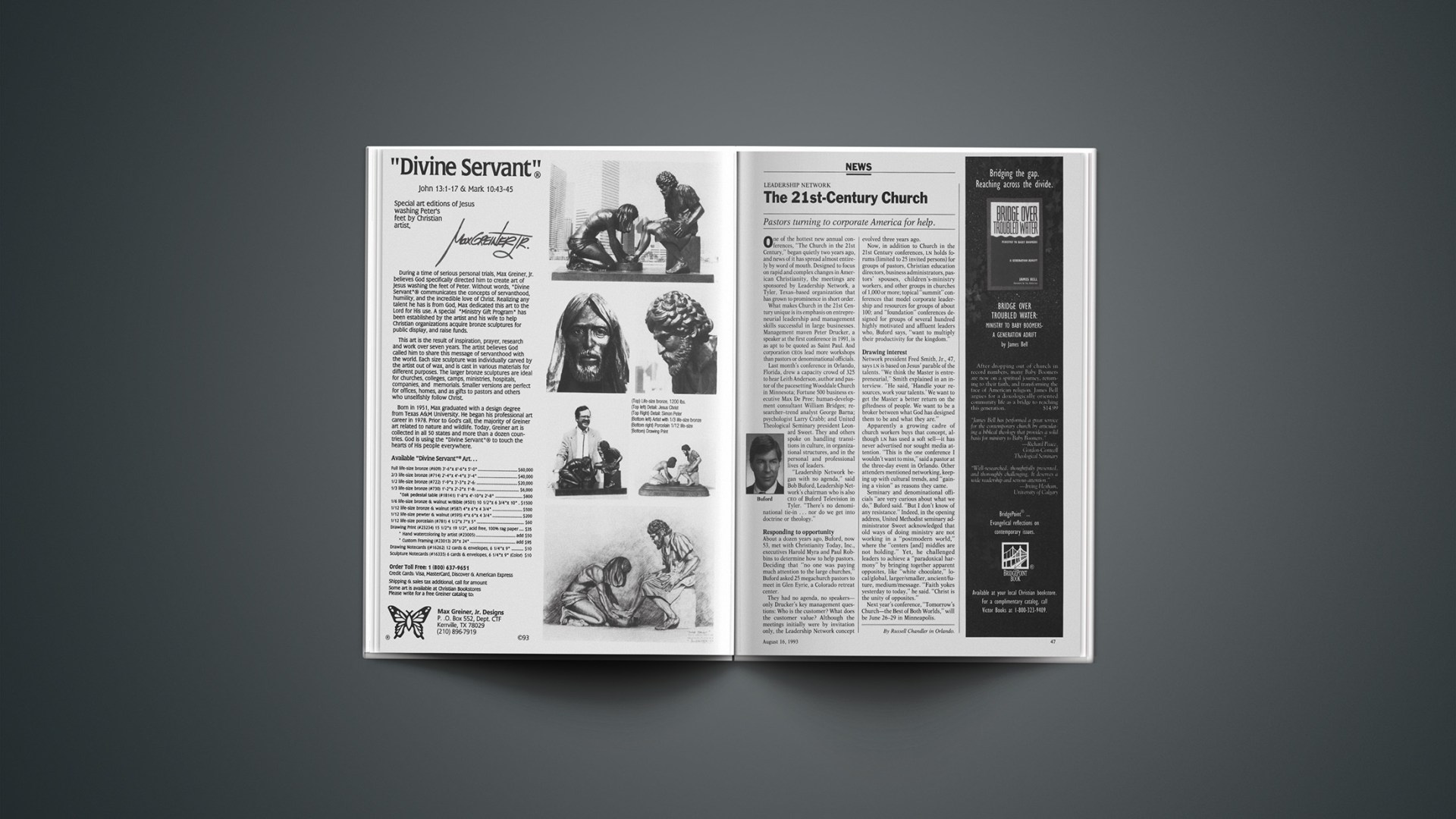
One of the hottest new annual conferences, “The Church in the 21st Century,” began quietly two years ago, and news of it has spread almost entirely by word of mouth. Designed to focus on rapid and complex changes in American Christianity, the meetings are sponsored by Leadership Network, a Tyler, Texas-based organization that has grown to prominence in short order.
What makes Church in the 21st Century unique is its emphasis on entrepreneurial leadership and management skills successful in large businesses. Management maven Peter Drucker, a speaker at the first conference in 1991, is as apt to be quoted as Saint Paul. And corporation CEOs lead more workshops than pastors or denominational officials.
Last month’s conference in Orlando, Florida, drew a capacity crowd of 325 to hear Leith Anderson, author and pastor of the pacesetting Wooddale Church in Minnesota; Fortune 500 business executive Max De Pree; human-development consultant William Bridges; researcher-trend analyst George Barna; psychologist Larry Crabb; and United Theological Seminary president Leonard Sweet. They and others spoke on handling transitions in culture, in organizational structures, and in the personal and professional lives of leaders.
“Leadership Network began with no agenda,” said Bob Buford, Leadership Network’s chairman who is also CEO of Buford Television in Tyler. “There’s no denominational tie-in … nor do we get into doctrine or theology.”
Responding to opportunity
About a dozen years ago, Buford, now 53, met with Christianity Today, Inc., executives Harold Myra and Paul Robbins to determine how to help pastors. Deciding that “no one was paying much attention to the large churches,” Buford asked 25 megachurch pastors to meet in Glen Eyrie, a Colorado retreat center.
They had no agenda, no speakers—only Drucker’s key management questions: Who is the customer? What does the customer value? Although the meetings initially were by invitation only, the Leadership Network concept evolved three years ago.
Now, in addition to Church in the 21st Century conferences, LN holds forums (limited to 25 invited persons) for groups of pastors, Christian education directors, business administrators, pastors’ spouses, children’s-ministry workers, and other groups in churches of 1,000 or more; topical “summit” conferences that model corporate leadership and resources for groups of about 100; and “foundation” conferences designed for groups of several hundred highly motivated and affluent leaders who, Buford says, “want to multiply their productivity for the kingdom.”
Drawing interest
Network president Fred Smith, Jr., 47, says LN is based on Jesus’ parable of the talents. “We think the Master is entrepreneurial,” Smith explained in an interview. “He said, ‘Handle your resources, work your talents.’ We want to get the Master a better return on the giftedness of people. We want to be a broker between what God has designed them to be and what they are.”
Apparently a growing cadre of church workers buys that concept, although LN has used a soft sell—it has never advertised nor sought media attention. “This is the one conference I wouldn’t want to miss,” said a pastor at the three-day event in Orlando. Other attenders mentioned networking, keeping up with cultural trends, and “gaining a vision” as reasons they came.
Seminary and denominational officials “are very curious about what we do,” Buford said. “But I don’t know of any resistance.” Indeed, in the opening address, United Methodist seminary administrator Sweet acknowledged that old ways of doing ministry are not working in a “postmodern world,” where the “centers [and] middles are not holding.” Yet, he challenged leaders to achieve a “paradoxical harmony” by bringing together apparent opposites, like “white chocolate,” local/global, larger/smaller, ancient/future, medium/message. “Faith yokes yesterday to today,” he said. “Christ is the unity of opposites.”
Next year’s conference, “Tomorrow’s Church—the Best of Both Worlds,” will be June 26–29 in Minneapolis.
By Russell Chandler in Orlando.