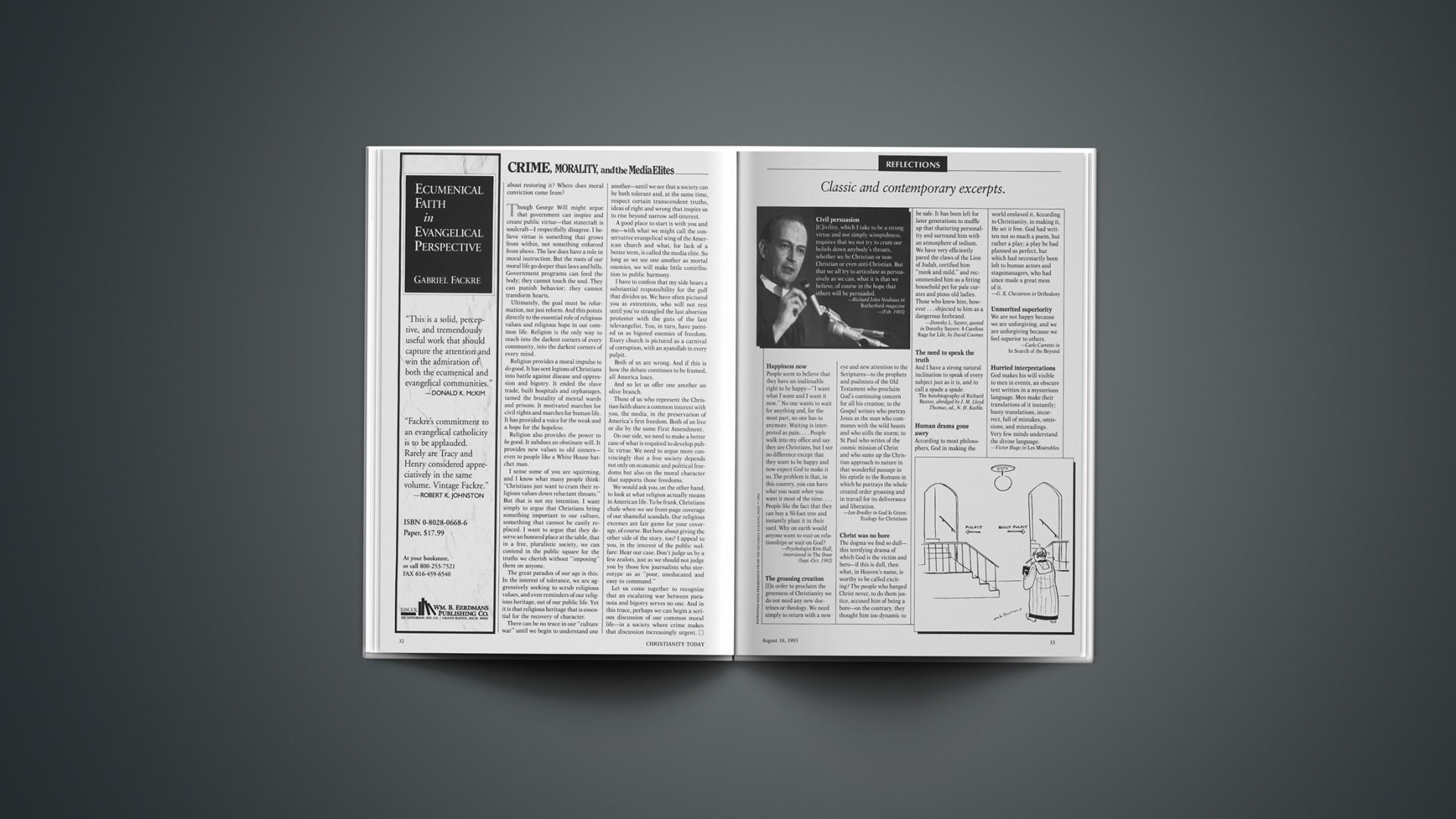

Classic and contemporary excerpts
Civil persuasion
[C]ivility, which I take to be a strong virtue and not simply wimpishness, requires that we not try to cram our beliefs down anybody’s throats, whether we be Christian or non-Christian or even anti-Christian. But that we all try to articulate as persuasively as we can, what it is that we believe, of course in the hope that others will be persuaded.
—Richard John Neuhaus in Rutherford magazine
—(Feb. 1993)
Happiness now
People seem to believe that they have an inalienable right to be happy—“I want what I want and I want it now.” No one wants to wait for anything and, for the most part, no one has to anymore. Waiting is interpreted as pain.… People walk into my office and say they are Christians, but I see no difference except that they want to be happy and now expect God to make it so. The problem is that, in this country, you can have what you want when you want it most of the time.… People like the fact that they can buy a 50-foot tree and instantly plant it in their yard. Why on earth would anyone want to wait on relationships or wait on God?
—Psychologist Kim Hall,
interviewed in The Door
(Sept.–Oct. 1992)
The groaning creation
[I]n order to proclaim the greenness of Christianity we do not need any new doctrines or theology. We need simply to return with a new eye and new attention to the Scriptures—to the prophets and psalmists of the Old Testament who proclaim God’s continuing concern for all his creation; to the Gospel writers who portray Jesus as the man who communes with the wild beasts and who stills the storm; to St Paul who writes of the cosmic mission of Christ and who sums up the Christian approach to nature in that wonderful passage in his epistle to the Romans in which he portrays the whole created order groaning and in travail for its deliverance and liberation.
—Ian Bradley in God Is Green:
Ecology for Christians
Christ was no bore
The dogma we find so dull—this terrifying drama of which God is the victim and hero—if this is dull, then what, in Heaven’s name, is worthy to be called exciting? The people who hanged Christ never, to do them justice, accused him of being a bore—on the contrary, they thought him too dynamic to be safe. It has been left for later generations to muffle up that shattering personality and surround him with an atmosphere of tedium. We have very efficiently pared the claws of the Lion of Judah, certified him “meek and mild,” and recommended him as a fitting household pet for pale curates and pious old ladies. Those who knew him, however … objected to him as a dangerous firebrand.
—Dorothy L. Sayers, quoted
in Dorothy Sayers: A Careless
Rage for Life, by David Coomes
The need to speak the truth
And I have a strong natural inclination to speak of every subject just as it is, and to call a spade a spade.
The Autobiography of Richard Baxter, abridged by J. M. Lloyd
Thomas, ed., N. H. Keeble.
Human drama gone awry
According to most philosophers, God in making the world enslaved it. According to Christianity, in making it, He set it free. God had written not so much a poem, but rather a play; a play he had planned as perfect, but which had necessarily been left to human actors and stagemanagers, who had since made a great mess of it.
—G. K. Chesterton in Orthodoxy
Unmerited superiority
We are not happy because we are unforgiving, and we are unforgiving because we feel superior to others.
—Carlo Carretto in
In Search of the Beyond
Hurried interpretations
God makes his will visible to men in events, an obscure text written in a mysterious language. Men make their translations of it instantly; hasty translations, incorrect, full of mistakes, omissions, and misreadings. Very few minds understand the divine language.
—Victor Hugo in Les Misérables