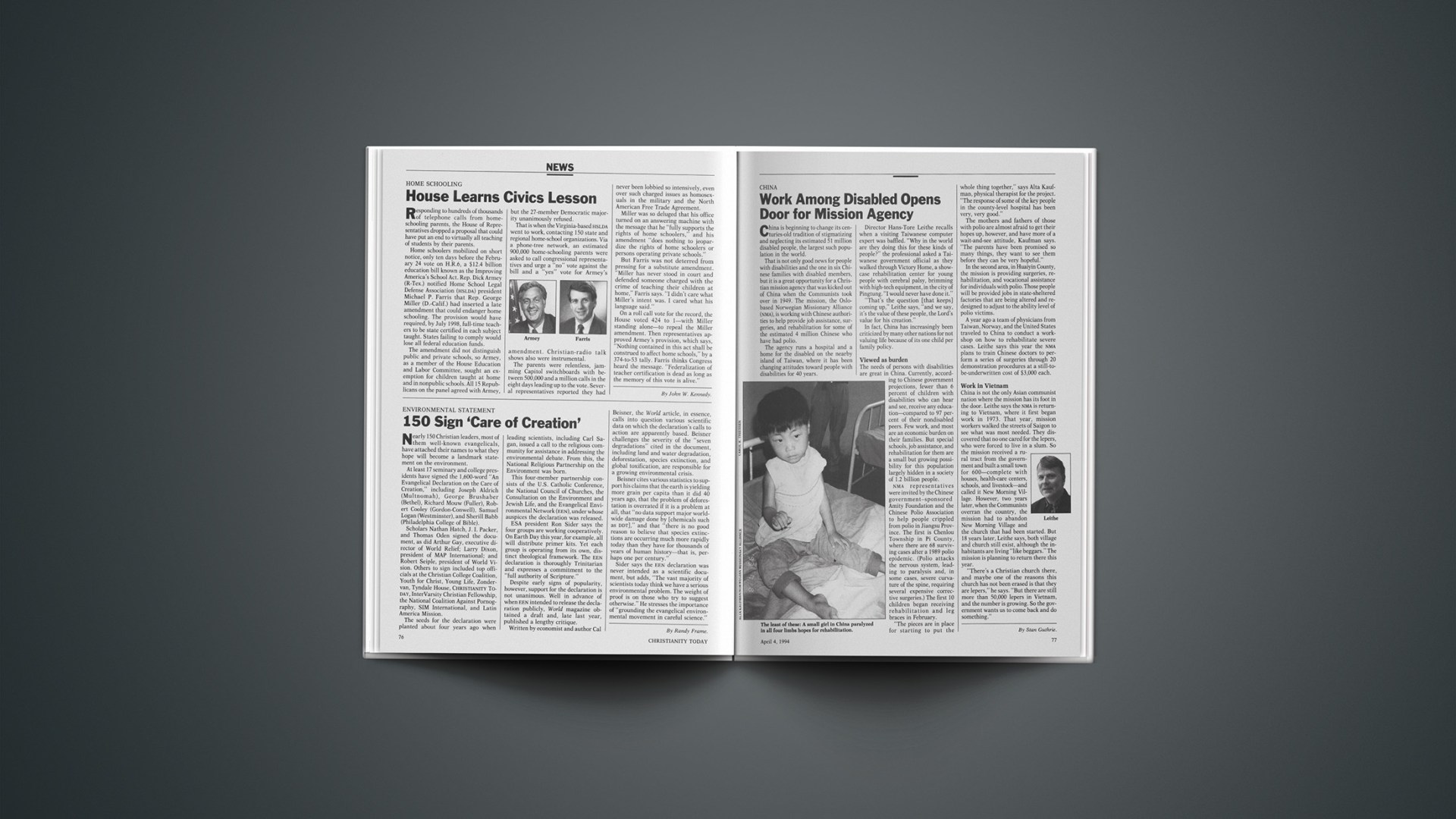

Responding to hundreds of thousands of telephone calls from home-schooling parents, the House of Representatives dropped a proposal that could have put an end to virtually all teaching of students by their parents.
Home schoolers mobilized on short notice, only ten days before the February 24 vote on H.R.6, a $12.4 billion education bill known as the Improving America’s School Act. Rep. Dick Armey (R-Tex.) notified Home School Legal Defense Association (HSLDA) president Michael P. Farris that Rep. George Miller (D.-Calif.) had inserted a late amendment that could endanger home schooling. The provision would have required, by July 1998, full-time teachers to be state certified in each subject taught. States failing to comply would lose all federal education funds.
The amendment did not distinguish public and private schools, so Armey, as a member of the House Education and Labor Committee, sought an exemption for children taught at home and in nonpublic schools. All 15 Republicans on the panel agreed with Armey, but the 27-member Democratic majority unanimously refused.
That is when the Virginia-based HSLDA went to work, contacting 150 state and regional home-school organizations. Via a phone-tree network, an estimated 900,000 home-schooling parents were asked to call congressional representatives and urge a “no” vote against the bill and a “yes” vote for Armey’s amendment. Christian-radio talk shows also were instrumental.
The parents were relentless, jamming Capitol switchboards with between 500,000 and a million calls in the eight days leading up to the vote. Several representatives reported they had never been lobbied so intensively, even over such charged issues as homosexuals in the military and the North American Free Trade Agreement.
Miller was so deluged that his office turned on an answering machine with the message that he “fully supports the rights of home schoolers,” and his amendment “does nothing to jeopardize the rights of home schoolers or persons operating private schools.”
But Farris was not deterred from pressing for a substitute amendment. “Miller has never stood in court and defended someone charged with the crime of teaching their children at home,” Farris says. “I didn’t care what Miller’s intent was. I cared what his language said.”
On a roll call vote for the record, the House voted 424 to 1—with Miller standing alone—to repeal the Miller amendment. Then representatives approved Armey’s provision, which says, “Nothing contained in this act shall be construed to affect home schools,” by a 374-to-53 tally. Farris thinks Congress heard the message. “Federalization of teacher certification is dead as long as the memory of this vote is alive.”
By John W. Kennedy.