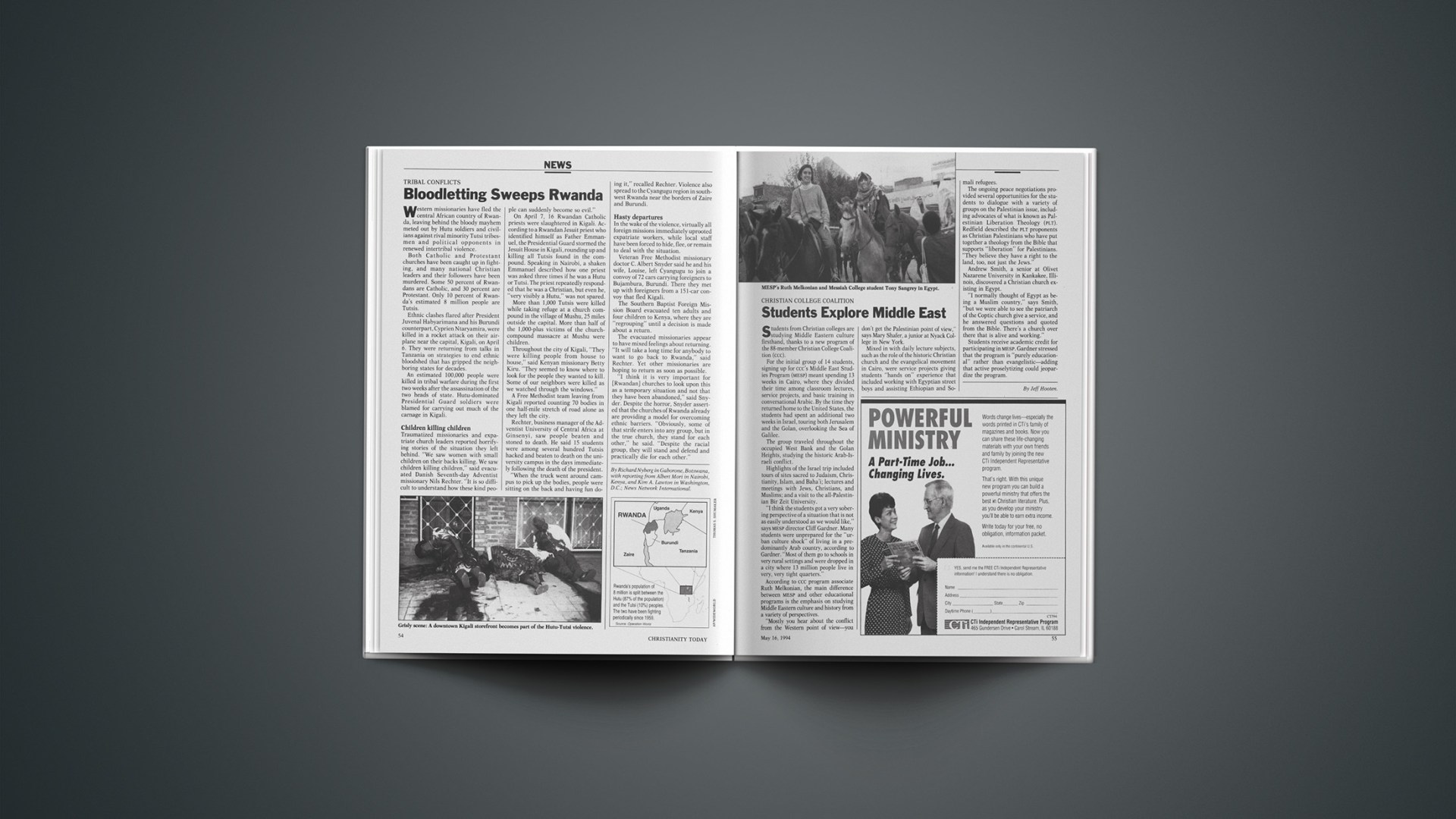
Students from Christian colleges are studying Middle Eastern culture firsthand, thanks to a new program of the 88-member Christian College Coalition (CCC).
For the initial group of 14 students, signing up for CCC’s Middle East Studies Program (MESP) meant spending 13 weeks in Cairo, where they divided their time among classroom lectures, service projects, and basic training in conversational Arabic. By the time they returned home to the United States, the students had spent an additional two weeks in Israel, touring both Jerusalem and the Golan, overlooking the Sea of Galilee.
The group traveled throughout the occupied West Bank and the Golan Heights, studying the historic Arab-Israeli conflict.
Highlights of the Israel trip included tours of sites sacred to Judaism, Christianity, Islam, and Baha’i; lectures and meetings with Jews, Christians, and Muslims; and a visit to the all-Palestinian Bir Zeit University.
“I think the students got a very sobering perspective of a situation that is not as easily understood as we would like,” says MESP director Cliff Gardner. Many students were unprepared for the “urban culture shock” of living in a predominantly Arab country, according to Gardner. “Most of them go to schools in very rural settings and were dropped in a city where 13 million people live in very, very tight quarters.”
According to CCC program associate Ruth Melkonian, the main difference between MESP and other educational programs is the emphasis on studying Middle Eastern culture and history from a variety of perspectives.
“Mostly you hear about the conflict from the Western point of view—you don’t get the Palestinian point of view,” says Mary Shafer, a junior at Nyack College in New York.
Mixed in with daily lecture subjects, such as the role of the historic Christian church and the evangelical movement in Cairo, were service projects giving students “hands on” experience that included working with Egyptian street boys and assisting Ethiopian and Somali refugees.
The ongoing peace negotiations provided several opportunities for the students to dialogue with a variety of groups on the Palestinian issue, including advocates of what is known as Palestinian Liberation Theology (PLT). Redfield described the PLT proponents as Christian Palestinians who have put together a theology from the Bible that supports “liberation” for Palestinians. “They believe they have a right to the land, too, not just the Jews.”
Andrew Smith, a senior at Olivet Nazarene University in Kankakee, Illinois, discovered a Christian church existing in Egypt.
“I normally thought of Egypt as being a Muslim country,” says Smith, “but we were able to see the patriarch of the Coptic church give a service, and he answered questions and quoted from the Bible. There’s a church over there that is alive and working.”
Students receive academic credit for participating in MESP. Gardner stressed that the program is “purely educational” rather than evangelistic—adding that active proselytizing could jeopardize the program.
By Jeff Hooten.