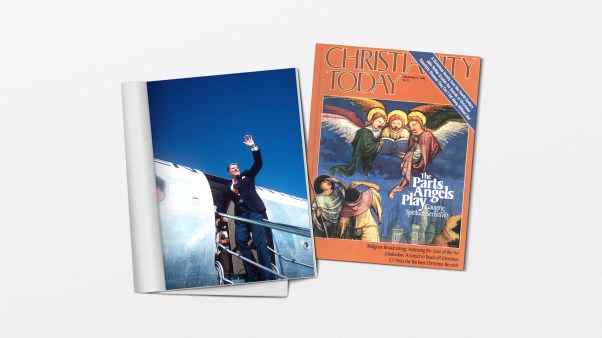

Fifty-one years after graduating from Wheaton College, 75-year-old Billy Graham returned to the suburban Chicago campus for the May dedication of the renovated Billy Graham Center Museum.
The museum, housed in the four-story Graham Center, contains exhibits spotlighting four decades of Graham’s ministry and a broad history of evangelism.
The six-month refurbishing effort—the first since the museum opened in 1980—adds several permanent pieces to the museum’s collection, including sermon notes from a Graham crusade and a specially designed pulpit used during rallies.
The result is a dazzling tribute to Graham’s legacy, which is exactly what has the modest evangelist concerned. “There’s too much Billy in here,” he said solemnly, while touring the new facility. “There needs to be more of the Lord.”
Before the ceremony, Graham reminisced about his years at Wheaton College, meeting his wife, Ruth, at the school, and his early days of ministry in the Chicago area. “It was here that I held my first pastorate and aired my first radio program.”
REACHING A NEW AUDIENCE
A half-century of ministry has not changed his theology, Graham said, but it has caused him to rethink his strategies. This month’s crusade in Cleveland is evidence. The event includes special rallies aimed at younger crowds. Graham hopes to bring the gospel to a new audience by forgoing a pulpit and shelving his suit and tie for a more casual look. The golden melodies of George Beverly Shea, Graham’s longtime soloist, also are being temporarily exchanged for the hip-hop rhythms of Christian rap artists DC Talk.
“I used to say take a newspaper in one hand and a Bible in the other and go preach the gospel,” he said. “Today I’d say take a television set and a radio—you have to be relevant.”
The evangelist, who joked that he and his wife had contributed to the world’s population with five children and more than 20 grandchildren, voiced particular concern for today’s younger generation. “They face both a darker and a brighter future,” he said.
“We see evil getting worse because we have new ways to do evil. However, we also see good getting better. I don’t know a time in my life when people wanted to help each other as much as they do today.”
By Edward Gilbreath.