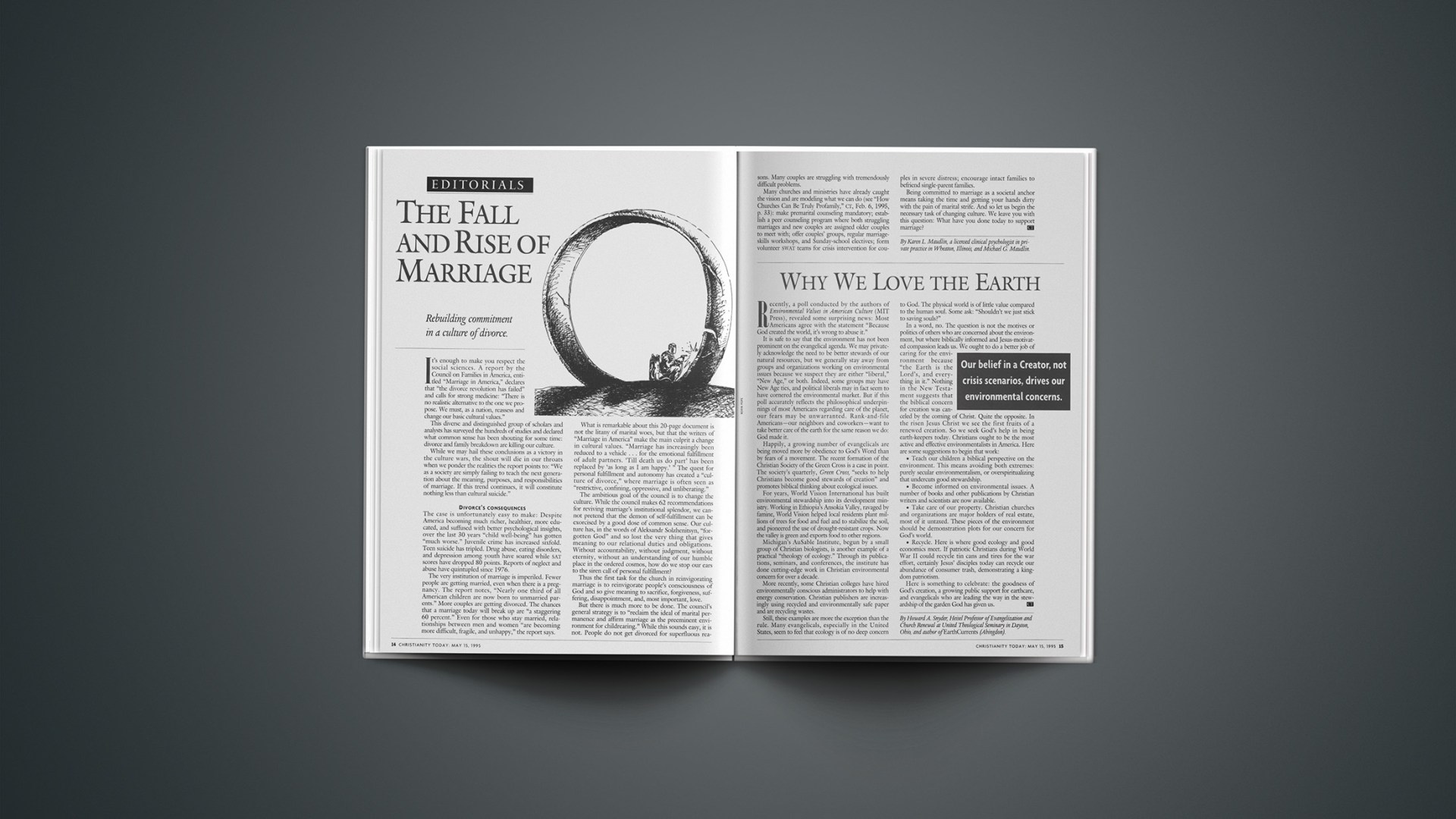

It’s enough to make you respect the social sciences. A report by the Council on Families in America, entitled “Marriage in America,” declares that “the divorce revolution has failed” and calls for strong medicine: “There is no realistic alternative to the one we propose. We must, as a nation, reassess and change our basic cultural values.”
This diverse and distinguished group of scholars and analysts has surveyed the hundreds of studies and declared what common sense has been shouting for some time: divorce and family breakdown are killing our culture.
While we may hail these conclusions as a victory in the culture wars, the shout will die in our throats when we ponder the realities the report points to: “We as a society are simply failing to teach the next generation about the meaning, purposes, and responsibilities of marriage. If this trend continues, it will constitute nothing less than cultural suicide.”
DIVORCE’S CONSEQUENCES
The case is unfortunately easy to make: Despite America becoming much richer, healthier, more educated, and suffused with better psychological insights, over the last 30 years “child well-being” has gotten “much worse.” Juvenile crime has increased sixfold. Teen suicide has tripled. Drug abuse, eating disorders, and depression among youth have soared while sat scores have dropped 80 points. Reports of neglect and abuse have quintupled since 1976.
The very institution of marriage is imperiled. Fewer people are getting married, even when there is a pregnancy. The report notes, “Nearly one third of all American children are now born to unmarried parents.” More couples are getting divorced. The chances that a marriage today will break up are “a staggering 60 percent.” Even for those who stay married, relationships between men and women “are becoming more difficult, fragile, and unhappy,” the report says.
What is remarkable about this 20-page document is not the litany of marital woes, but that the writers of “Marriage in America” make the main culprit a change in cultural values. “Marriage has increasingly been reduced to a vehicle … for the emotional fulfillment of adult partners. ‘Till death us do part’ has been replaced by ‘as long as I am happy.’ ” The quest for personal fulfillment and autonomy has created a “culture of divorce,” where marriage is often seen as “restrictive, confining, oppressive, and unliberating.”
The ambitious goal of the council is to change the culture. While the council makes 62 recommendations for reviving marriage’s institutional splendor, we cannot pretend that the demon of self-fulfillment can be exorcised by a good dose of common sense. Our culture has, in the words of Aleksandr Solzhenitsyn, “forgotten God” and so lost the very thing that gives meaning to our relational duties and obligations. Without accountability, without judgment, without eternity, without an understanding of our humble place in the ordered cosmos, how do we stop our ears to the siren call of personal fulfillment?
Thus the first task for the church in reinvigorating marriage is to reinvigorate people’s consciousness of God and so give meaning to sacrifice, forgiveness, suffering, disappointment, and, most important, love.
But there is much more to be done. The council’s general strategy is to “reclaim the ideal of marital permanence and affirm marriage as the preeminent environment for childrearing.” While this sounds easy, it is not. People do not get divorced for superfluous reasons. Many couples are struggling with tremendously difficult problems.
Many churches and ministries have already caught the vision and are modeling what we can do (see “How Churches Can Be Truly Profamily,” CT, Feb. 6, 1995, p. 33): make premarital counseling mandatory; establish a peer counseling program where both struggling marriages and new couples are assigned older couples to meet with; offer couples’ groups, regular marriage-skills workshops, and Sunday-school electives; form volunteer swat teams for crisis intervention for couples in severe distress; encourage intact families to befriend single-parent families.
Being committed to marriage as a societal anchor means taking the time and getting your hands dirty with the pain of marital strife. And so let us begin the necessary task of changing culture. We leave you with this question: What have you done today to support marriage?
*****************************
By Karen L. Maudlin, a licensed clinical psychologist in private practice in Wheaton, Illinois, and Michael G. Maudlin.
Copyright © 1995 Christianity Today. Click for reprint information.
ctmay95mhg5T60145508