SIDEBAR: Escaping Martyrdom in Saudi Arabia

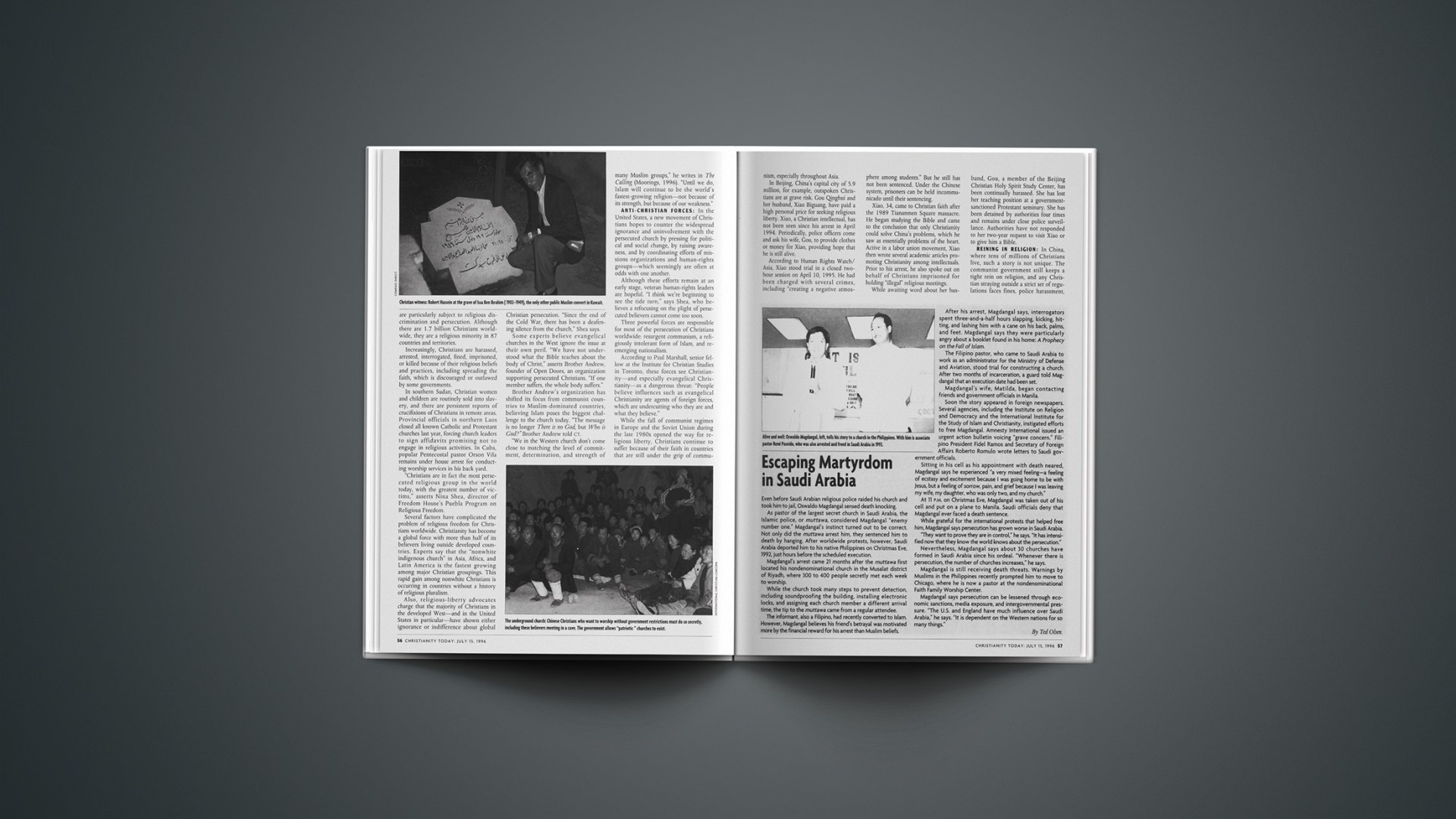
Even before Saudi Arabian religious police raided his church and took him to jail, Oswaldo Magdangal sensed death knocking.

As pastor of the largest secret church in Saudi Arabia, the Islamic police, or muttawa, considered Magdangal “enemy number one.” Magdangal’s instinct turned out to be correct. Not only did the muttawa arrest him, they sentenced him to death by hanging. After worldwide protests, however, Saudi Arabia deported him to his native Philippines on Christmas Eve, 1992, just hours before the scheduled execution.

Magdangal’s arrest came 21 months after the muttawa first located his nondenominational church in the Musalat district of Riyadh, where 300 to 400 people secretly met each week to worship.

While the church took many steps to prevent detection, including soundproofing the building, installing electronic locks, and assigning each church member a different arrival time, the tip to the muttawa came from a regular attendee.

The informant, also a Filipino, had recently converted to Islam. However, Magdangal believes his friend’s betrayal was motivated more by the financial reward for his arrest than Muslim beliefs.

After his arrest, Magdangal says, interrogators spent three-and-a-half hours slapping, kicking, hitting, and lashing him with a cane on his back, palms, and feet. Magdangal says they were particularly angry about a booklet found in his home: A Prophecy on the Fall of Islam.

The Filipino pastor, who came to Saudi Arabia to work as an administrator for the Ministry of Defense and Aviation, stood trial for constructing a church. After two months of incarceration, a guard told Magdangal that an execution date had been set.

Magdangal’s wife, Matilda, began contacting friends and government officials in Manila.

Soon the story appeared in foreign newspapers. Several agencies, including the Institute on Religion and Democracy and the International Institute for the Study of Islam and Christianity, instigated efforts to free Magdangal. Amnesty International issued an urgent action bulletin voicing “grave concern.” Filipino President Fidel Ramos and Secretary of Foreign Affairs Roberto Romulo wrote letters to Saudi government officials.

Sitting in his cell as his appointment with death neared, Magdangal says he experienced “a very mixed feeling–a feeling of ecstasy and excitement because I was going home to be with Jesus, but a feeling of sorrow, pain, and grief because I was leaving my wife, my daughter, who was only two, and my church.”

At 11 p.m. on Christmas Eve, Magdangal was taken out of his cell and put on a plane to Manila. Saudi officials deny that Magdangal ever faced a death sentence.

While grateful for the international protests that helped free him, Magdangal says persecution has grown worse in Saudi Arabia.

“They want to prove they are in control,” he says. “It has intensified now that they know the world knows about the persecution.”

Nevertheless, Magdangal says about 30 churches have formed in Saudi Arabia since his ordeal. “Whenever there is persecution, the number of churches increases,” he says.

Magdangal is still receiving death threats. Warnings by Muslims in the Philippines recently prompted him to move to Chicago, where he is now a pastor at the nondenominational Faith Family Worship Center.

Magdangal says persecution can be lessened through economic sanctions, media exposure, and intergovernmental pressure. “The U.S. and England have much influence over Saudi Arabia,” he says. “It is dependent on the Western nations for so many things.”

Copyright © 1996 Christianity Today. Click for reprint information.

Also in this issue

Persecuted: A crisis for the contemporary church

Christians, Jews Form Coalition

Lutheran, Catholic, and Black Churches Join Graham Effort

1,800 Churches Participating in Olympic Outreach

Gayle White in Atlanta

YANCEY: Confessions of a Spiritual Amnesiac

Why the Psalms Scare Us

Kathleen Norris

From the Fringe to the Fold

Ruth Tucker

ARTS: Messiaen’s Complicated Contemplations

Karen L. Mulder

NORTH AMERICAN SCENE: Arsons Continue, Frustration Sets In

Foes, Backers Seeks Common Ground

Ross Pavlac in Madison, Wisconsin

Congressmen Focus on Persecuted Believers

Bishops Propose Chastity Canon

Women Become 'Promise Keepers'

WORLD SCENE: Abducted SIL Missionary Freed

News

OBITUARY: Ex-Fuller President David Hubbard Dies

Palau Preached to a Preoccupied Metropolis

John W. Kennedy in Chicago, with reports from Bradley Baurain and Christian Coon

Evangelist Sets Sights on U.S. Latinos

By Andres T. Tapia in Chicago

The Suffering Church

Kim A. Lawton

SIDEBAR: Forgive Us Our Trespasses

News

News Briefs: July 15, 1996

Wire Story

SBC Targets Clinton, Disney, Jews

Timothy C. Morgan in New Orleans, with reports from Baptist Press

Risky Business

LETTERS: No Middle Ground

Editorial

EDITORIAL: Ministry in the Real World Order

Robert A. Seiple, president of World Vision U.S

Editorial

EDITORIAL: Burned, but Not Consumed

Richard A. Kauffman

ARTICLE: Saving the Safety Net

Everett L. Wilson

SIDEBAR: When Your Church Says It’s Wrong

Camilla F. Kleindienst, who lives in Fulton, Missouri.

News

News Briefs: July 15, 1996

ARTICLE: Tolerance Without Compromise

Richard J. Mouw

BOOKS: Getting Evangelicals into the Church

Robert W. Patterson

BOOKS: Wesley on CD

BOOKS: Hymns for the Politically Correct

Donald G. Bloesch

Classic & Contemporary Excerpts from July 15, 1996

SIDEBAR: Help for the Persecuted

View issue

Our Latest

My Top 5 Books on Christianity in South Asia

Compiled by Nathanael Somanathan

Wisdom on staying faithful in ministry and navigating multireligious realities in India, Sri Lanka, and beyond.

News

Top Women’s Cricket Player Trolled for Her Christian Faith

Vikram Mukka

Christian public figures in India face online attacks and offline consequences for speaking about Jesus.

The Russell Moore Show

Our Favorite Moments from 2025 Episodes

Russell and Leslie meander through the 2025 podcast episodes and share some of their favorite moments.

The Case Against VIP Tickets at Christian Conferences

Jazer Willis

Exclusive perks may be well-intended business decisions, but Christian gatherings shouldn’t reinforce economic hierarchy.

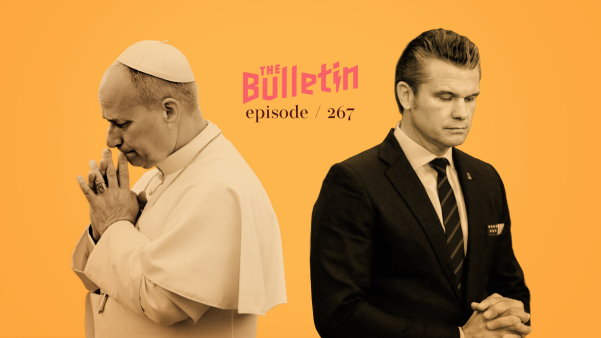
The Bulletin

Pete Hegseth’s Future, Farmers on Tariffs, and Religious Decline Stalls

Mike Cosper, Clarissa Moll

Hegseth scrutinized for drug boat strikes, farmers react to Trump’s tariffs, and a Pew report says religious decline has slowed.

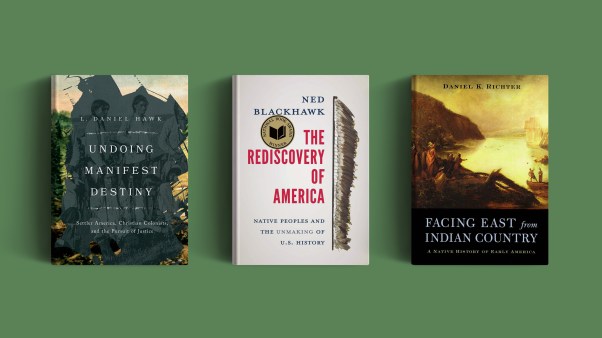
The Debate over Government Overreach Started in 1776

Three books to read this month on politics and public life.

Turn Toward Each Other and Away from the Screen

Perhaps technology has changed everything. But God is still here, still wiring humans for connection and presence.

Apple PodcastsDown ArrowDown ArrowDown Arrowarrow_left_altLeft ArrowLeft ArrowRight ArrowRight ArrowRight Arrowarrow_up_altUp ArrowUp ArrowAvailable at Amazoncaret-downCloseCloseEmailEmailExpandExpandExternalExternalFacebookfacebook-squareGiftGiftGooglegoogleGoogle KeephamburgerInstagraminstagram-squareLinkLinklinkedin-squareListenListenListenChristianity TodayCT Creative Studio Logologo_orgMegaphoneMenuMenupausePinterestPlayPlayPocketPodcastRSSRSSSaveSaveSaveSearchSearchsearchSpotifyStitcherTelegramTable of ContentsTable of Contentstwitter-squareWhatsAppXYouTubeYouTube