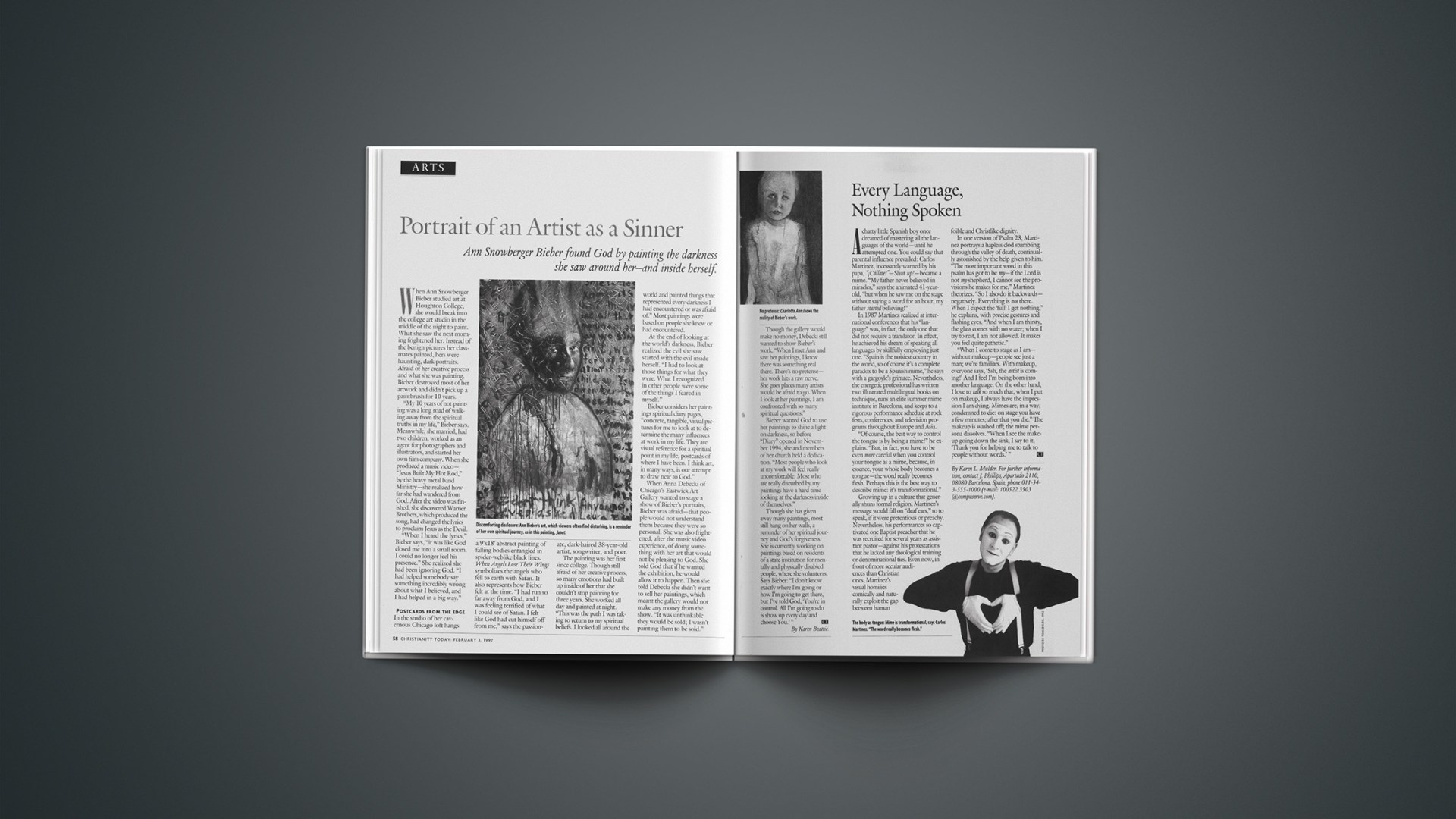

A chatty little Spanish boy once dreamed of mastering all the languages of the world-until he attempted one. You could say that parental influence prevailed: Carlos Martinez, incessantly warned by his papa, “Callate!”-Shut up!-became a mime. “My father never believed in miracles,” says the animated 41-year-old, “but when he saw me on the stage without saying a word for an hour, my father started believing!”
In 1987 Martinez realized at international conferences that his “language” was, in fact, the only one that did not require a translator. In effect, he achieved his dream of speaking all languages by skillfully employing just one. “Spain is the noisiest country in the world, so of course it’s a complete paradox to be a Spanish mime,” he says with a gargoyle’s grimace. Nevertheless, the energetic professional has written two illustrated multilingual books on technique, runs an elite summer mime institute in Barcelona, and keeps to a rigorous performance schedule at rock tests, conferences, and television programs throughout Europe and Asia.
“Of course, the best way to control the tongue is by being a mime!” he explains. “But, in fact, you have to be even more careful when you control your tongue as a mime, because, in essence, your whole body becomes a tongue-the word really becomes flesh. Perhaps this is the best way to describe mime: it’s transformational.”
Growing up in a culture that generally shuns formal religion, Martinez’s message would fall on “deaf ears,” so to speak, if it were pretentious or preachy. Nevertheless, his performances so captivated one Baptist preacher that he |was recruited for several years as assistant pastor-against his protestations that he lacked any theological training or denominational ties. Even now, in front of more secular audiences than Christian ones, Martinez’s visual homilies comically and naturally exploit the gap between human foible and Christlike dignity.
In one version of Psalm 23, Martinez portrays a hapless clod stumbling through the valley of death, continually astonished by the help given to him. “The most important word in this psalm has got to be my-if the Lord is not my shepherd, I cannot see the provisions he makes for me,” Martinez theorizes. “So I also do it backwards-negatively. Everything is not there. When I expect the ‘full’ I get nothing,” he explains, with precise gestures and flashing eyes. “And when I am thirsty, the glass comes with no water; when I try to rest, I am not allowed. It makes you feel quite pathetic.”
“When I come to stage as I am-without makeup-people see just a man; we’re familiars. With makeup, everyone says, ‘Ssh, the artist is coming!’ And I feel I’m being born into another language. On the other hand, I love to talk so much that, when I put on makeup, I always have the impression I am dying. Mimes are, in a way, condemned to die: on stage you have a few minutes; after that you die. The makeup is washed off; the mime persona dissolves. “When I see the makeup going down the sink, I say to it, Thank you for helping me to talk to people without words.'”
By Karen L. Mulder: For further information, contact J. Phillips, Apartado 2110, 08080 Barcelona, Spain; phone 011-34-3-555-1000 (e-mail: 100522.3503@compuserve.com).
Christianity Today: February 3, 1997 p. 58