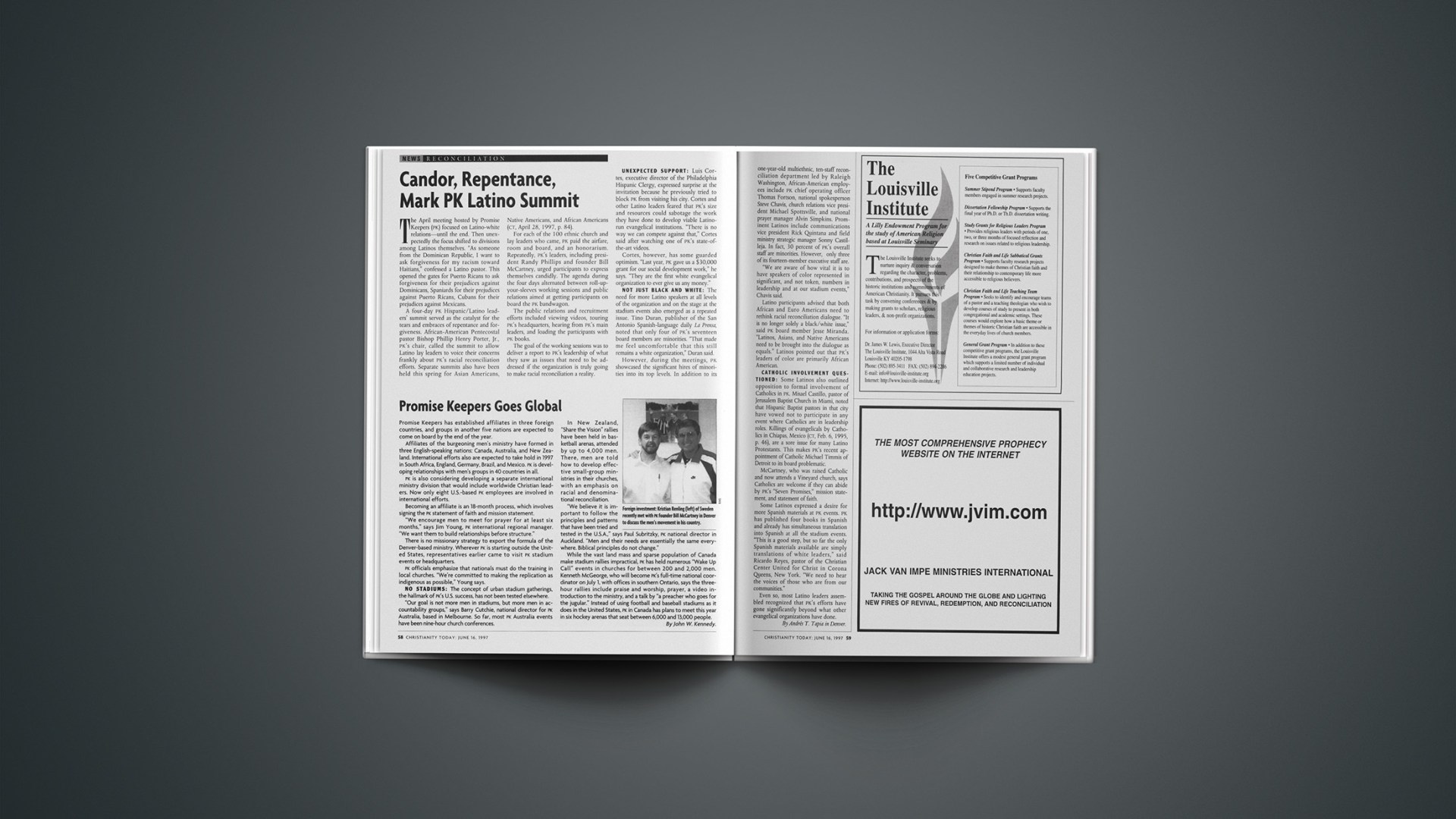

Promise Keepers has established affiliates in three foreign countries, and groups in another five nations are expected to come on board by the end of the year.
Affiliates of the burgeoning men’s ministry have formed in three English-speaking nations: Canada, Australia, and New Zealand. International efforts also are expected to take hold in 1997 in South Africa, England, Germany, Brazil, and Mexico. PK is developing relationships with men’s groups in 40 countries in all.
PK is also considering developing a separate international ministry division that would include worldwide Christian leaders. Now only eight U.S.-based PK employees are involved in international efforts.
Becoming an affiliate is an 18-month process, which involves signing the PK statement of faith and mission statement.
“We encourage men to meet for prayer for at least six months,” says Jim Young, PK international regional manager. “We want them to build relationships before structure.”
There is no missionary strategy to export the formula of the Denver-based ministry. Wherever PK is starting outside the United States, representatives earlier came to visit PK stadium events or headquarters.
PK officials emphasize that nationals must do the training in local churches. “We’re committed to making the replication as indigenous as possible,” Young says.
NO STADIUMS: The concept of urban stadium gatherings, the hallmark of PK’s U.S. success, has not been tested elsewhere.
“Our goal is not more men in stadiums, but more men in accountability groups,” says Barry Cutchie, national director for PK Australia, based in Melbourne. So far, most PK Australia events have been nine-hour church conferences.
In New Zealand, “Share the Vision” rallies have been held in basketball arenas, attended by up to 4,000 men. There, men are told how to develop effective small-group ministries in their churches, with an emphasis on racial and denominational reconciliation.
“We believe it is important to follow the principles and patterns that have been tried and tested in the U.S.A.,” says Paul Subritzky, PK national director in Auckland. “Men and their needs are essentially the same everywhere. Biblical principles do not change.”
While the vast land mass and sparse population of Canada make stadium rallies impractical, PK has held numerous “Wake Up Call” events in churches for between 200 and 2,000 men. Kenneth McGeorge, who will become PK’s full-time national coordinator on July 1, with offices in southern Ontario, says the three-hour rallies include praise and worship, prayer, a video introduction to the ministry, and a talk by “a preacher who goes for the jugular.” Instead of using football and baseball stadiums as it does in the United States, PK in Canada has plans to meet this year in six hockey arenas that seat between 6,000 and 13,000 people.
Copyright © 1997 Christianity Today. Click for reprint information.