

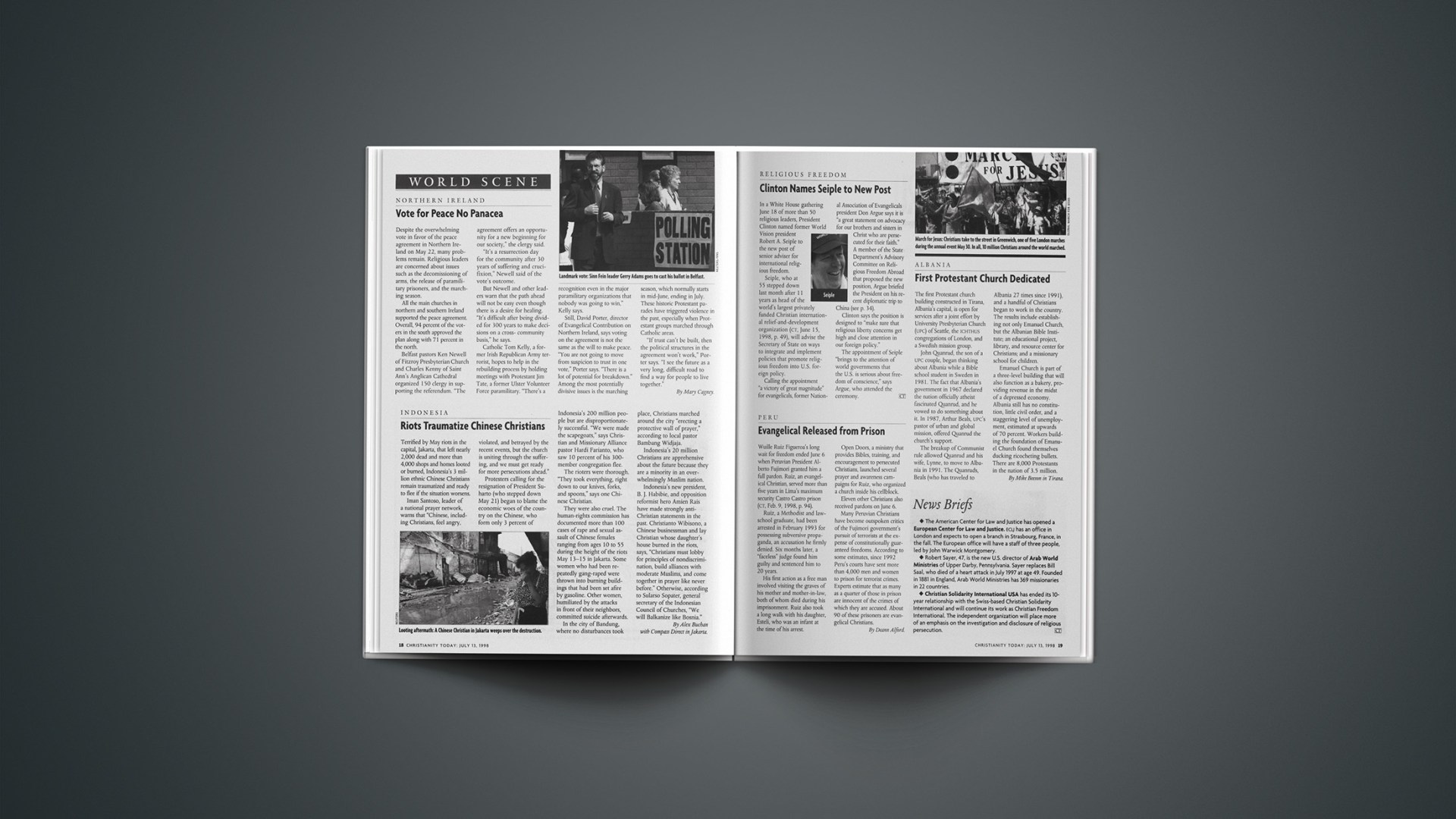
Vote for Peace No Panacea

Vote for Peace No Panacea

Despite the overwhelming vote in favor of the peace agreement in Northern Ireland on May 22, many problems remain. Religious leaders are concerned about issues such as the decomissioning of arms, the release of paramilitary prisoners, and the marching season.

All the main churches in northern and southern Ireland supported the peace agreement. Overall, 94 percent of the voters in the south approved the plan along with 71 percent in the north.

Belfast pastors Ken Newell of Fitzroy Presbyterian Church and Charles Kenny of Saint Ann’s Anglican Cathedral organized 150 clergy in supporting the referendum. “The agreement offers an opportunity for a new beginning for our society,” the clergy said.

“It’s a resurrection day for the community after 30 years of suffering and crucifixion,” Newell said of the vote’s outcome.

But Newell and other leaders warn that the path ahead will not be easy even though there is a desire for healing. “It’s difficult after being divided for 300 years to make decisions on a cross- community basis,” he says.

Catholic Tom Kelly, a former Irish Republican Army terrorist, hopes to help in the rebuilding process by holding meetings with Protestant Jim Tate, a former Ulster Volunteer Force paramilitary. “There’s a recognition even in the major paramilitary organizations that nobody was going to win,” Kelly says.

Still, David Porter, director of Evangelical Contribution on Northern Ireland, says voting on the agreement is not the same as the will to make peace. “You are not going to move from suspicion to trust in one vote,” Porter says. “There is a lot of potential for breakdown.” Among the most potentially divisive issues is the marching season, which normally starts in mid-June, ending in July. These historic Protestant parades have triggered violence in the past, especially when Protestant groups marched through Catholic areas.

“If trust can’t be built, then the political structures in the agreement won’t work,” Porter says. “I see the future as a very long, difficult road to find a way for people to live together.”

Copyright © 1998 Christianity Today. Click for reprint information.

Also in this issue

China's Changing Church: Eyewitnesses report looser regulation, ongoing repression, and booming revival. What does this mixed picture mean for the future?

Cover Story

China's Dynamic Church

Timothy C. Morgan

Lutherans, Episcopalians Revive Talks

Brimstone for the Broadminded

Bad Things Still Happen

What the Hands Reveal

Miracle Monument

Classic & Contemporary Excerpts from July 13, 1998

Fear and Faith in the Middle East

Church Nearly Closed After Lawsuit

Willmar Thorkelson

One-Year Mission Changes Lives

Randy Frame in Philadelphia

Market Gobbles Up Veggie Tales

Comic Relief: Dear John the Evangelist

Bob Hudson

House Rejects Prayer Amendment

Christy Gardner

West Bank: Persecution Reports Unfounded

Peri Stone in Jerusalem

New Bill Threatens Freedom of Speech Religion

S. Aaron Osborne in Jerusalem

Riots Traumatize Chinese Christians

by Alex Buchan with Compass Direct in Jakarta

Clinton Names Seiple to New Post

Evangelical Released from Prison

Deann Alford

First Protestant Church Dedicated

Mike Beeson in Tirana

Editorial

Lies We’ve Heard Before

News

News Briefs: July 13, 1998

If Christ Be Not Risen...

The Journalist in the Sedan Chair

LETTERS

Winding Paths Meet—Healing and Faith Find Connection

Cecile S. Holmes in Houston

Patterson's Election Seals Conservative Control

John W. Kennedy in Salt Lake City

Missiology: Uncovering Christianity's Hidden History

Richard A. Kauffman in Pasadena

Fraud: Faithful Lose Millions in Ponzi Scheme

Chuck Fager

Sex Allegations: Megachurch Pastor Quits, Denies Wrongdoing

by Art Moore in Seattle

News

News Briefs: July 13, 1998

Editorial

Discerning the Healing Spirits

China Mission: More than 'Ping-Pong Diplomacy'

Playing the Grace Card

Spencer Perkins

Karla Faye's Final Stop

Virginia Stem Owens

In the Word: What's Wrong with Spirituality?

Eugene H. Peterson

Do Demons Have Zip Codes?

Whatever Happened to Middle-Class Hypocrisy?

View issue

Our Latest

The Bulletin

Joe Kent Resigns, Iranian Threats, and a Victory for Parents’ Rights

Mike Cosper, Clarissa Moll, Russell Moore

Public opinions on the Iran war, homeland security risks, and disagreements about gender transition in the classroom.

Review

What Kids Think About God Matters

Three theology books to read this month.

Analysis

Q&A: Why Pakistan and Afghanistan Are Fighting and How Christians There Survive

The Bulletin with Knox Thames

A conversation with human rights lawyer and former diplomat Knox Thames.

Turning ‘a Miracle’ into Long-Haul Help for the Homeless

Taylor Berglund

A North Carolina nonprofit is thinking in decades, not days, about sustainable, affordable housing.

Urgency Is Not Faithfulness

Thomas Anderson

A church that quickly reacts to every controversy is echoing the culture, not God’s Word.

What to Expect at This Year’s Church Conventions

SBC, LCMS, ACNA, CREC, and Global Methodist gatherings in 2026 will weigh issues including abuse investigations and sexual ethics.

Review

‘The Faithful’ Celebrates the Women of the Bible

The first episode—and a set visit in Italy—introduced a me to a thoughtful new drama about multidimensional women in Scripture.

Gospel Matriarch Lucie Campbell Looked To God

Daylan Woodall

Her songs spoke to life’s uncertainties and God’s presence—and taught me how to hope.

Apple PodcastsDown ArrowDown ArrowDown Arrowarrow_left_altLeft ArrowLeft ArrowRight ArrowRight ArrowRight Arrowarrow_up_altUp ArrowUp ArrowAvailable at Amazoncaret-downCloseCloseEmailEmailExpandExpandExternalExternalFacebookfacebook-squareGiftGiftGooglegoogleGoogle KeephamburgerInstagraminstagram-squareLinkLinklinkedin-squareListenListenListenChristianity TodayCT Creative Studio Logologo_orgMegaphoneMenuMenupausePinterestPlayPlayPocketPodcastprintRSSRSSSaveSaveSaveSearchSearchsearchSpotifyStitcherTelegramTable of ContentsTable of Contentstwitter-squareWhatsAppXYouTubeYouTube






