Children’s Literature: Parents Push for Wizard-free Reading

Bestsellers now under fire in some classroom

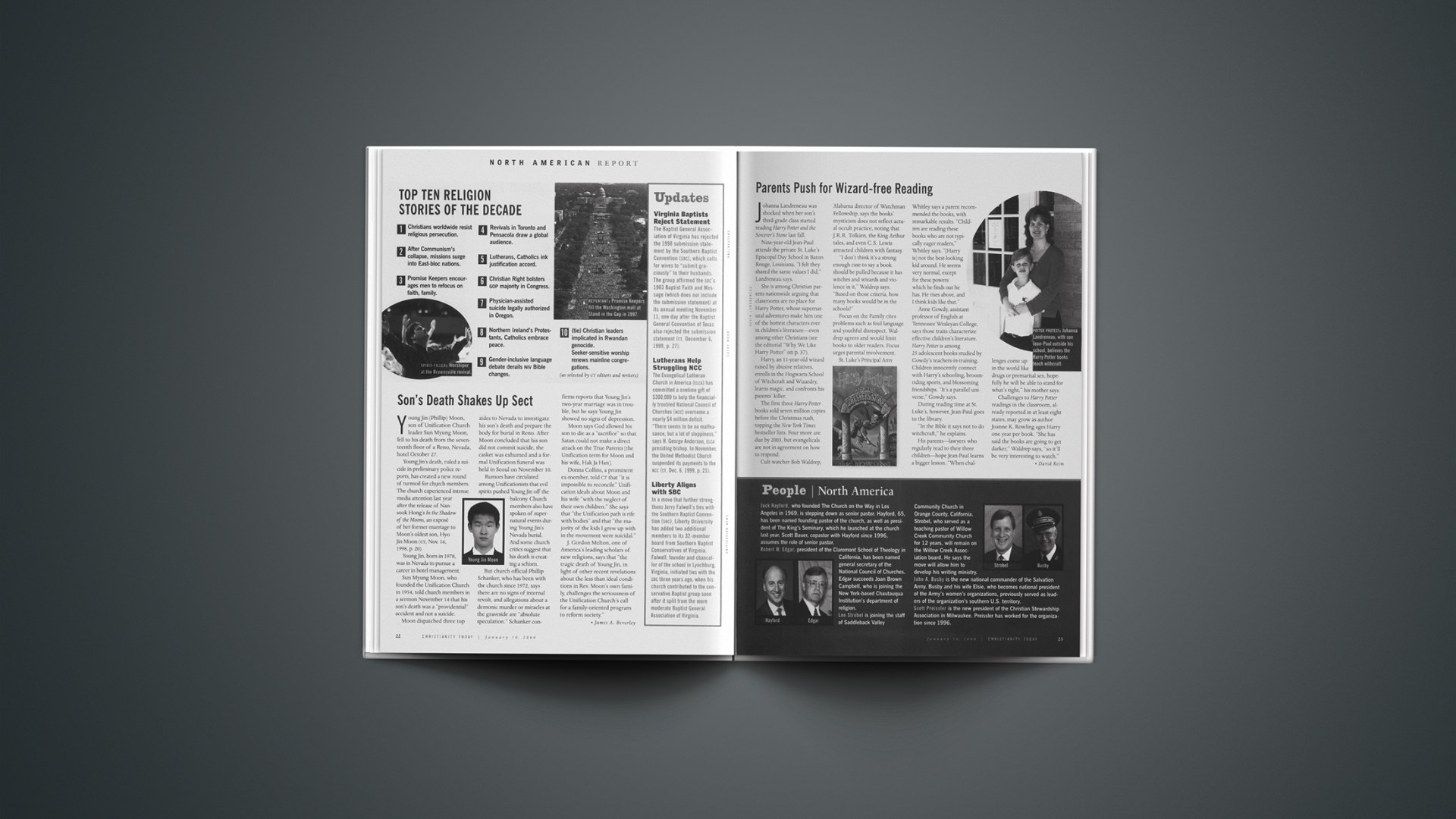
Johanna Landreneau was shocked when her son's third-grade class started reading Harry Potter and the Sorcerer's Stone last fall. Nine-year-old Jean-Paul attends the private St. Luke's Episcopal Day School in Baton Rouge, Louisiana. "I felt they shared the same values I did," Landreneau says.

She is among Christian parents nationwide arguing that classrooms are no place for Harry Potter, whose supernatural adventures make him one of the hottest characters ever in children's literature—even among other Christians.

Harry, an 11-year-old wizard raised by abusive relatives, enrolls in the Hogwarts School of Witchcraft and Wizardry, learns magic, and confronts his parents' killer.

The first three Harry Potter books sold seven million copies before the Christmas rush, topping the New York Times bestseller lists. Four more are due by 2003, but evangelicals are not in agreement on how to respond.

Cult-watcher Bob Waldrep, Alabama director of Watchman Fellowship, says the books' mysticism does not reflect actual occult practice, noting that J. R. R. Tolkien, the King Arthur tales, and even C.S. Lewis attracted children with fantasy. "I don't think it's a strong enough case to say a book should be pulled because it has witches and wizards and violence in it," Waldrep says. "Based on that criteria, how many books would be in the schools?"

Focus on the Family cites problems such as foul language and youthful disrespect. Waldrep agrees and would limit books to older readers. Focus urges parental involvement.

St. Luke's Principal Amy Whitley says a parent recommended the books, with remarkable results. "Children are reading these books who are not typically eager readers," Whitley says. "[Harry is] not the best-looking kid around. He seems very normal, except for these powers which he finds out he has. He rises above, and I think kids like that."

Anne Gowdy, assistant professor of English at Tennessee Wesleyan College, says those traits characterize effective children's literature. Harry Potter is among 25 adolescent books studied by Gowdy's teachers-in-training. Children innocently connect with Harry's schooling, broom-riding sports, and blossoming friendships. "It's a parallel universe," Gowdy says.

During reading time at St. Luke's, however, Jean-Paul goes to the library. "In the Bible it says not to do witchcraft," he explains.

His parents—lawyers who regularly read to their three children—hope Jean-Paul learns a bigger lesson. "When challenges come up in the world like drugs or premarital sex, hopefully he will be able to stand for what's right," his mother says.

Challenges to Harry Potter readings in the classroom, already reported in at least eight states, may grow as author Joanne K. Rowling ages Harry one year per book. "She has said the books are going to get darker," Waldrep says, "so it'll be very interesting to watch."

Related Elsewhere

See today's related Harry Potter stories, "Why We Like Harry Potter | The series is a 'Book of Virtues' with a preadolescent funny bone, "and "Opinion Roundup: Positive About Potter | Despite what you've heard, Christian leaders like the children's books."

Copyright © 2000 Christianity Today. Click for reprint information.

Also in this issue

The CT archives are a rich treasure of biblical wisdom and insight from our past. Some things we would say differently today, and some stances we've changed. But overall, we're amazed at how relevant so much of this content is. We trust that you'll find it a helpful resource.

Cover Story

How God Won When Politics Failed

Tim Stafford

Cover Story

The Forgiveness Factor

Gary Thomas

Things We Ought to Know

reviewed by Harold O. J. Brown

Letters to the Editor: January 10, 2000

It Takes a Village to Fight Divorce

Why We Like Harry Potter

A Christianity Today Editorial

Forgive and Remember

Author Wendy Shalit Is Proud to Be Modest

A conversation between Lauren F. Winner and Wendy Shalit

In the Word: On the Receiving End

Cornelius Plantinga Jr.

Take, Eat—But How Often?

Craig S. Keener

Classic & Contemporary Excerpts from January 10, 2000

Popular Culture: The Film Dogma Is Anti-Dogma

Douglas LeBlanc

Time for a Change

In Print: Beyond Do-Goodism

New & Noteworthy: Christian Living

Beating the Odds

Setting Captives Free

Jody Veenker

Chasing Amy

Taming the Reformation

Douglas A. Sweeney

Out of the Ashes

John W. Kennedy in Riobamba

Paying for Free Speech

Gordon Govier in Madison, Wisconsin

New Bibles Carry Hefty Price Tags

Wire Story

Sudan: CSI Loses U.N. Status

Religion News Service

Wire Story

Methodists: Creech stripped of clergy credentials

Religion News Service

Presbyterians Support Same-Sex Unions

Top Ten Religion Stories of the Decade

Selected by CT Editors and Writers

Son's Death Shakes Up Sect

James A. Beverley

Updates: January 10, 2000

People: North America

Wire Story

Baptist Foundation of America Lands in Bankruptcy Court

Herb Hollinger, Baptist Press

Higher Education: Crumbling Family Values

Douglas LeBlanc

Nigeria: Islamic Law Raises Tensions

Obed Minchakpu in Jos, Nigeria, with Compas Direct

Costa Rica: Coffee Sales Perk Up Ministry Support

Deann Alford

Briefs: The World

Northern Ireland: Peace at Last?

Mary Cagney

Smorgasbord Spirituality

James A. Beverley in Cape Town

India: Loving the Lepers

By Anto Ankara in New Delhi, Ecumenical News International

View issue

Our Latest

The Just Life with Benjamin Watson

Anquan Boldin: From the Muck to the Movement

What it means to move from the field to the fight and to pursue justice when it becomes personal.

Jonathan McReynolds Fuses Gospel Music with ’80s Pop in ‘Closer’

A conversation with the Grammy-winning artist about fame, intimacy with God, and the music of the neon decade.

Review

Martin Scorsese Presents ‘Mary’ for a Secular Age

The renowned filmmaker’s new episode of his Fox Nation series, The Saints, is timed for Easter and focuses on the mother of Jesus.

Every Head Bowed, Every Eye Closed

Is the way we talk to God for our comfort or for his glory?

Public Theology Project

Stop Being Anxious About Your Anxiety

Jesus meets our worries with reassurance, not rebuke.

Low-Tech Parenting Must Be a Big Tent

If we want to parent wisely in a digital age, we must pair courage with grace—not judgmentalism.

Friction-Maxxing Higher Ed

Kristin VanEyk and Elisabeth E. Lefebvre

Christian colleges can offer complexity and real challenges instead of pat answers and easy degrees.

A Sign, Not a Weathervane

CT sought to point people to the Bible through the personal and public crises of 1978.

Apple PodcastsDown ArrowDown ArrowDown Arrowarrow_left_altLeft ArrowLeft ArrowRight ArrowRight ArrowRight Arrowarrow_up_altUp ArrowUp ArrowAvailable at Amazoncaret-downCloseCloseEmailEmailExpandExpandExternalExternalFacebookfacebook-squareGiftGiftGooglegoogleGoogle KeephamburgerInstagraminstagram-squareLinkLinklinkedin-squareListenListenListenChristianity TodayCT Creative Studio Logologo_orgMegaphoneMenuMenupausePinterestPlayPlayPocketPodcastprintRSSRSSSaveSaveSaveSearchSearchsearchSpotifyStitcherTelegramTable of ContentsTable of Contentstwitter-squareWhatsAppXYouTubeYouTube