Hit the Wall and Keep Going

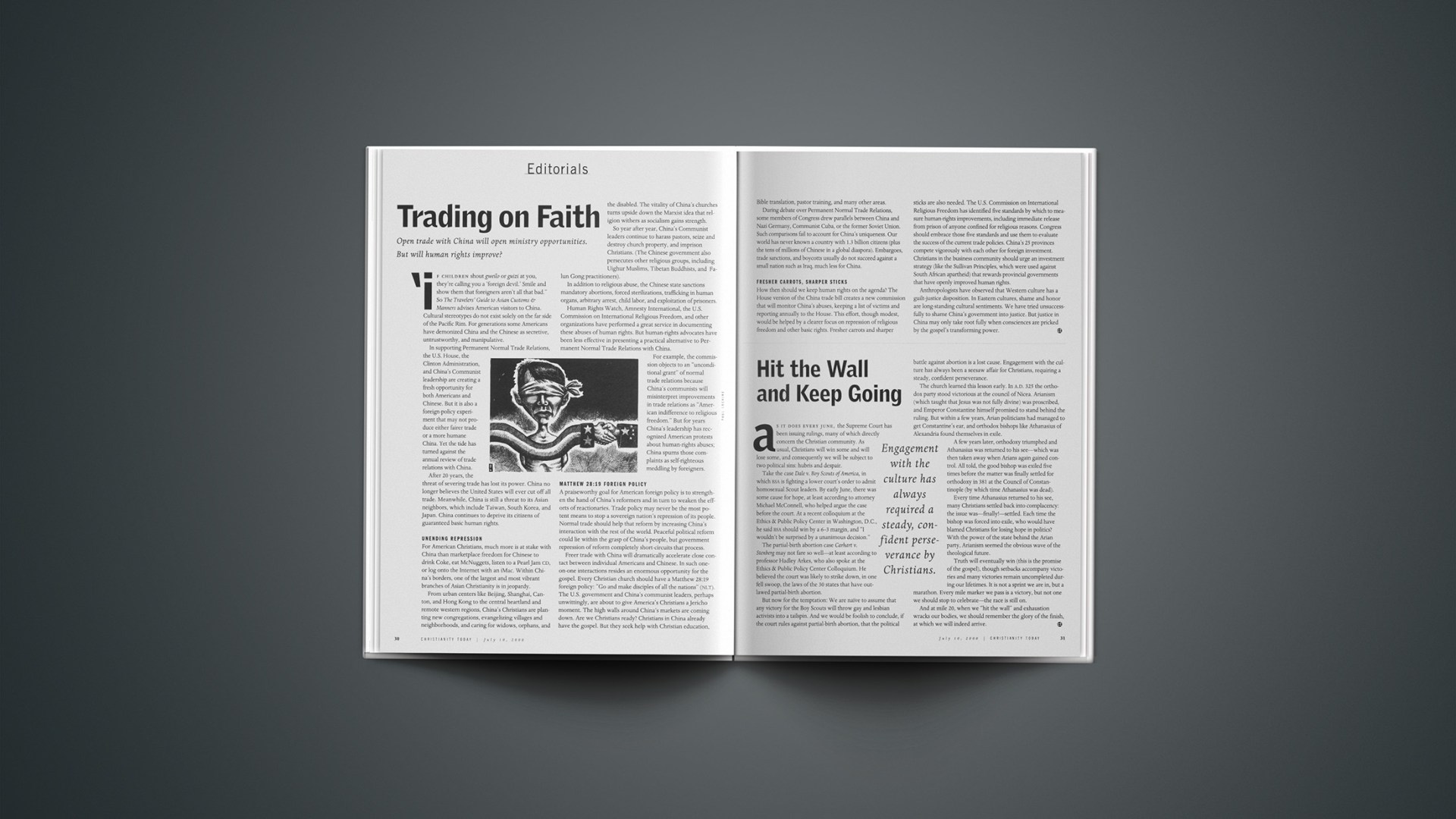
Engagement with the culture has always required a steady, confident perseverance by Christians.

As it does every June, the Supreme Court has been issuing rulings, many of which directly concern the Christian community. As usual, Christians have won some and lost some, and consequently we are subject to two political sins: hubris and despair.Take the case Dale v. Boy Scouts of America, in which BSA fought a lower court’s order to admit homosexual Scout leaders. By early June, there was some cause for hope, at least according to attorney Michael McConnell, who helped argue the case before the court. At a recent colloquium at the Ethics & Public Policy Center in Washington, D.C., he said BSA should win by a 6– 3 margin, and “I wouldn’t be surprised by a unanimous decision.” (It actually wasn’t so close, winning by a 5-4 margin.)The partial-birth abortion case Carhart v. Stenberg was not expected to fare so well—at least according to professor Hadley Arkes, who also spoke at the Ethics & Public Policy Center Colloquium. He believed the court was likely to strike down, in one fell swoop, the laws of the 30 states that have outlawed partial-birth abortion. They did, but only by another one vote difference.The court split the other two cases on religious activity yesterday as well. In the win column, it narrowly allowed public school systems to lend library books, computers and other instructional items to religious schools. In the loss column, it restricted free speech outside abortion clinics, allowing an eight-foot “buffer zone” free of literature or “oral arguments” around anyone entering a medical facility.But now for the temptation: We are naïve to assume that a for the Boy Scouts will throw gay and lesbian activists into a tailspin. And we would be foolish to conclude that the political battle against abortion is a lost cause. Engagement with the culture has always been a seesaw affair for Christians, requiring a steady, confident perseverance.The church learned this lesson early. In A.D. 325 the orthodox party stood victorious at the council of Nicea. Arianism (which taught that Jesus was not fully divine) was proscribed, and Emperor Constantine himself promised to stand behind the ruling. But within a few years, Arian politicians had managed to get Constantine’s ear, and orthodox bishops like Athanasius of Alexandria found themselves in exile.A few years later, orthodoxy triumphed and Athanasius was returned to his see—which was then taken away when Arians again gained control. All told, the good bishop was exiled five times before the matter was finally settled for orthodoxy in 381 at the Council of Constantinople (by which time Athanasius was dead).Every time Athanasius returned to his see, many Christians settled back into complacency: the issue was—finally!—settled. Each time the bishop was forced into exile, who would have blamed Christians for losing hope in politics? With the power of the state behind the Arian party, Arianism seemed the obvious wave of the theological future.Truth will eventually win (this is the promise of the gospel), though setbacks accompany victories and many victories remain uncompleted during our lifetimes. It is not a sprint we are in, but a marathon. Every mile marker we pass is a victory, but not one we should stop to celebrate—the race is still on.And at mile 20, when we “hit the wall” and exhaustion wracks our bodies, we should remember the glory of the finish, at which we will indeed arrive.

Related Elsewhere

See today’s ChristianityToday.com Weblog, which contains summaries of all four of yesterday’s decisions, as well as links to news coverage and the decisions themselves.

Copyright © 2000 Christianity Today. Click for reprint information.

Also in this issue

Losing Our Promiscuity: There is no contraceptive for a broken heart—that's what the sex-without-commitment generation has discovered. And now the church has an unprecedented opportunity to reach it.

Cover Story

Losing Our Promiscuity

Paula Rinehart

Consider This: The God of Alan Dershowitz

Steven H. Aden

Incarnating Mystery

By Wendy Murray Zoba

The Just-Chaplain Theory

Douglas K. Stewart

Consider This: The Bobo Future

Roberto Rivera

Praying for Hope

Nancy Guthrie

In the Word: Stony the Road We Trod

Marguerite Shuster

Your World: Every Day is Casual Friday

‘Rice With Chicken’ Writers in Demand

Kenneth D. MacHarg

Kazakhstan: Central Asia's Great Awakening

Tobin Perry in Almaty

The First Black Liberation Movement

Tim Stafford

News

Film: Cameras Rolling

By Denyse O'Leary in Toronto

Building a Bridge

Wendy Murray Zoba

Uganda: Innocence Stolen

Greg Taylor in Kampala

Bush and Gore Size Up Prolife Running Mates

Jody Veenker

The Back Page | Philip Yancey: Lessons from Rock Bottom

Is Suicide Unforgivable?

Lewis B. Smedes

Evangelism: Is Amsterdam 2000 Graham's 'Swan Song'?

Briefs: The World

Trading on Faith in China

A Christianity Today Editorial

The Editor Who Cancelled His Subscription

Classic & Contemporary Excerpts from July 10, 2000

Greece: Identity-Card Data Divide Churches

Ecumenical News International

Trade: Freer Trade, Freer Faith?

Tony Carnes

Briefs: North America

Trends Church Guarantees 'Express Service' for Busy Believers

Mark I. Pinsky in Eustis

Updates

Religious Freedom Ruling Set

Sex and the Single Christian

An interview with Steve Tracy

Africa: World Bank, Local Pastors Link to Fight Poverty

Odhiambo Okite

Church Disputes: Culture Clash

Jody Veenker in Orlando

View issue

Our Latest

Public Theology Project

Why Christians Ignore What the Bible Says About Immigrants

Believers can disagree on migration policies—but the Word of God should shape how we minister to vulnerable people.

Review

Apologetics Can Be a Balm—or Bludgeon

Daryn Henry

A new history of American apologetics from Daniel K. Williams offers careful detail, worthwhile lessons, and an ambitious, sprawling, rollicking narrative.

Hold the Phone?

Anna Mares

Faced with encouragement to lessen technology use, younger Christians with far-flung families wonder how to stay connected.

The Russell Moore Show

Joseph Loconte on the War for Middle-Earth

What if the most decisive battles in our time aren’t fought with ballots or bombs—but with the imagination?

Norman Podhoretz Leaves a Legacy of Political Principle

Michael Cosper

The Jewish intellectual upheld the Judeo-Christian tradition.

News

A House of Worship Without a Home

One year after the Palisades and Eaton fires, congregations meditate on what it means to be a church without a building.

‘The Image of God Was Always In My Mother’

Kate Lucky

Responses to our Sept-Oct issue.

Disintegration is the Church’s Greatest Threat

A note from Mission Advancement about the Big Tent Initiative and One Kingdom Campaign.

Apple PodcastsDown ArrowDown ArrowDown Arrowarrow_left_altLeft ArrowLeft ArrowRight ArrowRight ArrowRight Arrowarrow_up_altUp ArrowUp ArrowAvailable at Amazoncaret-downCloseCloseEmailEmailExpandExpandExternalExternalFacebookfacebook-squareGiftGiftGooglegoogleGoogle KeephamburgerInstagraminstagram-squareLinkLinklinkedin-squareListenListenListenChristianity TodayCT Creative Studio Logologo_orgMegaphoneMenuMenupausePinterestPlayPlayPocketPodcastRSSRSSSaveSaveSaveSearchSearchsearchSpotifyStitcherTelegramTable of ContentsTable of Contentstwitter-squareWhatsAppXYouTubeYouTube