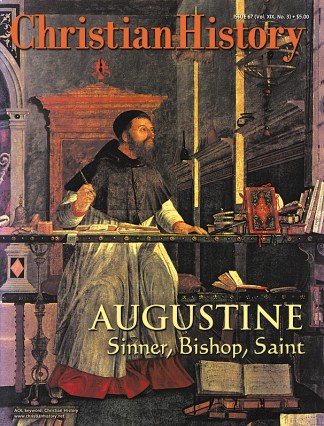
Because Augustine is such a towering figure in Western history, one of our goals for this issue was to describe his “everyday” self. We discovered he was both more extraordinary and more human than the legend we knew.
Yes, he was a brilliant theologian whose mind ranged over a vast array of issues (human nature, the Trinity, original sin, the church) with greater depth and dexterity than many of today’s theological specialists.
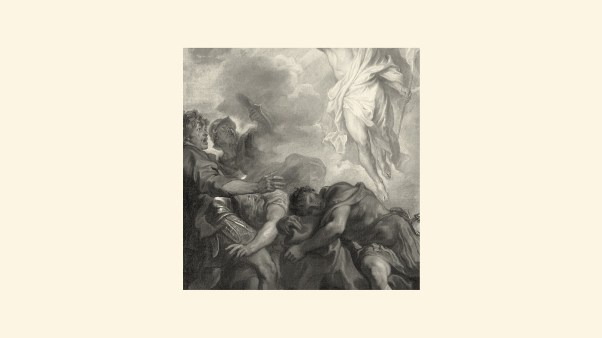
Yes, he was a regal bishop who used his ecclesiastical authority to reign in schismatics and refine the teachings of the church—this is the view of Augustine handed down through the art of the ages, as the images in this issue show.
But Augustine was also a human being who struggled with common, run-of-the-mill weaknesses: sex, vanity, self-recriminations, a hot temper, and bouts with despair.
Though his insights have shaped Western thought for more than 1,500 years, he was a searching, confused, and waffling young man on his way to his conversion: see Robert Payne’s article, “The Dark Heart Filled with Light.”
Though he exercised his authority as bishop in teaching and administering, he was always sensitive to the pastoral dimension of his office: see Bruce Shelley’s article, “The Bishop at Work.”
Though he engaged in philosophical theology, he also tried to answer practical questions that Christians of his day, and ours, face: see our special section “What Would Augustine Say?“
This is our second issue on Augustine. The first (issue 15) gives a good overview of his life and legacy. Here we’ve tried to narrow our focus and give you a greater sense of his complexity as a great thinker, but also as a man.
With this issue, I step down as editor of Christian History. I’ve been connected with the magazine for six years, the last four as editor.
The magazine has been a dream job for me. Each quarter I’ve been allowed to become a minor specialist in one era, person, or event—but then, before I get immersed in minutia, I have been able to move on to another topic! So I envy the staff who remain—Marshall Shelley, Elesha Coffman, Rai Whitlock, and Janine Petry.
Everyone around here says my editing will be missed. Perhaps. On the other hand, Christian History has for some time been a team effort, and the fact that most of the team remains insures that the high quality you’ve come to expect from the magazine will continue. This issue, which was pulled together with relatively little input from me, is a case in point.
As for me, I’m moving on from “Christianity Yesterday” (as a friend put it) to Christianity Today, where I have been managing editor since May 1. As I depart, I want to thank the many loyal readers of Christian History who over the years have offered support and encouragement (and the occasional correction). It’s another reason why editing Christian History has been a pleasure. Thanks.
Copyright © 2000 by the author or Christianity Today/Christian History magazine. Click here for reprint information on Christian History.