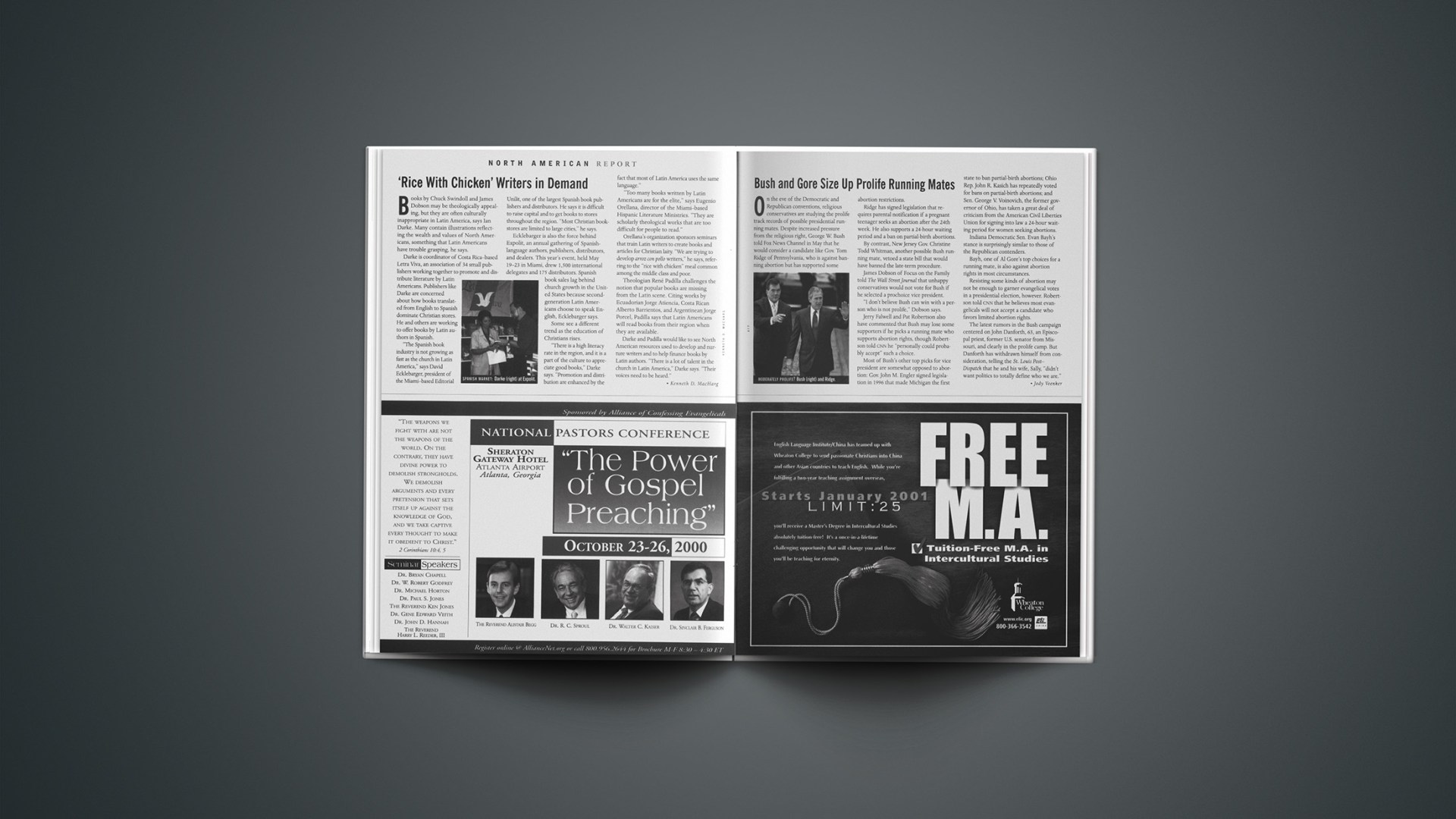
‘Rice With Chicken’ Writers in Demand

Latin American publishers join together to promote regional writers.

Books by Chuck Swindoll and James Dobson may be theologically appealing, but they are often culturally inappropriate in Latin America, says Ian Darke. Many contain illustrations reflecting the wealth and values of North Americans, something that Latin Americans have trouble grasping, he says.

Darke is coordinator of Costa Rica–based Letra Viva, an association of 34 small publishers working together to promote and distribute literature by Latin Americans. Publishers like Darke are concerned about how books translated from English to Spanish dominate Christian stores. He and others are working to offer books by Latin authors in Spanish.

"The Spanish book industry is not growing as fast as the church in Latin America," says David Ecklebarger, president of the Miami– based Editorial Unilit, one of the largest Spanish book publishers and distributors. He says it is difficult to raise capital and to get books to stores throughout the region. "Most Christian bookstores are limited to large cities," he says.

Ecklebarger is also the force behind Expolit, an annual gathering of Spanish- language authors, publishers, distributors, and dealers. This year's event, held May 19–23 in Miami, drew 1,500 international delegates and 175 distributors. Spanish book sales lag behind church growth in the United States because second-generation Latin Americans choose to speak English, Ecklebarger says.

Some see a different trend as the education of Christians rises.

"There is a high literacy rate in the region, and it is a part of the culture to appreciate good books," Darke says. "Promotion and distribution are enhanced by the fact that most of Latin America uses the same language."

"Too many books written by Latin Americans are for the elite," says Eugenio Orellana, director of the Miami–based Hispanic Literature Ministries. "They are scholarly theological works that are too difficult for people to read."

Orellana's organization sponsors seminars that train Latin writers to create books and articles for Christian laity. "We are trying to develop arroz con pollo writers," he says, referring to the "rice with chicken" meal common among the middle class and poor.

Theologian René Padilla challenges the notion that popular books are missing from the Latin scene. Citing works by Ecuadorian Jorge Atiencia, Costa Rican Alberto Barrientos, and Argentinean Jorge Porcel, Padilla says that Latin Americans will read books from their region when they are available.

Darke and Padilla would like to see North American resources used to develop and nurture writers and to help finance books by Latin authors. "There is a lot of talent in the church in Latin America," Darke says. "Their voices need to be heard."

Related Elsewhere

ChristianityToday.com has recently covered the growth of Hispanic Christian Radio in the US, and the sales boom of the Spanish translation of the New International Version of the Bible.

Actor and comedian Jorge Porcel discusses his new autobiography and his faith in with Intervizion.

Jorge Atiencia's new book, Jesucristo, el Ultimo Hombre de la Historia, is being promoted on Letra Viva's site, and reviewed in the Latin American Evangelist page.

Visit Letra Viva, or research other Spanish-language publishers like Unilit and Kairos Comuncadores.

Other Spanish-language books are available at the Christianity Online Bookstore.

Copyright © 2000 Christianity Today. Click for reprint information.

Also in this issue

Losing Our Promiscuity: There is no contraceptive for a broken heart—that's what the sex-without-commitment generation has discovered. And now the church has an unprecedented opportunity to reach it.

Cover Story

Losing Our Promiscuity

Paula Rinehart

Consider This: The God of Alan Dershowitz

Steven H. Aden

Incarnating Mystery

By Wendy Murray Zoba

The Just-Chaplain Theory

Douglas K. Stewart

Consider This: The Bobo Future

Roberto Rivera

Praying for Hope

Nancy Guthrie

In the Word: Stony the Road We Trod

Marguerite Shuster

Your World: Every Day is Casual Friday

Kazakhstan: Central Asia's Great Awakening

Tobin Perry in Almaty

The First Black Liberation Movement

Tim Stafford

News

Film: Cameras Rolling

By Denyse O'Leary in Toronto

Building a Bridge

Wendy Murray Zoba

Uganda: Innocence Stolen

Greg Taylor in Kampala

Bush and Gore Size Up Prolife Running Mates

Jody Veenker

The Back Page | Philip Yancey: Lessons from Rock Bottom

Is Suicide Unforgivable?

Lewis B. Smedes

Evangelism: Is Amsterdam 2000 Graham's 'Swan Song'?

Briefs: The World

Trading on Faith in China

A Christianity Today Editorial

The Editor Who Cancelled His Subscription

Classic & Contemporary Excerpts from July 10, 2000

Greece: Identity-Card Data Divide Churches

Ecumenical News International

Trade: Freer Trade, Freer Faith?

Tony Carnes

Briefs: North America

Trends Church Guarantees 'Express Service' for Busy Believers

Mark I. Pinsky in Eustis

Updates

Religious Freedom Ruling Set

Sex and the Single Christian

An interview with Steve Tracy

Africa: World Bank, Local Pastors Link to Fight Poverty

Odhiambo Okite

Church Disputes: Culture Clash

Jody Veenker in Orlando

Hit the Wall and Keep Going

A Christianity Today Editorial

View issue

Our Latest

Public Theology Project

Why Christians Ignore What the Bible Says About Immigrants

Believers can disagree on migration policies—but the Word of God should shape how we minister to vulnerable people.

Review

Apologetics Can Be a Balm—or Bludgeon

Daryn Henry

A new history of American apologetics from Daniel K. Williams offers careful detail, worthwhile lessons, and an ambitious, sprawling, rollicking narrative.

Hold the Phone?

Anna Mares

Faced with encouragement to lessen technology use, younger Christians with far-flung families wonder how to stay connected.

Norman Podhoretz Leaves a Legacy of Political Principle

Michael Cosper

The Jewish intellectual upheld the Judeo-Christian tradition.

The Russell Moore Show

Joseph Loconte on the War for Middle-Earth

What if the most decisive battles in our time aren’t fought with ballots or bombs—but with the imagination?

News

A House of Worship Without a Home

One year after the Palisades and Eaton fires, congregations meditate on what it means to be a church without a building.

‘The Image of God Was Always In My Mother’

Kate Lucky

Responses to our Sept-Oct issue.

Disintegration is the Church’s Greatest Threat

A note from Mission Advancement about the Big Tent Initiative and One Kingdom Campaign.

Apple PodcastsDown ArrowDown ArrowDown Arrowarrow_left_altLeft ArrowLeft ArrowRight ArrowRight ArrowRight Arrowarrow_up_altUp ArrowUp ArrowAvailable at Amazoncaret-downCloseCloseEmailEmailExpandExpandExternalExternalFacebookfacebook-squareGiftGiftGooglegoogleGoogle KeephamburgerInstagraminstagram-squareLinkLinklinkedin-squareListenListenListenChristianity TodayCT Creative Studio Logologo_orgMegaphoneMenuMenupausePinterestPlayPlayPocketPodcastRSSRSSSaveSaveSaveSearchSearchsearchSpotifyStitcherTelegramTable of ContentsTable of Contentstwitter-squareWhatsAppXYouTubeYouTube