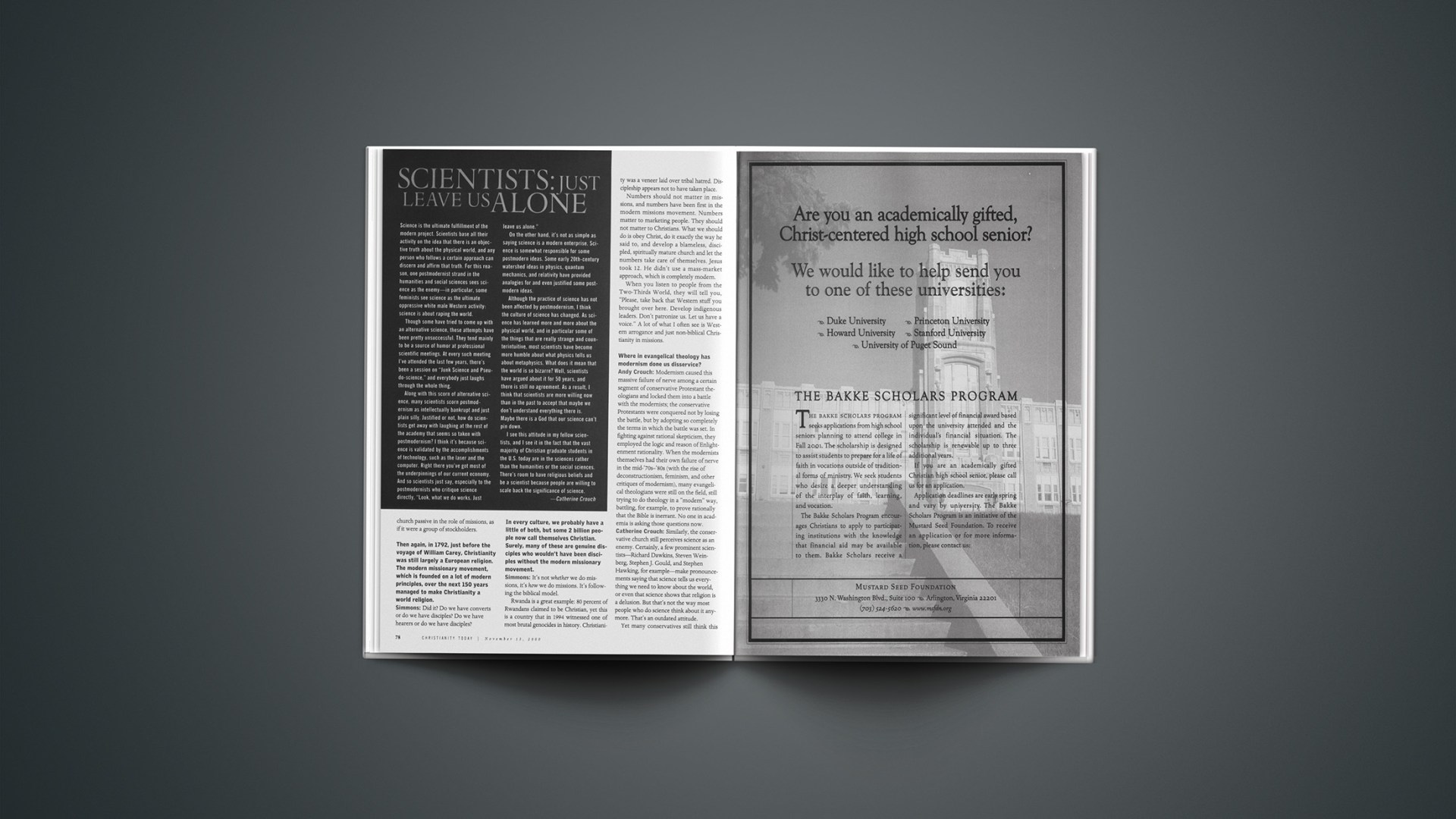
Scientists: Just Leave Us Alone

Not all the academy is so taken with postmodernism.

Science is the ultimate fulfillment of the modern project. Scientists base all their activity on the idea that there is an objective truth about the physical world, and any person who follows a certain approach can discern and affirm that truth. For this reason, one postmodernist strand in the humanities and social sciences sees science as the enemy—in particular, some feminists see science as the ultimate oppressive white male Western activity: science is about raping the world.

Though some have tried to come up with an alternative science, these attempts have been pretty unsuccessful. They tend mainly to be a source of humor at professional scientific meetings. At every such meeting I’ve attended the last few years, there’s been a session on “Junk Science and Pseudo-science,” and everybody just laughs through the whole thing.

Along with this scorn of alternative science, many scientists scorn postmodernism as intellectually bankrupt and just plain silly. Justified or not, how do scientists get away with laughing at the rest of the academy that seems so taken with postmodernism? I think it’s because science is validated by the accomplishments of technology, such as the laser and the computer. Right there you’ve got most of the underpinnings of our current economy. And so scientists just say, especially to the postmodernists who critique science directly, “Look, what we do works. Just leave us alone.”

On the other hand, it’s not as simple as saying science is a modern enterprise. Science is somewhat responsible for some postmodern ideas. Some early 20th-century watershed ideas in physics, quantum mechanics, and relativity have provided analogies for and even justified some postmodern ideas.

Although the practice of science has not been affected by postmodernism, I think the culture of science has changed. As science has learned more and more about the physical world, and in particular some of the things that are really strange and counterintuitive, most scientists have become more humble about what physics tells us about metaphysics. What does it mean that the world is so bizarre? Well, scientists have argued about it for 50 years, and there is still no agreement. As a result, I think that scientists are more willing now than in the past to accept that maybe we don’t understand everything there is. Maybe there is a God that our science can’t pin down.

I see this attitude in my fellow scientists, and I see it in the fact that the vast majority of Christian graduate students in the U.S. today are in the sciences rather than the humanities or the social sciences. There’s room to have religious beliefs and be a scientist because people are willing to scale back the significance of science.

Related Elsewhere

This article is a sidebar to the story, “The Anti-Moderns | Six postmodern Christians discuss the possibilities and limits of postmodernism.” See our other related stories in this package, “What is Postmodernism? | The often-maligned movement is today’s academic Rorschach blot” and “Urbanites: More Justice, Less Epistemology | The emerging urban class is targeting capitalism and Christianity—often for good reason.”

Catherine Crouch is a postdoctoral fellow in physics at Harvard. Check out her web page and the Galileo project on physics education. She also presented two talks on science and Christian faith at InterVarsity’s Urbana 96 convention: “Issues for Christians in the Sciences” and “Opportunities for Witness and Service as a Scientist.”

Copyright © 2000 Christianity Today. Click for reprint information.
Also in this issue

Community Is Their Middle Name: Willow Creek Community Church is more than weekend seeker services.

Cover Story

Community Is Their Middle Name

Verla Wallace

Urban Outreach: Baptists Transform Kentucky Tavern

Ken Walker

Trashy Talk

Richard A. Kauffman

Quotations to Contemplate

Furthermore: Nice Is Not the Point

Pie-in-the-Sky Now

Ed Gitre

Rock & Roll Apologetics

Douglas LeBlanc

Neighborhood Outpost

’Gifting Clubs’ Shut Down

Chuck Fager

Downsizing: Prison Fellowship Downsizing

Jody Veenker

Updates

The New Scarlet Letter

Vincent Bacote

Briefs: North America

Left Behind Series Puts Tyndale Ahead

Corrie Cutrer

Eight UMC Pastors Quit Denomination

Corrie Cutrer

Tajikistan: Church Bombing Kills 10

Barbara G. Baker

India: Justice Delayed for Dalits

Manpreet Singh in Munan Khurd

Briefs: The World

Ready to Stand on Their Own?

Beverly Nickles in Moscow

Indonesia: Ambon's Wounded

Russell Rankin in Ambon

Urbanites: More Justice, Less Epistemology

Carlos Aguilar

Sort of Mellowing

Verla Wallace

The Next 25 Years

Verla Wallace

The Man Behind the Megachurch

Lauren F. Winner

Willow Creek's Place in History

Michael S. Hamilton

Unprepared to Teach Parenting?

Kathleen Terner

The Antimoderns

A forum with Carlos Aguilar, Vincent Bacote, Andy Crouch, Catherine Crouch, Sherri King, and Chris Simmons

What Exactly Is Postmodernism?

Review

Through a Glass Darkly

Jeff M. Sellers

Policy Wonks for Christ

Lauren F. Winner

Thanksgiving at Fair Acres

Virginia Stem Owens

Lives Measured in Minutes

Sheryl Henderson Blunt

Souls on Ice

Stephen T. Hunt

The Newest Establishment

A Lexicon of Death

A Christianity Today Editorial

No Sympathy for the Devil

A Christianity Today Editorial

View issue

Our Latest

The Bulletin

Venezuelan Oil, LA Fires Aftermath, and Revival In America

Mike Cosper, Clarissa Moll, Russell Moore

The global aftershock of military action in Venezuela, California churches rebuild one year after LA fires, and the possibility of revival in America.

What Christian Parents Should Know About Roblox

Isaac Wood

The gaming platform poses both content concerns and safety risks that put minors in “the Devil’s crosshairs.” The company says tighter restrictions are coming.

How Artificial Intelligence Is Rewiring Democracy

Three books on politics and public life to read this month.

Analysis

The Dangerous Ambition of Regime Change

The Bulletin

Is America’s appetite for power in Venezuela bigger than its ability to handle it?

News

Kenyan Christians Wrestle with the Costs of Working Abroad

Pius Sawa

Working in the Gulf States promises better pay, but pastors say the distance harm marriages and children.

Happy 80th Birthday, John Piper

Justin Taylor

Fame didn’t change how the Reformed theologian lives.

So What If the Bible Doesn’t Mention Embryo Screening?

Silence from Scripture on new technologies and the ethical questions they raise is no excuse for silence from the church.

The Chinese Evangelicals Turning to Orthodoxy

Yinxuan Huang

More believers from China and Taiwan are finding Eastern Christianity appealing. I sought to uncover why.

Apple PodcastsDown ArrowDown ArrowDown Arrowarrow_left_altLeft ArrowLeft ArrowRight ArrowRight ArrowRight Arrowarrow_up_altUp ArrowUp ArrowAvailable at Amazoncaret-downCloseCloseEmailEmailExpandExpandExternalExternalFacebookfacebook-squareGiftGiftGooglegoogleGoogle KeephamburgerInstagraminstagram-squareLinkLinklinkedin-squareListenListenListenChristianity TodayCT Creative Studio Logologo_orgMegaphoneMenuMenupausePinterestPlayPlayPocketPodcastRSSRSSSaveSaveSaveSearchSearchsearchSpotifyStitcherTelegramTable of ContentsTable of Contentstwitter-squareWhatsAppXYouTubeYouTube