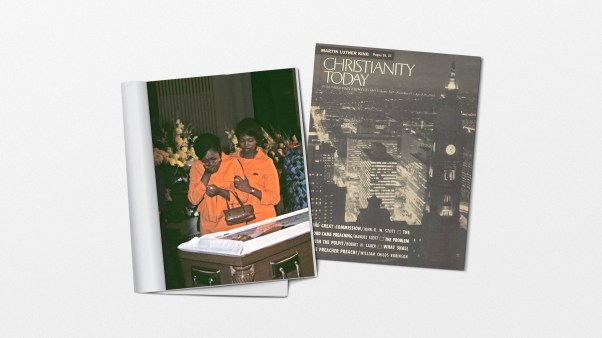
This article originally appeared in the March 17, 1972 issue of Christianity Today.
Last week, the National Archives released 500 hours of White House tapes from 1972. Among them was a conversation between President Richard Nixon and evangelist Billy Graham, which included controversial statements about Jews. During Nixon’s presidency, critics raised questions about Graham’s relationship with the president. In the March 17, 1972 issue of Christianity Today, a pre-Watergate editorial defended the influence evangelical leaders can provide to heads of state.
Billy Graham’s friendship with Richard Nixon and other American presidents has subjected the evangelist to considerable criticism. Often the accusations revolve around the idea that this liaison demeans evangelical Christianity by identifying the leading Bible preacher of our time with a particular political outlook.
We grant that there is risk involved when a clergyman becomes a confidant of powerful figures in the secular world. But is not the risk far outweighed by the opportunity? Have not many evangelicals long prayed for an entreÉ without compromise in the affairs of state?
Our view on this point coincides with that expressed last month by Editor Louis Benes of the Church Herald, official weekly organ of the Reformed Church in America. “We ought to thank God,” wrote Benes, “that four presidents have recognized the integrity of this man of God and sought the friendship and counsel of a man of his character and faith in God. Who else would we want there? What if our president sought the counsel and advice of a member of the Mafia, or a “God is dead” theologian, or someone dedicated to the “playboy” philosophy?”
Benes expressed the hope that Graham “and other Christian leaders, both Roman Catholic and Protestant, who have contacts with responsible men at all levels of governments, will use such contacts for good, and thus make their influence count for truth and righteousness.”
In the case of Graham, there is no evidence that he has watered down his convictions to gain access to the White House. Those who make such charges aren’t listening to him. Hardly a week goes by that Graham does not warn America of coming judgment unless there is repentance.
Come critics seem to be saying that Graham must keep his distance from government leaders lest he be identified as a “court preacher.” Indeed, there are numerous examples from the Bible and in church history of false prophets who said what rulers wanted to hear instead of God’s Word. Surely Graham would welcome our prayers that he will be faithful as he tries to avoid the separatistic “holier-than-thou” mentality that would minimize contact with the affairs of this world for fear of contamination.
There are ample biblical precedents for what he is doing: Esther and Mordecai, Joseph, and Daniel show that one can make his influence for God felt through private relationships with heads of state. “Who can say but that God has brought you into the palace for just such a time as this?” (Esther 4:14).
Copyright © 2002 Christianity Today. Click for reprint information.
Related Elsewhere
Christianity Today’s Weblog covered the recent controversy over Nixon and Graham’s 1972 taped statements on Friday and today.
Christianity Today coverage of Billy Graham’s relationship with the Jewish faith includes:
Graham Feted By American Jewish Committee | In 1977, Graham walked a fine line between in his work ‘to proclaim the Gospel to Jew and Gentile.’ (Nov. 18, 1977)
Billy Graham: ‘I have never felt called to single out the Jews’ | The evangelist discusses targeted evangelism in one of his most quoted statements. (March 16, 1973)