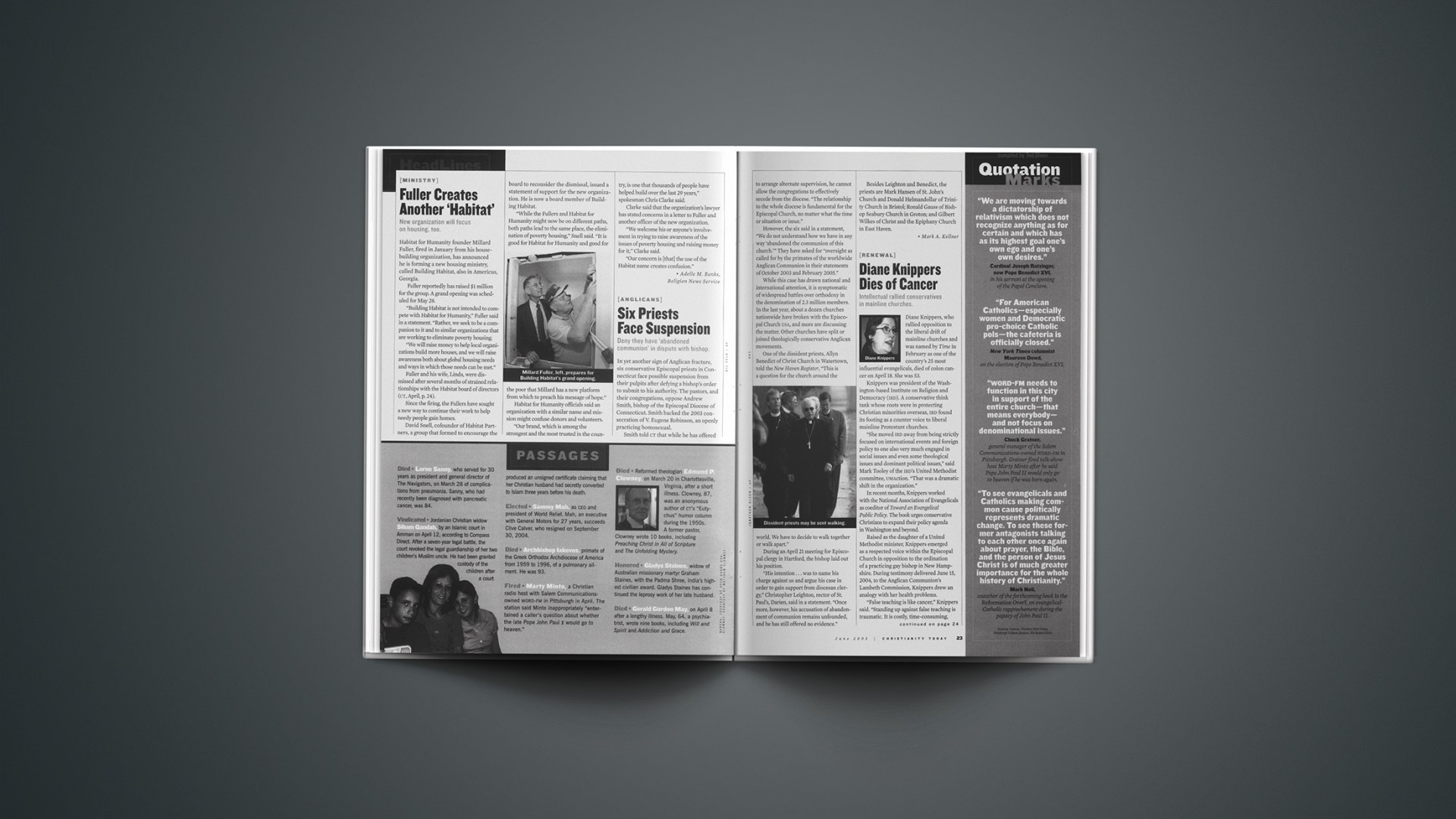

Diane Knippers, who rallied opposition to the liberal drift of mainline churches and was named by Time in February as one of the country’s 25 most influential evangelicals, died of colon cancer on April 18. She was 53.
Knippers was president of the Washington-based Institute on Religion and Democracy (IRD). A conservative think tank whose roots were in protecting Christian minorities overseas, IRD found its footing as a counter voice to liberal mainline Protestant churches.
“She moved IRD away from being strictly focused on international events and foreign policy to one also very much engaged in social issues and even some theological issues and dominant political issues,” said Mark Tooley of the IRD’s United Methodist committee, UMAction. “That was a dramatic shift in the organization.”
In recent months, Knippers worked with the National Association of Evangelicals as coeditor of Toward an Evangelical Public Policy. The book urges conservative Christians to expand their policy agenda in Washington and beyond.
Raised as the daughter of a United Methodist minister, Knippers emerged as a respected voice within the Episcopal Church in opposition to the ordination of an openly gay bishop in New Hampshire. During testimony delivered June 15, 2004, to the Anglican Communion’s Lambeth Commission, Knippers drew an analogy with her health problems.
“False teaching is like cancer,” Knippers said. “Standing up against false teaching is traumatic. It is costly, time-consuming, sometimes agonizingly painful, humiliating, and exhausting. But if the church does not aggressively treat the cancer of false teaching at its early stage, it will grow, and it will kill the body.”
IRD published a scathing report last September about mainline churches’ unbalanced policy toward the Israeli-Palestinian conflict. The National Council of Churches accused Knippers of playing “partisan secular politics.”
“Diane Knippers was right at the heart of all the Protestant, mainline renewing movements,” CT executive editor Tom Oden said. “She was really the point person for communicating the concerns for renewal groups within mainline Protestantism, and she was very instrumental in bringing us together.”
Copyright © 2005 Christianity Today. Click for reprint information.
Related Elsewhere:
Knippers was named by Time magazine as one of the country’s 25 most influential evangelicals
The Institute for Religion and Democracy has several reflections on Knippers from IRD members and other admirers.
CT ran an obituary last month.