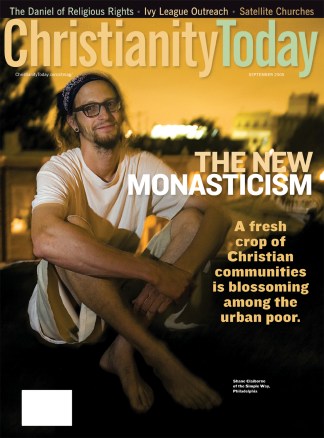
When Rob Moll, CT’s online assistant editor, went to visit the Simple Way in Philadelphia, it was the children who burned themselves into his memory. The intentional Christian community’s main house sits on a street corner, allowing children to route their boisterous parade from one sidewalk through the back door into the kitchen, through the living room, and out onto a different sidewalk by way of the front door. Like these children, the communities Rob visited showed both a touch of chaos and an abundance of vibrant life.
The Simple Way felt vaguely familiar to Rob: lots of well-worn second-hand furniture; people intensely devoted to a goal. It felt like the house he lived in during college—except that the focus was not on studies but on serving the neighbors.
That devotion dovetailed with what Rob saw at worship the first night he stayed with them. About 50 people gathered in the Circle of Hope worship service in the warehouse space above the church’s thrift store. Though postmodern in style, the spirit was ancient, drawn straight from the Book of Acts.
In contrast to the devoted and comfortably disheveled life of the Simple Way community, the neighborhood shocked Rob. “I had never seen urban blight on that scale,” he told me, even though he had lived near Chicago’s infamous Cabrini Green public housing development for a year. The houses in Philadelphia’s Kensington neighborhood looked like they were collapsing. And when he visited another ministry in nearby Camden, New Jersey, it reminded him of a war zone from which the people had fled.
Rob’s road to the Simple Way began in a seminar at Wheaton College. About 150 students packed a small lecture hall to hear three guest speakers address the question, “Will Affluence Kill Our Commitment?” Simple Way founder Shane Claiborne and two other activists spoke, but in the discussion period, it was Claiborne who seemed to capture the students’ imaginations. Says Rob, “They were eager to be led into a more demanding faith.”
Christian history is full of creative attempts at forming demanding communities. The waves of monastic innovation in the Middle Ages come to mind.
History repeats itself. But usually with some variation. So how does the “new monasticism” described in this issue’s cover story compare with earlier movements?
Rob compared notes with Larry Eskridge of the Institute for the Study of American Evangelicalism, who has just completed a dissertation on the Jesus People, a 1960s radical movement that still has a vibrant service-oriented community in Chicago’s Uptown. (After you read “The New Monasticism“, click here to read Rob’s interview with Eskridge.)
Many who ended up in the Jesus People and similar movements had dropped out of society in search of love, community, and sharing. Burned by the explosive experiments in living, they found new hope in Jesus and a new center around which to build community. Like the flower children of the ’60s and ’70s, the pioneers of today’s intentional Christian communities are resisting individualism and materialism, but they have been largely spared the intermediate false steps and have channeled their devotion into creative action for the kingdom.
Copyright © 2005 Christianity Today. Click for reprint information.