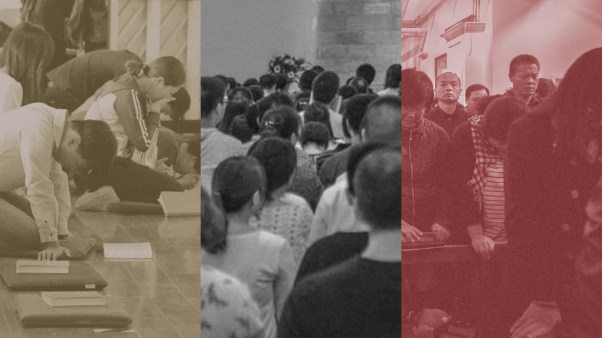
Churches pour enormous resources into creating meaningful worship experiences. But what if those experiences don’t carry the meaning we intend? Pastor and theologian David Fitch believes a worship experience by itself is not enough in our postmodern culture. Instead he calls us to think beyond sermons and music to create a new framework for understanding worship that may not be new at all.
At our theology pub last month we sat around and conversed on the issue of worship. I put forward the typology of “lecture hall” versus “rock concert” as the primary modes of worship for evangelicals, and I suggested that both were inadequate for forming truthful minds and faithful experience in Christians.
The people at our pub ranged in age from 16 to early 50’s. Most seemed to agree that a worship service geared entirely towards a 55 minute sermon seeking to dispense information to Cartesian minds is inadequate for spiritual formative. Less obvious and hotly debated was rock concert-style worship’s ability to form us into Christlikeness.
I continue to assert that a sufficient theology of worship must come to grips with the epistemological shifts of the last century whereby we can no longer be naive that a “religious experience,” like the one sought in a rock concert worship service, provides immediate access to God. Experience is something learned and trained into. An experience is produced through interpretive frameworks, particularly language. As Lindbeck would say, “there is no uninterpreted experience.” This is one reason the evangelical church must move beyond the “rock concert pep rally” if we wish to recover a worship that shapes truthful minds and faithful experience. Rock concert worship produces an experience, but then fails to give people a framework to interpret it.
Carl Raschke’s The Next Reformation: Why Evangelicals Must Embrace PostModernity (Baker, 2004) argues that charismatic worship is the best way forward. I am certainly grateful to Prof. Raschke for his analysis and am in agreement with him on many points. Still, I am puzzled by Raschke’s proposal that evangelicalism embrace charismatic worship experience as an engagement with postmodernity. He states:
Charismatic Christianity is emblematic of the new postmodern evangelicalism. It is multicultural, global in scope, and interracial. It is post denominational, not simply non denominational. It is post propositional and post theological. For the most part it is more biblically oriented than many of today’s so-called Bible churches. The dance with the Lord is the dance of the believer in the full presence of, and in full relationship with the Lord of heaven and earth, who is the Lord of the dance. Dancing, like genuine faith, is an intimate experience.
I think I get what he finds attractive about charismatic churches from this quote. I find all of this attractive as well, including the multicultural-interracial-global nature of charismatic churches and the authentic self expression that is found in their worship. But if the theologians are right and there is no “uninterpreted experience” than even the Charismatic worship experience alone cannot be the answer.
However, this does not require us to forgo charismatic experience, or any authentic experience of God’s presence in mystery and transcendence. Rather, we must go to the deep, rich, and historic liturgies of our history in Christ that help people properly interpret the worship experience. Instead of seeking a spontaneous experience without a framework to understand it, let us return to the mystery centered around His Table, let us return to symbol, poetic prayer, liturgical participation, creedal affirmation, historic confessions, great responses in music and song all born within an arena of worship that is made accessible and beautiful by the liturgists, artists, and curators of our churches.
This then is where experience is shaped and formed out of our relationship to God. This does not mean a return to dry, dead, rote liturgy. Rather let’s make liturgy alive and accessible just as several of our emergent church brothers/sisters are attempting to do. As the emergent church seeks to take evangelicalism (and others) past modernity, we will only find authentic charismatic experience in these postmodern times through the passageway of renewed liturgical practices that provide both an experience and a framework to interpret it. I think the AMIA churches (Anglican Mission in America) are evangelical churches in our midst that are showing us the way in this regard. And I think there are several other emergent churches doing the same.
David Fitch is pastor of Life on the Vine Christian Community in Long Grove, Illinois, a professor of ministry, theology, and ethics at Northern Seminary, and author of The Great Giveaway: Reclaiming the Mission of the Church from Big Business, Parachurch Organizations, Psychotherapy, Consumer Capitalism, and Other Modern Maladies (Baker 2005).