


News

ECFA Reveals Where Evangelicals Give (and No Longer Give) Their Money

(UPDATED) Charitable giving continues to decrease for small nonprofits, but bigger organizations are benefiting.

Christianity Today January 17, 2013

In this series

Update (June 6): ECFA has released updated statistics showing that donations to large nonprofits are on the rise. Yet small nonprofits are not as fortunate: Donations to these organizations in 2012 decreased for the second year in a row.

According to ECFA, "Organizations with under $5 million in annual revenues saw cash donations decrease by 3.6 percent in 2012, while those above $5 million in revenue saw a 2 percent increase. Charities with under $1 million in annual revenues saw cash donations decrease by 9.6 percent."

CT has spotlighted what type of ministries receive the most money.

––-

Although charitable giving to member organizations has decreased nearly 2 percent, the Evangelical Council for Financial Accountability (ECFA) reports that evangelical support for child-related ministries continues to rise–and even more so for short-term missions.

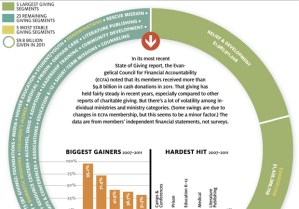
According to ECFA's 2012 State of Giving annual report, cash donations to ECFA-accredited organizations totaled $9.84 billion in 2011, a 1.7 percent decrease from 2010's $9.67 billion.

The previous figure was a 5.8 percent increase over total giving in 2009.

But although total giving is down–reflecting the "tight national economy," ECFA says–contributions in several categories rose significantly over previous years.

The largest giving increase came in the short-term missions category, which saw donations jump 21 percent from 2010 to 2011. In addition, donations to adoption agencies, pregnancy resource centers, and orphan care grew by roughly 12 percent each.

Categories with significant giving decreases for 2011 include camps and conferences (down 10 percent), foundations (8 percent), and K-12 education (8 percent). Giving to denominational churches also decreased by 6 percent.

CT reported how giving to evangelical foundations increased by almost 70 percent in 2010, signaling how wealthy Christians are favoring new tools for family funds.


Also in this series

Our Latest

Ministering to Women Includes Physical Health

Caitlin Estes

Counseling women through infertility and other medical issues may feel awkward. Church leaders have an obligation to do it anyway.

Excerpt

Joy Is in the Waiting

Grace P. Pouch

An excerpt from Savoring Childhood: Practical Wisdom for Slowing Down.

Analysis

Q&A: Some Israelis See Esther’s Story in the Attacks on Iran

The Bulletin with Yossi Klein Halevi

Journalist Yossi Klein Halevi speaks to CT about Jewish reflections on the US and Israel-led war.

News

AI Necromancy Impersonates the Dead

As more people interact with AI chatbots mimicking their deceased loved ones, how should Christians engage?

‘We’re God’s Guerilla Warriors’

Interview by Ashley Hales

Theologian Fleming Rutledge sits down with CT’s Ashley Hales to discuss the Crucifixion, the Resurrection, and how Christianity isn’t self-help.

Public Theology Project

This Easter, Let’s Lose Our Hope

We need more than reassurance, punditry, or prediction.

Torn on IVF, Evangelicals Turn to Natural Family Planning

Traditionally a Catholic enterprise, Protestants are increasingly turning to natural procreative technology.

Helping the Church Think Clearly

A note from CT’s President in our March/April issue.

Apple PodcastsDown ArrowDown ArrowDown Arrowarrow_left_altLeft ArrowLeft ArrowRight ArrowRight ArrowRight Arrowarrow_up_altUp ArrowUp ArrowAvailable at Amazoncaret-downCloseCloseEmailEmailExpandExpandExternalExternalFacebookfacebook-squareGiftGiftGooglegoogleGoogle KeephamburgerInstagraminstagram-squareLinkLinklinkedin-squareListenListenListenChristianity TodayCT Creative Studio Logologo_orgMegaphoneMenuMenupausePinterestPlayPlayPocketPodcastprintRSSRSSSaveSaveSaveSearchSearchsearchSpotifyStitcherTelegramTable of ContentsTable of Contentstwitter-squareWhatsAppXYouTubeYouTube