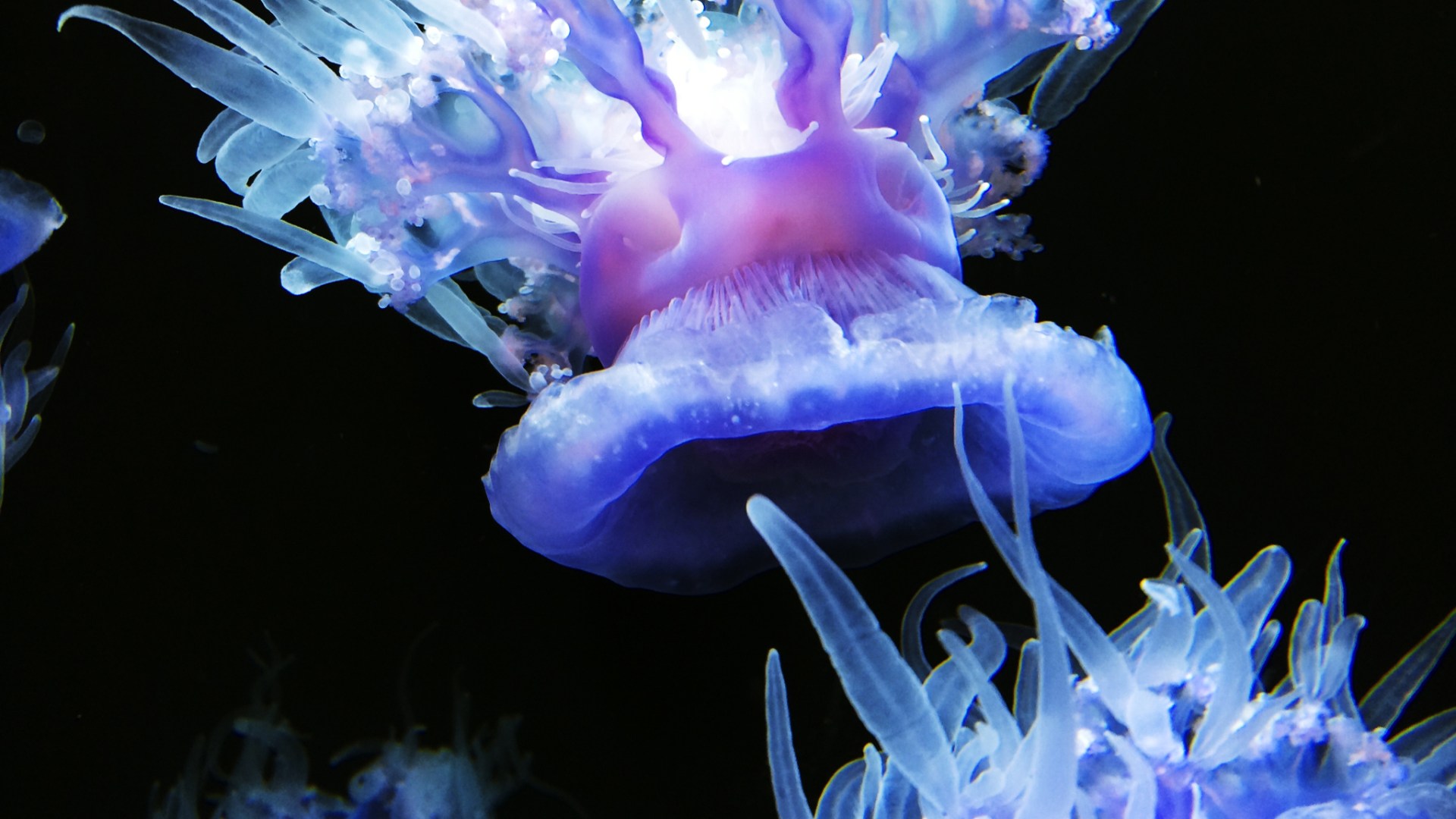

Creation offers many analogies to theology, and one of the more unexpected is this: God is said to be eternal, with neither beginning nor end. Creation, on the other hand, has a beginning, and all creatures therein have an end. But one creature seems to mimic God’s immortality. As with all analogies, it isn’t perfect; still it harkens to deeper truths. —The Editors
Earth’s oceans are so vast and diverse that something in the ocean will prove an exception to almost every biological rule, like everything that lives must eventually die. Enter the exception: Turritopsis nutricula, the immortal jellyfish.
Turritopsis are tiny translucent jellies, just a quarter of an inch across at the base of their bell-shaped bodies, wrapped in sinuous tentacles that sting prey and deliver food. The jellies’ lives are pretty boring: eat, reproduce, repeat. Life is brutal for small ocean invertebrates, and predation or environmental stress quickly claims them. Turritopsis are dubbed immortal not because they don’t die, but because they needn’t. They possess the ability—unique among the more familiar animals on the planet—to age in reverse.
Turritopsis start life as a collection of anemone-like polyps that grow across the seabed, multiplying into a lace-like colony with tiny towers of tentacles extending out to catch passing food. The polyps also produce buds that break away and become a medusa, a swimming jellyfish. In turn, the jellies develop gonads to create the next generation of polyps, and then die. All of which is perfectly normal for this kind of jelly.
Turritopsis throws this cycle into reverse. Following injury or the introduction of a new environmental stressor, a swimming Turritopsis medusa converts its bodies’ specialized cells, even its gonads, back into their original larval forms. From there, it can grow up all over again—with a new body, better adapted to its surroundings. Turritopsis resemble nothing in fiction so much as the hero of the television classic Doctor Who. When close to death, his body “regenerates” with a different appearance and personality. Like the Doctor, these little jellyfish can restart their life cycles following a trauma that fails to kill them outright.
This process is called transdifferentiation, and it allows Turritopsis to side-step senescence. An animal capable of reverting to a juvenile state need never grow old, and thus these animals are technically immortal. We’ve learned a great deal about the molecular process of transdifferentiation, but little is known about the actual behavior of this species in the wild. Transdifferentiation has never been observed outside a laboratory, even in Turritopsis. Tiny and translucent, the immortal medusas are nearly invisible in the water column. No individual has been tracked long enough to determine whether Turritopsis really use this process to avoid the consequences of growing old.
Reprinted with permission from The Extreme Life of the Sea (Princeton University Press, 2014).