Note: There are, of course, spoilers here for the previous two films in the franchise.
When last we left Katniss Everdeen (Lawrence), she had just been rescued from her second Hunger Games arena and what had looked like her inevitable death. We’d discovered that an underground resistance movement is rebelling against President Snow and his forces in the capital of Panem. The rebels pulled Katniss out of the arena and flew her to safety.
 Lionsgate
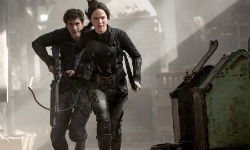
As Mockingjay – Part I opens, we learn the fallout of that rescue. Katniss’s fellow tribute, Peeta (Hutcherson) has been left behind and is now either working with President Snow (Sutherland) or being forced into making propaganda videos with Casear Flickerman (Tucci). Plutarch Heavensbee (Hoffman) is convinced that Katniss can be a symbol—the Mockingjay—around which the rebelling districts can unite. But rebel President Coin (Moore) find Katniss’s reluctance suspicious, and is (rightfully) contemptuous of her “demands” on the rebels who want her to participate.
The bulk of Part I revolves around Katniss eventually agreeing to play the part of the Mockingjay—and the lead up to all-out war between Snow’s forces and the growing rebellion.
Would it surprise you to learn that Suzanne Collins’ Hunger Games trilogy has been one of the ten most frequently challenged or banned books in schools and libraries for three of the last four years? The American Library Association tracks such challenges, which it defines as “a formal, written complaint, filed with a library or school requesting that materials be removed because of content or appropriateness.”
I’d get indifference. But I don’t get the outright hostility. The Hunger Games books capture how volatile your emotions are as an adolescent, but otherwise, they’re pretty standard serial potboilers.
The films are competently made—though they’re not without some small problems. The colors were washed out; the lens choices can create background focus problems. Here and there, the lighting is so dim that it’s hard to see what’s happening.
And breaking the final novel into two parts creates some pacing problems, making much of the first hour feel like filler. You can hardly label the film “Part I” and seriously wonder whether or not Katniss will join the rebellion.
Katniss is sixteen in the first book. The age difference between Jennifer Lawrence (who is 24) and Katniss is becoming a problem as the movies progress. Some of Katniss’s emotional volatility is more forgivable in the book. But here, when she sees people being rounded up and executed but insists to President Coin that she will not join the rebels unless her sister is allowed to keep her cat, she comes across as, well, a self-entitled celebrity.
But, at the end of the day, Katniss is still a morally grounded heroine. She first volunteers to be a tribute to save her sister’s life. She’s trying to do the right thing in the midst of horrible circumstances. Given how much R-rated bloodletting and breast-baring is at the movies these days, is this really where people want to draw their line in the sand?
 Lionsgate
I’ve mostly been a neutral observer in this particular culture battle, and since reviewing a big-budget franchise film is a bit like trying to get a football fan to change which team he is rooting for in the middle of the third quarter, I approached The Hunger Games: Mockingjay – Part I as the opportunity for a thought experiment. I imagined myself the father of a teenaged girl who came home from high school with a dog-eared paperback and begged me to take her to the movie on father-daughter date night. Better yet—or certainly more plausibly—I imagined the most culturally conservative deacon at my church calling me up and asking what I thought of the youth pastor’s movie selection for the Friday night church lock-in.
The results: did you know my thesaurus lists sixteen synonyms for “innocuous”? You can make some legitimate artistic criticisms of The Hunger Games. But when you get right down to it, those criticisms basically boil down to the fact that it isn’t highbrow.
Well, neither was Star Wars, the franchise The Hunger Games most resembles. Both are about rebellions against a non-descript political tyranny. Both are driven by love triangles that ground the epic stakes in human emotions. Both boast better actors than we’re used to seeing in these kinds of movies. Both sparingly but effectively use villains who scare us because of just how much they terrify our heroes. Mostly, though, both are thinly plotted serials that serve as an excuse for linking together battles, escapes, rescues, and romance.
Perhaps the most puzzling part of the ALA’s report is the list of reasons people give who challenge to the books: “sexually explicit,” “unsuitable to age group,” “anti-ethnic,” “anti-family,” “religious viewpoint,” and “insensitivity” were all reasons people provided for why Katniss should be banned from our classrooms and purged from our public shelves.

I don’t get it, at least from the films. Katniss and Gale awkwardly mention a furtive kiss in the kitchen and that’s about as sexually explicit as it gets. The crowds in each district look racially diverse at a glance, so unless “anti-ethnic” is a dog-whistle code for suggesting President Snow represents a white patriarchy, I’m clearly missing something. As for “religious viewpoint”(s), well, if there isn’t much God talk in Mockingjay, there sure is a lot of the loving of—and fighting for—one’s neighbor.
My thought experiment ended (as they so often do) not with a lecture I’d deliver to my imaginary teenager but with a series of questions I would ask of her. What would you do if someone threatened your family? What are the ways you feel ignored, exploited, or abused by the world you’re inheriting? With so much propaganda filling the airwaves, who do you trust and why?
Our teenagers are smarter and wiser than we often give them credit for being. Perhaps, in that spirit, it’s worth paying attention to the things they like.
Caveat Spectator
Mockingjay – Part I is rated PG-13 for action violence and some disturbing themes and images. Katniss tours a ward of wounded citizens who have been hurt in an assault by the capital. We see prisoners of war being executed while on their knees with bags over their heads. There is a moderate amount of shoot-and-fall killing and plenty of property damage in explosions. We do see one fairly violent scene involving hand-to-hand fighting where a male character assaults a female character. In perhaps the most disturbing scene, one of the former game winners (Finnick) reveals that he was subjected to sexual slavery/forced prostitution after winning the Hunger Games. As this was part of a speech in a propaganda video that was intercut with a military-style rescue mission, it may be something that younger viewers wouldn’t necessarily pick up on, but parents will know it is there.
Kenneth R. Morefield is an Associate Professor of English at Campbell University. He is the editor of Faith and Spirituality in Masters of World Cinema, Volumes I & II, and the founder of 1More Film Blog.